
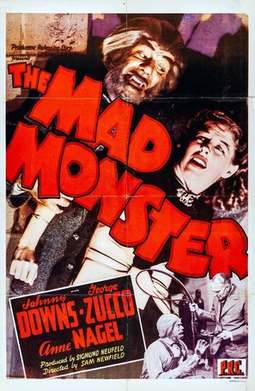
Sam Newfield directed over 250 feature films. In some years he made more than twenty. He directed them for PRC — Producers Releasing Corporation — which was run by his brother Sigmund Neufeld, which means that the most prolific director of the sound era was, functionally, working for his family. The shooting schedule for The Mad Monster has been reported variously as two weeks and as five days. Either figure, applied to a 77-minute horror picture released five months after Universal’s The Wolf Man, describes a production that was not in the business of deliberation.
And yet George Zucco is in it. It’s the same George Zucco , who had played Professor Moriarty opposite Basil Rathbone, three years earlier, and who would show up opposite Tyrone Power in Captain from Castile (1947) . Later he’d share the screen with Spencer Tracy and Ingrid Bergman , before his career sort of ended .
Den of Geek put the dual nature plainly, like : “It would be incorrect to say he sold out to the horror genre, though , even if horror buffs have made him their own.” At PRC, Newfield gave Zucco top billing and turned a distinguished British character actor into a horror icon. Zucco, for his part, commits to every scene with more investment than a five-day shoot on a poverty row lot requires from anyone.
The film is PRC’s only werewolf picture. It was banned in the UK until 1952. When it finally received a British release, censors required a disclaimer about blood transfusions be attached. The man doing the transfusing wears overalls. These are the coordinates of The Mad Monster, and they are more interesting than the plot alone suggests.
The Mad Monster 1942 — Movie Overview Table
| Detail | Information |
|---|---|
| Title | The Mad Monster |
| Release Date | May 15, 1942 |
| Country | United States |
| Runtime | 77 minutes |
| Genre | Horror, Mad Scientist, Werewolf Film |
| Language | English |
| Format | Black & White, Sound |
| Director | Sam Newfield (born Samuel Neufeld) |
| Producer | Sigmund Neufeld (Sam Newfield’s brother; head of PRC) |
| Screenplay | Fred Myton |
| Cinematography | Jack Greenhalgh |
| Editor | Holbrook N. Todd |
| Music | David Chudnow |
| Special Effects | Eugene C. Stone |
| Makeup | Harry Ross |
| Art Direction | Fred Preble |
| Production / Distributor | Producers Releasing Corporation (PRC) |
| Filming Started | March 19, 1942 at Chadwick Studios; approximately 5–14 day shoot |
| Notable | PRC’s only werewolf film; released five months after Universal’s The Wolf Man; banned in UK until 1952; featured in MST3K (1989) |
| UK Release Note | Accompanied by required censor disclaimer about blood transfusions |
| IMDb Rating | 3.2/10 |
| Public Domain | Yes — freely available to stream and download |
Full Cast — The Mad Monster (1942)
| Actor | Role |
|---|---|
| George Zucco | Dr. Lorenzo Cameron |
| Glenn Strange | Petro (the gardener / wolf man) |
| Anne Nagel | Lenora Cameron |
| Johnny Downs | Tom Gregory (Reporter) |
| Robert Strange | Professor Blaine |
| Gordon De Main | Professor Fitzgerald |
| Reginald Barlow | Professor Warwick |
| John Elliott | Professor Hatfield |
| Sarah Padden | Grandmother |
| Mae Busch | Susan |
| Ed Cassidy | Father |
| Henry Hall | Country Doctor |
| Slim Whitaker | Officer Dugan |
| Gil Patric | Detective Lieutenant |
| Darby Jones | Native Chief (uncredited) |
Sam Newfield, Sigmund Neufeld, and the PRC Family Business
Sam Newfield was born Samuel Neufeld. His brother Sigmund ran Producers Releasing Corporation. Sam directed for Sigmund, anglicised his surname in the credits, and between the two of them they operated what The Chiseler essay on Newfield called the dominant machine of poverty row filmmaking: fast schedules, minimal budgets, a stable of reliable actors, and a cinematographer (Jack Greenhalgh) who showed up to every Newfield-Neufeld production like a member of the extended family.
The Wikipedia record lists Sam Newfield’s directorial output at over 250 feature films. He directed under at least two pseudonyms — Sherman Scott and Peter Stewart — to avoid the appearance of market saturation when multiple Newfield pictures released in the same calendar month. The year he made The Mad Monster he also directed at least a dozen other pictures. The shooting schedule that the Derek Winnert review noted as a two-week maximum has been cited elsewhere as potentially five days. Neither figure is surprising.
The Chiseler essay made the case for Newfield’s films more directly than most: “No one on poverty row made movies that looked as cheap as Sam Newfield and that’s why I love his work: Claustrophobic, atmosphere propelled by desperation, and littered with harsh shadows caused by shining a bright spotlight on the performers.” The four-by-four-foot fog-covered swamp set that appears to cover the entire exterior world of The Mad Monster is the visual record of a production that made its constraints into something approaching a style.
Full Plot Summary — The Mad Monster (1942)
On a fog-covered night in the swamp, Dr. Lorenzo Cameron (George Zucco) draws blood from a caged wolf and injects it into his gardener Petro (Glenn Strange), a strong, simple-minded man who trusts Cameron completely. Petro grows fur and fangs, loses consciousness, and wakes up having no memory of what happened. Cameron turns to an empty table and addresses the spectral images of four professors who publicly ridiculed his theory that wolf-blood transfusions could create human beings with wolf-like traits — and cost him his university position in the process.

Cameron’s war argument — that his wolf soldiers could serve the military against enemies who “strike with ferocious fanaticism” — gets dismissed by the imagined professors just as it was dismissed by the real ones. Cameron pivots without pause: the war application no longer matters. He will use Petro to kill the professors individually. He administers the antidote. Petro returns to human form and remembers nothing.
The Little Girl and the Proof of Concept
Cameron sends Petro into the swamp as a wolf the following night. Petro enters a nearby home and kills a child. When Cameron learns of it, his response is clinical: the formula works. He turns to his actual objective — the professors — and begins setting up the scenarios in which Petro, now a wolf, will be alone with each one. The sequence of academic deaths proceeds methodically, and the more Cameron uses the transformation, the less predictable it becomes. Petro starts to hear voices from the swamp telling him to do something terrible. He remains unaware of what he’s doing when transformed.
Tom Gregory, Lenora, and the Investigation
Cameron’s daughter Lenora (Anne Nagel) is involved with Tom Gregory (Johnny Downs), a newspaper reporter investigating the child’s death. As the professors die off one by one, Gregory begins drawing lines between them that point toward Cameron. Lenora, loyal to her father and ignorant of what he’s doing, is caught between the investigation and the household.
There is also a practical anomaly that the film raises and does not explain: in one scene, Petro in wolf form appears to be bulletproof. The old country woman who lives nearby is the only character in the film who uses the word “werewolf.” Cameron himself calls Petro a “wolf man” with wolf-like traits from the transfusion. The film is careful about its terminology — this is a scientific procedure, not folklore — and then declines to explain the supernatural elements that appear anyway.
The Fire, the Wolf, and the Ending Cameron Earned
A thunderstorm produces a lightning strike on Cameron’s laboratory. The house catches fire. Lenora and Tom encounter Petro in wolf form while escaping and get clear of the building. Cameron does not. Petro turns on Cameron — the man who has been injecting him, using him, pointing him at human targets without his knowledge — and kills him. The fire brings the house down on both of them. The wolf man and the mad scientist end together in the same structure, which is the only logical place for the film to put them.
George Zucco — Professor Moriarty to Mad Scientist in Three Years
George Zucco was born in Manchester in 1886, and later on (you know how it goes ) he served as a lieutenant in the British Army’s West Yorkshire Regiment during World War I. Through the 1920s he sort of built a stage career bit by bit, then in the mid 1930s he showed up in Hollywood. He played Benjamin Disraeli, opposite Helen Hayes, in Victoria Regina, (1935). After that he appeared with Gary Cooper and George Raft in Souls at Sea (1937) , and by 1939 he was playing Professor Moriarty in The Adventures of Sherlock Holmes opposite Basil Rathbone . That part is the one for which most general audiences know him, if they know him at all.
Then PRC happened. Zucco took every role offered to him through the 1940s — his IMDb page lists 96 films across a twenty-year career — and a significant portion of those films were poverty row horror pictures where his bearing, hawk-like features, piercing eyes, and clipped British accent made him the natural casting choice for any role requiring menacing intelligence. He was Dr. Cameron in The Mad Monster. He was also in The Mummy’s Tomb (1942), The Mad Ghoul (1943), Dead Men Walk (1943), The Mummy’s Ghost (1944), and House of Frankenstein (1944). Then in Captain from Castile (1947) and Joan of Arc (1948), back in major studio productions with major stars, giving performances the genre work tends to overshadow entirely.
In The Mad Monster, Zucco plays Cameron not as a cackling pantomime but as a man with genuine grievance who has taken a logical position to an illogical conclusion. The opening scene where he addresses the spectral professors at the empty table is the film’s best — and Zucco plays it with complete commitment, which is not what a five-day PRC shooting schedule requires of anyone. The Moria Reviews assessment was fair: “George Zucco provides a magnificently sinister presence.” The film doesn’t deserve it. It has it anyway.
Glenn Strange — The Wolf Man in Overalls Who Would Become Frankenstein
Glenn Strange was 6’5″, of Irish and Cherokee descent, an eighth-generation grandson of Pocahontas and John Rolfe of Jamestown, a singing cowboy and former stuntman who had spent most of his career in westerns. At PRC, as The Chiseler essay noted, he became “the studio’s answer to Lon Chaney Jr.” — top-billed in horror pictures, playing the monster, wearing makeup that the budget could support.
Petro’s wolf man look was created by PRC’s makeup artist Harry Ross, and it is genuinely distinctive in ways the budget probably didn’t intend. The Moria Reviews description landed precisely: “Glenn Strange’s wolf man doesn’t look that menacing — he walks upright, has facial hair and a rather ludicrously unthreatening medieval pageboy hairstyle.” He wears overalls throughout, both human and wolf form. The Letterboxd observation — “There’s more wolfman in this movie than THE WOLFMAN. And that one doesn’t rock goofy overalls!” — is accurate on both counts.
Like, two years after The Mad Monster, Universal hired Strange to play that Frankenstein monster, you know the one— the part he would later take on in House of Frankenstein (1944) , then House of Dracula (1945) , and also Abbott and Costello Meet Frankenstein (1948), which was sort of the last chapter of the classic Universal monster cycle. And he spent most of his post film career as Sam Noonan the bartender for Gunsmoke, a job he kept for years, basically. The wolfman in overalls ended up as one of the more familiar faces on American television. He died in September 1973.
Two Stranges — Robert Strange and Glenn Strange in the Same Film
The cast of The Mad Monster contains both Glenn Strange, playing Petro, and Robert Strange, playing Professor Blaine — one of the academics Cameron targets. They are not related. Robert Strange was a character actor who appeared steadily in films and on stage through the 1930s and 1940s. Glenn Strange was a former cowboy stuntman of Irish-Cherokee descent from New Mexico. Their shared surname in the same cast is a coincidence that the film’s promotional materials apparently didn’t bother noting, which feels like a missed opportunity for a poverty row publicity department.
Where to Watch The Mad Monster (1942) Free Online
The Mad Monster is in the public domain and legally available across multiple platforms at no cost.
| Platform | Format | Cost |
|---|---|---|
| Internet Archive | Stream + Download (multiple formats) | Free |
| YouTube | Stream (multiple uploads; quality varies) | Free |
| Tubi | Stream (with ads) | Free |
| Pluto TV | Stream (with ads) | Free |
| Gold Ninja Video Blu-ray | Physical release with commentary track — highest available quality | Paid |
The Mad Monster (1942) on Internet Archive:
Is The Mad Monster (1942) in the Public Domain?
Yes. The Mad Monster is in the public domain in the United States and appears on the List of Films in the Public Domain. It is freely available to stream, download, and share without restriction or payment. The Gold Ninja Video Blu-ray release is a separately produced commercial edition with additional material; the underlying film remains public domain. The Internet Archive carries the most consistent version for free downloading and reuse.
Critical Reception — Then and Now
The film holds a 3.2 out of 10 on IMDb, which is the honest rating for a five-to-fourteen-day PRC production riding Universal’s werewolf wave five months after The Wolf Man. The Scifist review noted it as “not the studio’s worst outing” at 3/10, while observing that at 77 minutes it runs longer than a PRC production tends to justify. The Derek Winnert review landed at two stars: “flaccid it may be, but sneakily enjoyable, especially for Zucco’s performance.”
The film was featured in MST3K’s first season in 1989 — early enough in the show’s run that the riffing format was still finding its footing, which means The Mad Monster has the distinction of being MST3K material before MST3K was a cultural institution. Its appearance on the show is part of how PRC horror of this tier found its modern audience, typically through the comedy-first lens that makes it hard to evaluate the films on their own terms.
What the film actually has going for it sits in a specific place: George Zucco performing at full commitment in a film that cost almost nothing, on a fog-machine-and-spotlight set that looks like what it is, alongside a 6’5″ former cowboy stuntman in overalls and a pageboy hairstyle who is technically the werewolf. That combination is not replicable by intention. It exists because poverty row filmmaking created conditions under which it could happen, and because George Zucco said yes to everything, and because Glenn Strange was available.
Frequently Asked Questions — The Mad Monster (1942)
Q: What is The Mad Monster (1942) about?
A discredited scientist injects his simple-minded gardener with wolf blood, transforming him into a murderous wolf man, and then uses him to kill the academic colleagues who destroyed his career. As the murders escalate, the scientist’s daughter and a newspaper reporter begin closing in on the truth. The film ends when the transformed gardener turns on the scientist who created him.
Q: Is The Mad Monster (1942) in the public domain?
Yes. The Mad Monster is in the public domain in the United States and appears on the List of Films in the Public Domain. It is freely available to stream, download, and share. The Internet Archive, YouTube, Tubi, and Pluto TV all carry it at no cost.
Q: Who directed The Mad Monster?
Sam Newfield directed the film. Born Samuel Neufeld, Newfield was the brother of Sigmund Neufeld, who ran PRC (Producers Releasing Corporation). Newfield directed over 250 feature films across his career and has been called the most prolific director of the sound era. He sometimes directed under the pseudonyms Sherman Scott and Peter Stewart to avoid the appearance of market saturation.
Q: Why was The Mad Monster banned in the UK?
The film was banned in the UK until 1952. When it was finally granted a British release, censors required that a disclaimer about blood transfusions accompany the film. The concern was that the film’s central premise — injecting wolf blood to create a wolfman — might mislead audiences about how blood transfusions actually work.
Q: What is George Zucco’s role in The Mad Monster?
George Zucco plays Dr. Lorenzo Cameron, the mad scientist who develops the wolf-blood formula and uses his gardener Petro as the test subject and instrument of revenge. Zucco was a respected British character actor who had played Professor Moriarty opposite Basil Rathbone in The Adventures of Sherlock Holmes (1939). Multiple reviewers noted his performance as the film’s main asset, with Moria Reviews calling him ‘a magnificently sinister presence.’
Q: What did Glenn Strange do after The Mad Monster?
Glenn Strange went on to play the Frankenstein monster in three Universal horror films: House of Frankenstein (1944), House of Dracula (1945), and Abbott and Costello Meet Frankenstein (1948). He later became widely known as Sam Noonan, the bartender on the television series Gunsmoke, a role he held for years. Strange was of Irish and Cherokee descent and was a distant cousin of Western film narrator Rex Allen.
Q: Are Glenn Strange and Robert Strange related in real life?
No. Glenn Strange (Petro, the wolfman) and Robert Strange (Professor Blaine, one of Cameron’s victims) share a surname but are not related. Glenn Strange was a former cowboy stuntman and singer of Irish-Cherokee descent from New Mexico. Robert Strange was a stage and film character actor. Their shared surname in the same cast is coincidence.
Q: Was The Mad Monster on Mystery Science Theater 3000?
Yes. The Mad Monster was featured in an early episode of Mystery Science Theater 3000 in 1989, during the show’s first season. Its appearance on MST3K is one of the main ways the film found its modern audience, though the comedy-riffing format tends to frame it as pure camp rather than as a historical document of PRC’s horror output.
Q: How long did it take to film The Mad Monster?
Filming began on March 19, 1942 at Chadwick Studios. The official shooting schedule was approximately two weeks, though multiple sources have suggested it may have been completed in as few as five days. PRC productions under Sam Newfield typically operated on extremely tight schedules with no budget for retakes.
Q: Where can I watch The Mad Monster (1942) for free?
The Mad Monster is freely available on the Internet Archive, YouTube, Tubi, and Pluto TV. All versions are legal to stream and download under the film’s public domain status in the United States. A Blu-ray release with commentary is available from Gold Ninja Video for the highest quality presentation.
Related Free Classic Horror and Monster Films
If The Mad Monster (1942) sent you further into public domain horror and 1940s monster cinema, these are the natural places to keep going:
- Public Domain Cartoons
- Public Domain Horror Movies – Free Classic Scary Films Online
- Bird of Paradise (1932) Full Movie Review, Plot, Cast & Free Classic Romance Film
- Public Domain Movies List – All Free Classic Films (Complete Guide)
Movie Tags
The Mad Monster 1942, The Mad Monster full movie, watch The Mad Monster free, The Mad Monster public domain, Sam Newfield director, Sigmund Neufeld PRC producer, George Zucco actor, George Zucco mad scientist, Glenn Strange werewolf, Glenn Strange Frankenstein, Anne Nagel actress, PRC horror film, Producers Releasing Corporation, poverty row horror, 1940s werewolf film, mad scientist horror 1942, Mystery Science Theater 3000 Mad Monster, MST3K horror classic, public domain horror movie free, classic werewolf film public domain