
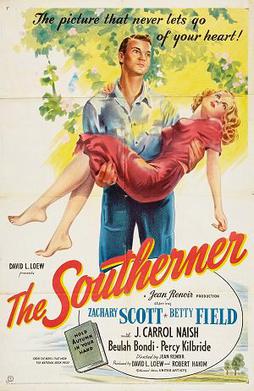
It was to be the cast of Joel McCrea and his wife Frances Dee as the Tuckers. They fled before the cameras even began to roll, as McCrea didn’t like the script and had some disagreements with director Jean Renoir. United Artists apparently wanted out of its distribution agreement as well, and producer David Loew had to threaten to withdraw his other pictures from the studio to keep it going. The only film to come through all this was The Southerner (1945), which Renoir declared his greatest satisfaction with a Hollywood film.
It’s a pretty impressive comment on a Texas sharecropper drama from a French émigré. Renoir was in exile in the occupied France, and here he was shooting dirt, mules and a well that wouldn’t provide water, while William Faulkner was off in the background reading on the script. This won Renoir an Oscar nomination for Best Director and a National Board of Review award in the same category. It’s one of the most viewed works in the public domain today and you can watch it free today.
The Southerner 1945 — Movie Overview Table
| Detail | Information |
|---|---|
| Title | The Southerner |
| Release Year | 1945 (sources give April 30 or May 18, 1945) |
| Country | United States |
| Runtime | 91–92 minutes (some sources list 96) |
| Genre | Drama |
| Language | English |
| Format | Black & White |
| Director | Jean Renoir |
| Screenplay | Hugo Butler and Jean Renoir (uncredited input from William Faulkner and Nunnally Johnson) |
| Based On | “Hold Autumn in Your Hand” (1941 novel) by George Sessions Perry |
| Cinematography | Lucien Andriot |
| Music | Werner Janssen |
| Producers | Robert Hakim, David L. Loew, Samuel Rheiner |
| Production Company | Loew-Hakim, Inc. / Jean Renoir Productions |
| Distributor | United Artists |
| Budget | Approximately $750,000 |
| Awards | National Board of Review: Best Director (Jean Renoir), film ranked third-best of 1945; three Academy Award nominations (Best Director, Best Music Score, Best Sound Recording) |
| Working Titles | Hold Autumn in Your Hand; Tuckers of Texas |
| Preservation | UCLA Film & Television Archive |
| IMDb Rating | 7.1/10 |
| Public Domain | Yes — freely available to watch and download |
Full Cast Table — The Southerner (1945)
| Actor | Role |
|---|---|
| Zachary Scott | Sam Tucker |
| Betty Field | Nona Tucker |
| J. Carrol Naish | Devers |
| Beulah Bondi | Granny Tucker |
| Percy Kilbride | Harmie |
| Charles Kemper | Tim |
| Blanche Yurka | Mama Tucker |
| Norman Lloyd | Finlay |
| Estelle Taylor | Lizzie |
| Paul Harvey | Ruston |
| Noreen Nash | Becky Devers |
| Jack Norworth | Dr. White |
| Nestor Paiva | Bartender |
| Paul E. Burns | Uncle Pete Tucker |
| Jay Gilpin | Jot Tucker |
| Jean Vanderwilt | Daisy Tucker |
The Cast That Almost Wasn’t — McCrea Walks, Zachary Scott Steps In
Hollywood trade names first revealed that real-life husband and wife Joel McCrea and Frances Dee were Sam and Nona Tucker. McCrea resigned during the pre-production process when he was less pleased about Renoir’s impressionistic approach to the script. They were replaced by Zachary Scott and Betty Field at the beginning of the principal photography.
Scott was loaned to Warner Bros. He was a Southern farm boy of his own and the movie was his second feature, apart from a cameo appearance in Hollywood Canteen. His first movie was The Mask of Dimitrios. In modern interpretations, Scott is given the credit for introducing Faulkner to Renoir and launching his novel’s career in the production.
The cast list of supporting characters features who’s who of the 1940s character actors. Beulah Bondi plays the Tucker matriarch. The general store owner Harmie is played by future Ma and Pa Kettle star Percy Kilbride. J. Carrol Naish adds credence to the threat of Devers’ bitter neighbor. A young Norman Lloyd, who was later to be known for Hitchcock’s Saboteur, portrays Devers’s henchman.
There is a book that is being written by Renoir, Faulkner, and the Question of Who Wrote It?
The book was brought to him by another émigré, a friend of Renoir since La Bête humaine, producer Robert Hakim, who also introduced him to a draft screen play by Hugo Butler. Renoir read the book and gave his consent to direct it, provided that he wrote his own screenplay. That version then went to Nunnally Johnson and William Faulkner who were not credited to the film.
Now, what was actually in Faulkner’s hands? Upon this, Scott later asserted that Faulkner wrote the entire thing. But it is not a fact accepted by Renoir biographers. They attribute to Renoir most of the script, and say that Faulkner edited several scenes, including the scene in which Sam lights the family stove for the first time. That’s probably more of a polish than rewrite, but Faulkner’s hand was much publicized in 1945 and this brought an unusual literary pedigree to the film.
The novel was also well known, and the prestige surrounding it was carried over to the source novel. In 1941, George Sessions Perry, a Texas resident from Rockdale published Hold Autumn in Your Hand to great acclaim. Renoir preserved the rural quality of the novel, but cut out many of the narrative devices, focusing on weather, hunger and a family’s stubbornness.

The Southerner (1945) is a plot summary of the novel.
Sam Tucker (Zachary Scott) is a cotton-picker who is fed up with working other people’s fields in Texas. He decides to go and farm his own land. He and his wife, Nona (Betty Field), and their children, Jot and Daisy, and an older relative, journey with two mules and a pouch of seed.
A Farm With No Water
There is no working well on the land the Tuckers lease. Their neighbor Devers (J. Carrol Naish) grudgingly allows them to tap into his water supply setting up the film’s central conflict. It is a hard winter, and the family is on the verge of starvation and freezing.
Sickness and Credit and a Gift of a Cow
By the spring, young Jot is pretty sick and requires milk and vegetables to get better. The Tuckers have some more credit to be repaid, but Harmie (Percy Kilbride), the general store owner, says no. Tim, Sam’s friend (Charles Kemper), suggests he get a steady job in the city at the factory, which will put an end to the experiment. Sam refuses. Then it rains and Harmie responds to the family’s prayer by gifting them a cow, the cotton starts to grow, and a vegetable garden is planted.
Devers, the Catfish, and the Storm
Norman Lloyd’s hired man Finlay (Norman Lloyd) and Devers concoct a plan to destroy the Tuckers, since Devers covets their property. Devers comes home with a gun after a violent confrontation, and discovers Sam about to land the massive catfish Devers has been hunting for years. Sam swaps in exchange for his family’s peace. Now life looks promising as Harmie marries Sam’s grandmother. Soon though, a devastating thunderstorm hits the Tuckers’ house and the Tuckers family must begin their life again.
The Cast That Almost Wasn’t — McCrea Walks, Zachary Scott Steps In
Hollywood trade items first announced Joel McCrea and Frances Dee, real-life spouses, as Sam and Nona Tucker. McCrea left during pre-production, unhappy with Renoir’s impressionistic approach to the script. Zachary Scott and Betty Field took over at the start of principal photography.
Scott came on loan from Warner Bros. He had grown up on a Southern farm himself, and the film was only his second feature if you don’t count a brief appearance in Hollywood Canteen. His screen debut had come in The Mask of Dimitrios. Scott is credited, in modern accounts, with bringing William Faulkner into the project by introducing the novelist to Renoir.
The supporting cast is a who’s-who of 1940s character actors. Beulah Bondi plays the Tucker matriarch. Percy Kilbride, the future Ma and Pa Kettle star, plays the general-store owner Harmie. J. Carrol Naish brings real menace to the bitter neighbor Devers. A young Norman Lloyd, later famous for Hitchcock’s Saboteur, plays Devers’s henchman.
Renoir, Faulkner, and the Question of Who Wrote It
Producer Robert Hakim, a fellow émigré and a friend of Renoir’s since La Bête humaine, brought him the novel along with a draft screenplay by Hugo Butler. Renoir read the book and agreed to direct on one condition: he would write his own version of the script. That version then passed through the hands of Nunnally Johnson and William Faulkner, neither of whom received screen credit.
How much did Faulkner actually write? Scott later claimed Faulkner wrote the whole thing. Renoir biographers dispute that. They credit Renoir with most of the script and say Faulkner reworked a couple of scenes, including the one where Sam lights the family stove for the first time. The truth likely sits closer to a dialogue polish than a full rewrite, but Faulkner’s involvement was well publicized in 1945 and gave the film an unusual literary pedigree.
The source novel carried its own prestige. George Sessions Perry, a Texan from Rockdale, published Hold Autumn in Your Hand in 1941 to strong acclaim. Renoir kept the novel’s rural texture but trimmed away much of its plot machinery, building the film around weather, hunger, and a family’s stubbornness.
Full Plot Summary — The Southerner (1945)
Sam Tucker (Zachary Scott) is a Texas cotton picker who is tired of working someone else’s fields. He decides to farm his own land. With his wife Nona (Betty Field), their children Jot and Daisy, and an older relative in tow, he sets out with two mules and a small bag of seed.
A Farm With No Water
The land the Tuckers lease has no working well. Their neighbor Devers (J. Carrol Naish) reluctantly lets them draw from his water supply, and that grudging favor sets up the film’s central conflict. A hard winter follows, and the family nearly starves and freezes.
Sickness, Credit, and a Gift of a Cow
By spring, young Jot falls seriously ill and needs milk and vegetables to recover. Harmie (Percy Kilbride), the general-store owner, refuses the Tuckers further credit. Sam’s friend Tim (Charles Kemper) offers to find him steady factory work in the city, a safer path that would end the whole experiment. Sam refuses. Harmie then answers the family’s prayers with the gift of a cow, the cotton begins to bloom, and a vegetable garden goes in.
Devers, the Catfish, and the Storm
Devers and his hired man Finlay (Norman Lloyd) scheme to ruin the Tuckers, because Devers wants their land. After a violent argument, Devers arrives with a gun and finds Sam about to land the enormous catfish Devers has been chasing for years. Sam trades the fish for his family’s peace. Harmie marries Sam’s grandmother, and life finally looks fruitful. Then a terrible thunderstorm ravages the Tuckers’ home, and the family has to start over once more.
Filmed the Flood — Friant Dam and a Future Director’s Apprenticeship
Many of the shots were taken on the Hollywood sound stage at General Service Studios, but the water scenes were shot in real water. In California’s Central Valley, a section of Mount Millerton which is now under Millerton Lake in the San Joaquin River was used for the production that employed water released from the recently completed Friant Dam. Today few viewers realize that a Texas drama that flooded was an engineered California release.
Robert Aldrich was the assistant director on the film who would direct Kiss Me Deadly, What Ever Happened to Baby Jane? and The Dirty Dozen. An apprenticeship under Renoir’s long takes and location-centric style might have influenced Aldrich as he watched his later, more physical, films.
A Frenchman’s Texas — Authenticity, Agee and a Southern Backlash
The reception the film received was quite divided. A close friend of the rural South, critic James Agee of Tennessee declared it “one of the most sensitive and beautiful American-made pictures I have seen. He singled out the nighttime possum hunt for capturing a Southern country winter’s hungry, mournful mystery. But Agee also claimed the movie was a travesty, because Renoir didn’t portray the speech, walk, or carriage of southerners correctly.
Other parts of the South responded more directly. The movie was met with strong criticism at several Southern theaters at its launch. One of the greatest draws of The Southerner is the tension created by an outsider’s lyrical gaze on a community who don’t see it that way, and it’s a decision you’re left to make on your own.
Where to Watch The Southerner (1945) Free Online
The Southerner is free to use and legally available on many platforms, throughout the public domain. There is some variation in the quality of the copies. There are many public domain prints in circulation with a muffled sound and soft images, and a restoration mastered from 35mm material saved by the UCLA Film & Television Archive is now available commercially from Kino Classics. The roughness of your free copy is not a fault with the film, but a transfer fault.
| Platform | Format | Cost |
|---|---|---|
| Internet Archive | Stream + Download (multiple formats) | Free |
| YouTube | Stream | Free |
| Public Domain Movies | Stream | Free |
| Kino Classics (restored edition) | DVD / Blu-ray | Paid |
The Southerner (1945) on Internet Archive:
In what ways is The Southerner (1945) Public Domain?
Yes. The Southerner is free for all to stream, download, share and screen in the United States without restriction or cost. The Kino Classics edition is a commercial release. The film is free, but a newly restored transfer is subject to its own rights and is not to be copied from the paid version of the film.
The play was given a positive critical reception in the old days and remains so up to the present.
It has an IMDb rating of 7.1 and its rating has only increased. In 1945, the New York Times critic Bosley Crowther acknowledged that it may not be “entertainment” in the hard-line Hollywood definition, but that it was a “rich, unusual and sensitive delineation of a segment of the American scene. Variety also gave it a thumbs up, lauding Scott and Field in addition to Bondi, Kilbride, Kemper and Naish, but added that there doesn’t seem to be much of any chance for the farm workers, like the Tuckers, to ever be lifted from poverty.
Subsequent critics have been kinder. It was rated 4 stars by Leonard Maltin and is among the most-viewed features in the Internet Archive. It is also his third and final American “land” film, following Swamp Water (1941) and This Land Is Mine (1943) and is generally regarded as his most American film. The film’s strengths are the sense of touch of mud, of weather, of the insects, of the animals, of the plant, of the light, of the water.
Frequently Asked Questions — The Southerner 1945
Q: What is The Southerner (1945) about?
A Texas cotton picker, Sam Tucker (Zachary Scott), moves his wife Nona (Betty Field) and children onto a run-down leased farm to grow their own cotton. They face starvation, a child’s illness, a hostile neighbor named Devers, and a devastating storm, but Sam refuses to give up the dream of working his own land.
Q: Is The Southerner (1945) in the public domain?
Yes. The Southerner is in the public domain in the United States and is freely available on the Internet Archive, YouTube, and Public Domain Movies. A separate restored edition from Kino Classics is a paid commercial release.
Q: Who directed The Southerner?
Jean Renoir, the celebrated French director of Grand Illusion and The Rules of the Game, directed it during his years in Hollywood. He earned an Academy Award nomination for Best Director and won the National Board of Review award for Best Director.
Q: Did William Faulkner write The Southerner?
Faulkner contributed uncredited to the script, along with Nunnally Johnson. The credited screenwriters are Hugo Butler and Jean Renoir. Zachary Scott later claimed Faulkner wrote the entire script, but Renoir biographers say Renoir wrote most of it and Faulkner reworked a few scenes.
Q: Who was originally cast in The Southerner?
Joel McCrea and his wife Frances Dee were first cast as Sam and Nona Tucker. They left during pre-production over McCrea’s dissatisfaction with the script and creative differences with Renoir, and were replaced by Zachary Scott and Betty Field.
Q: What novel is The Southerner based on?
It is based on Hold Autumn in Your Hand, a 1941 novel by Texas author George Sessions Perry. The film’s working titles were Hold Autumn in Your Hand and Tuckers of Texas.
Q: Did The Southerner win any awards?
Jean Renoir won the National Board of Review award for Best Director, and the board ranked the film third-best of 1945. It received three Academy Award nominations: Best Director, Best Music Score (Werner Janssen), and Best Sound Recording (Jack Whitney).
Q: How long is The Southerner?
The film runs approximately 91 to 92 minutes, depending on the print. Some sources list a longer 96-minute running time.
Q: Where can I watch The Southerner (1945) for free?
The Southerner is freely available on the Internet Archive, YouTube, and Public Domain Movies. All public domain versions are legal to stream and download, though picture and sound quality vary between copies.
Related Free Classic Drama Films
If The Southerner (1945) drew you into 1940s American drama and Renoir’s lyrical realism, these are the natural titles to explore next:
- Becky Sharp (1935) Full Movie Review, Plot, Cast & Free Technicolor Drama Classic
- Danger Lights (1930) Full Movie Review, Plot, Cast & Free Railroad Drama Classic
- His Double Life (1933) Full Movie Review, Plot, Cast & Free Comedy-Drama Classic
- Public Domain Movies List – All Free Classic Films (Complete Guide)