
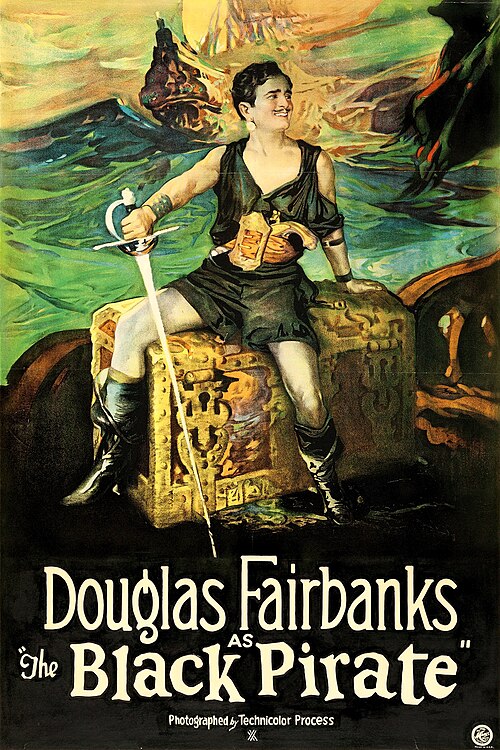
The most popular stunt in pirate-movie history is a trick – and the MythBusters proved it. The Black Pirate (1926)- Douglas Fairbanks throws a knife at a sail, and rides it up to the deck as the blade tears the canvas in half. It’s like a daring stunt. In fact, the sail was pre-cut, and tilted on a separate set, and a propeller inflated the fabric. Fairbanks wore a harness and the knife was attached to a rope and counter weight. The MythBusters tried out the stunt in a 2007 pirate’s episode and came to the conclusion that it was busted.
What looks real and what the camera captured is that gap that defines the whole film. It was filmed in two-strip Technicolor, months spent on color tests and the blue sky eliminated. The outcome is one of the most perfectly crafted silent films ever produced, and was added to the National Film Registry in 1993. It’s in the public domain and you can view it free now!
The Black Pirate 1926 — Movie Overview Table
| Detail | Information |
|---|---|
| Title | The Black Pirate |
| Release Year | 1926 (New York premiere March 8, 1926) |
| Country | United States |
| Runtime | 88–94 minutes (varies by print and projection speed) |
| Genre | Adventure, Swashbuckler, Pirate Film |
| Language | Silent (English intertitles) |
| Format | Color (Two-Strip Technicolor) |
| Director | Albert Parker |
| Screenplay | Jack Cunningham, from a story by Douglas Fairbanks (credited as “Elton Thomas”) |
| Producer | Douglas Fairbanks |
| Cinematography | Henry Sharp (Technicolor cameras: Arthur Ball, George Cave) |
| Art Direction | Carl Oscar Borg |
| Music | Mortimer Wilson |
| Production Company | The Elton Corporation |
| Distributor | United Artists |
| Significance | One of the first feature-length films shot entirely in two-color Technicolor |
| Honors | National Film Registry (1993); AFI 100 Years…100 Thrills nominee |
| Preservation | Restored by the British National Film Archive (1970s) and by MoMA (2023) |
| IMDb Rating | 7.0/10 |
| Public Domain | Yes — freely available to watch and download |
Full Cast Table — The Black Pirate (1926)
| Actor | Role |
|---|---|
| Douglas Fairbanks | The Duke of Arnoldo / The Black Pirate |
| Billie Dove | Princess Isobel |
| Anders Randolf | Pirate Captain |
| Donald Crisp | MacTavish |
| Tempe Pigott | Duenna |
| Sam De Grasse | Pirate Lieutenant |
| Charles Stevens | Powder Man |
| Charles Belcher | Chief Passenger (Nobleman) |
| E. J. Ratcliffe | The Governor |
| John Wallace | Peg-Leg Pirate |
| Fred Becker | Pirate |
| Barry Norton | Youth (uncredited) |
| Mary Pickford | Princess Isobel in the final embrace (uncredited cameo) |
The Sail Slide is the most copied stunt by Sail.The Sail Slide is Pirate Cinema’s Most Copied Stunt.
Fairbanks cuts a line, climbs to the topsail and thrusts his knife into the canvas, sliding down as it tears. MoMA says “any pirate worth his or her salt had to duplicate the scene later on. It was later adapted by later films of Against All Flags to The Goonies.
The set-up was ingenious. The production filmed the stunt on a separate set from which the sail was cut and tilted with an inflated balloon driven by an airplane propeller, and angled the camera to give the illusion of being vertical. The knife was suspended on a rope and counterweight and Fairbanks had a harness beneath his costume.
It is not certain who performed it. Other sources cite Charles Stevens or Chuck Lewis, while William K. Everson has Richard Talmadge to thank. The video review said by biographers Rudy Behlmer and Tracey Goessel reveals the footage is of Fairbanks himself and that he was the one who shot it, he told Robert Parrish.
A Pirate Movie Without a Blue Sky — Fairbanks and Two-Strip Technicolor
Fairbanks joked that color was “like putting lipstick on the Venus de Milo. He then saw The Toll of the Sea (1922), and wrote to Technicolor’s Herbert Kalmus, and determined that pirates was a case for color. He asserted that a black and white pirate tale was bland.
There was a problem with the process: two-strip Technicolor was only able to capture red and green, and not blue or yellow. That weakness became Fairbanks’ style. He decided to use a limited palette, and he drew on the work of such artists as Rembrandt and illustrators such as Howard Pyle and Maxfield Parrish. After months of testing, his staff used to tint the studio sea green, turn the sky soft white with a few browns, dye or paint every costume and prop.
Tests were very comprehensive. The crew had to use six different shades of the color and paint the walls of the studio to create a color chart to test out the colors. Later, director Albert Parker said he was originally terrified of the notion of shooting a color film, but came up with the idea after visiting a Rembrandt exhibit at the Huntington Library.

A Script Without Much of a Script
The sets were as much a part of the story as were the colors. The running time was kept briefer and the story was simplified because Technicolor was so costly. The shooting plan is said to be just under 2,000 words, and the completed film has only approximately 78 intertitles.
About the ideas, they were cooking for years. In fact, Jackie Coogan claimed that he inspired Fairbanks with the idea after reading Howard Pyle’s Book of Pirates, and parts of the story of Zorro with pirates were used again in Fairbanks’ film. He wrote the story under his pseudonym “Elton Thomas”, formed from his middle names, and the completed screenplay is given to Jack Cunningham.
Building a Pirate Fleet on a Hollywood Lot
Color tests revealed control of outdoor light was difficult, so the production decided not to go onto Santa Catalina Island. Rather, almost all the sets and approximately 95 percent of the exteriors were constructed at Hollywood’s Pickford-Fairbanks studios. The waves were generated by a large water container having aircraft propellers around the edges.
They constructed four of these ships, three galleons and a galley of 100 oars, a crew of approximately 380 manned four small, single-stuntman galleons for action shots. The sets were designed by Carl Oscar Borg, who was a self-taught painter, and a former sailor. Costumes and positioning were done by diorama designer and pirate specialist Dwight Franklin and the duels were choreographed by fencing master Fred Cavens.
The iconic underwater shot of the approximately 50 soldiers swimming in formation was staged off backwash and upright. Extras suspended from piano wires to hold pipes pouring small balls and feathers, which turn into air bubbles when the film is flipped.
He was joined by Billie Dove, Donald Crisp and the Supporting Cast
Fairbanks’ original cast was to feature an unknown actress playing the part of the heroine. He then saw Billie Dove in the Technicolor western Wanderer of the Wasteland (1924), and called her on set to offer her the role. In total, out of the 300 color tests for the part, Parker said only about a dozen actresses had true “color personality.”
Fairbanks star Donald Crisp, who directed Don Q, Son of Zorro (1925), is MacTavish, the one-armed pirate. He was to win the Best Supporting Actor Oscar for How Green Was My Valley (1941). The Pirate Lieutenant gets a good snarl from Sam De Grasse who was the lecherous Prince John in Fairbanks’ Robin Hood, and fencing experience helped Anders Randolf’s Pirate Captain.
Oh, and one more trivia: Mary Pickford, Fairbanks’s wife, is uncredited for the final kiss (in Dove’s costume).
FULL SUMMARY — The Black Pirate (1926)
Spoiler alert: the summary below includes spoilers about the end of the movie.
A Wreck and a Vow
A pirate captures, mauls and loots the ship then sinks it and blows it up. An old man and his son are two survivors that wash up on shore on an island. The old man gives his son a signet ring and then dies, and the son buries him and swears to take revenge.
Joining the Pirates
Meanwhile, the Pirate Captain and Lieutenant bury loot across the island and they plot to assassinate each other’s crew so as to keep the secret. Then the son comes as the Black Pirate and invites him/her to join. He shows his worth by killing the Captain in a duel and then promises to take the next ship, singlehanded. He does, and convinces the pirates to ransom the ship.
The Plank and the Rescue are required to be executed in the correct sequence.The Plank must come before the Rescue.
One of the captives is a lovely young girl, which the Lieutenant takes as his own. At the first sight, the Black Pirate falls in love with her and rescues her, presenting her as a “princess”, who must be kept safe to assure the ransom. The Lieutenant is a spy and sabotages the ransom ship, and makes the Black Pirate reveal himself as a traitor and walks to the plank.
However, the Black Pirate is able to survive and return with a force with the assistance of the Black Pirate’s ally MacTavish. After a long fight the pirates are routed. He’s a Duke, and the “princess” a noble lady.
What Happened After — Technicolor’s Troubles and Fairbanks’s Last Color Feature is a documentary about the final four years of the Technicolor company and the closing of Fairbanks’ last colour film studio.
It was a success, being one of the most successful rentals of 1926. However, the double-strip color prints were fragile and had a tendency to cause trouble in the normal theaters. The heat caused the film to curl up, or “cup,” and it left the film out of focus, requiring either repair or replacement of prints by Technicolor. The film was a great success, but the problems continued, Kalmus would go on to say.
This would be Fairbanks’ last full-length Technicolor film. For The Gaucho (1927) he used color only for a prologue. The film still had an impact on Hollywood: Technicolor’s film The Viking (1928) was patterned after the film, and later pirate films, such as The Black Swan (1942) and The Crimson Pirate (1952), helped cement the connection Fairbanks had originally envisioned between pirates and Technicolor.
The Black Pirate (1926) Free Online is a gem from the silent era.The Black Pirate (1926) Free Online is a gem from the silent era.
The Black Pirate is in the public domain and can be legally 100% downloaded for free on several platforms. The quality of the prints is variable – older public domain prints are more gray and washed out than the restored prints.
| Platform | Format | Cost |
|---|---|---|
| Internet Archive | Stream + Download (multiple formats) | Free |
| YouTube | Stream | Free |
| Public Domain Movies | Stream | Free |
The Black Pirate (1926) on Internet Archive:
See If The Black Pirate (1926) is Public Domain?
Yes. The Black Pirate can be freely streamed, downloaded, shared and screened without any restrictions or cost in the United States. As far as I know the original film is free to use, but note that modern restorations, soundtracks, and Kino and Cohen Media Group’s Blu-Ray are all their own rights.
The picture has been restored twice. In 1970, a two-year restoration project was begun at the request of Douglas Fairbanks, Jr., by the British National Film Archive. MoMA finished a new restoration from the original camera negatives in 2023, which was premiered at the BFI London Film Festival on 15th October 2023. The film was made using five cameras: 4 colour and 1 black and white in Fairbanks.
Critical Reception — Then and Now
The movie has an IMDb rating of 7.0. It was a hugely-popular success in 1926, being one of the highest-grossing films of that year in the United States, with approximately $1.7 million in domestic rentals; it was also one of the best films of the year, according to critics. Not everyone cheered. British critic John Grierson railed in his review, “The Pink Pirate,” against the “prettiness and fairytaleness of the film – too pretty and too fairytale-like for a tale of pirates. French critic Léon Moussinac ridiculed the color and the ‘sail stunt’ was the only shot to remember.
Subsequent critics have been less harsh. It was “an entertaining, for its time, swashbuckling revenge story on the high seas”, wrote Dennis Schwartz. Fairbanks biographer Jeffrey Vance took it a step further, dubbing it the “most carefully prepared and controlled work of Fairbanks’s entire career. Historian Jeffrey Richards likened its feel to a graceful dance, a film as light as air.
Our point of view: watch it for the craft. Easy to follow for the purpose, but one of the great stunts of the late silent era, because the plot is so good, the design is so good and Fairbanks’ grin is so good.
Frequently Asked Questions — The Black Pirate 1926
Q: What is The Black Pirate (1926) about?
A nobleman vows to avenge his father’s death at the hands of pirates and infiltrates their band as the Black Pirate. He helps capture a ship, but things get complicated when he finds a young woman aboard whom he wants to protect.
Q: Is The Black Pirate (1926) in the public domain?
Yes. The Black Pirate is in the public domain in the United States and is freely available on the Internet Archive, YouTube, and Public Domain Movies.
Q: Was The Black Pirate shot in color?
Yes. It was shot in two-strip Technicolor, which records only red and green, so Fairbanks chose a muted palette and avoided blue skies. It is considered one of the first feature-length films shot entirely in two-color Technicolor.
Q: Who directed The Black Pirate?
Albert Parker directed the film, with Douglas Fairbanks producing and starring. The screenplay is credited to Jack Cunningham from a story by Fairbanks, who used the pseudonym Elton Thomas.
Q: How was the famous sail-slide stunt filmed?
The scene was shot on a separate set with a tilted, pre-cut sail inflated by a propeller. A counterweighted rope held the knife, and Fairbanks wore a harness. The MythBusters later tested the stunt and declared it busted.
Q: Who stars in The Black Pirate?
Douglas Fairbanks plays the Duke of Arnoldo, the Black Pirate. Billie Dove plays Princess Isobel, with Donald Crisp as MacTavish, Sam De Grasse as the Pirate Lieutenant, and Anders Randolf as the Pirate Captain.
Q: Did Mary Pickford appear in The Black Pirate?
Yes, in an uncredited cameo. Pickford, Fairbanks’s wife, replaced Billie Dove in the final kiss scene, wearing Dove’s costume.
Q: Is The Black Pirate in the National Film Registry?
Yes. The Library of Congress selected it for the National Film Registry in 1993 as culturally, historically, or aesthetically significant.
Q: How long is The Black Pirate?
The film runs about 88 to 94 minutes, depending on the print and projection speed.
Q: Where can I watch The Black Pirate (1926) for free?
The Black Pirate is freely available on the Internet Archive, YouTube, and Public Domain Movies. All public domain versions are legal to stream and download.
Related Free Classic Adventure and Early Color Films
If The Black Pirate (1926) drew you into silent-era spectacle and early color cinema, these are the natural titles to explore next:
- Becky Sharp (1935) Full Movie Review, Plot, Cast & Free Technicolor Classic
- Man in the Attic (1953) Full Movie Review, Plot, Cast & Free Jack the Ripper Thriller Classic
- Danger Lights (1930) Full Movie Review, Plot, Cast & Free Railroad Drama Classic
- Public Domain Movies List – All Free Classic Films (Complete Guide)