
D.W. Griffith made exactly two sound films in his whole career. Abraham Lincoln (1930) was the first, and the circumstances around it kinda tell you something important before the movie even starts. Griffith had built his reputation on silent epics— The Birth of a Nation (1915), Intolerance (1916) , pictures that sort of set the terms for what the medium could do at that scale. But by 1930 that reputation was starting to fade back. Sound had arrived and the industry re-organised around it, and Griffith ended up as a director whose most known work carried that extra load of racial politics in ways that were, increasingly, hard to untangle from the filmmaking itself .
Choosing Abraham Lincoln as the subject of his first talkie was, in that context, a statement. It was also a genuinely ambitious production — the screenplay written in collaboration with poet Stephen Vincent Benét, the lead role given to Walter Huston at the height of his powers, the Civil War rendered on a scale that United Artists was not entirely comfortable financing. The film was a box office failure. It later appeared in a list of the fifty worst films ever made, which says more about changing critical fashions than about the film’s actual qualities. What it actually is, ninety-five years later, is an essential document of early sound filmmaking and a more complex portrait of Lincoln than its reputation suggests.
Abraham Lincoln 1930 — Movie Overview Table
| Detail | Information |
|---|---|
| Title | Abraham Lincoln |
| Release Date | August 25, 1930 |
| Country | United States |
| Runtime | 96 minutes |
| Genre | Historical Drama, Biopic |
| Language | English |
| Format | Black & White, Sound |
| Director | D.W. Griffith |
| Screenplay | Stephen Vincent Benét and Gerrit Lloyd |
| Production / Distribution | United Artists |
| Notable Detail | One of only two sound films Griffith ever directed; screenplay co-written with Pulitzer Prize-winning poet Stephen Vincent Benét |
| Historical Note | First major sound-era Hollywood biopic of Abraham Lincoln |
| Public Domain | Yes — freely available to stream and download |
Full Cast — Abraham Lincoln (1930)
| Actor | Role |
|---|---|
| Walter Huston | Abraham Lincoln |
| Una Merkel | Ann Rutledge |
| Kay Hammond | Mary Todd Lincoln |
| Ian Keith | John Wilkes Booth |
| Hobart Bosworth | General Robert E. Lee |
| E. Alyn Warren | Stephen A. Douglas / General Grant |
| Henry B. Walthall | Colonel Marshall |
| James Bradbury Sr. | General Scott |
| Otto Hoffman | Offut |
| Edgar Dearing | Armstrong |
D.W. Griffith and the Sound Era — What This Film Cost Him to Make
Griffith’s transition to sound was not just a technical adjustment. It was a renegotiation of everything that had made him significant. His filmmaking language — the grammar of cutting, the handling of crowds, the way he used landscape as emotional space — had been developed entirely within the silent medium over more than two decades. Sound required a different pacing, a different relationship between camera and performer, a different understanding of where the audience’s attention goes when dialogue is doing work that images used to do alone.
He was also, by 1930, working from a diminished position. The controversy surrounding The Birth of a Nation had not faded. Several of his subsequent productions had underperformed commercially. United Artists, the studio he’d co-founded along with Chaplin, Pickford, and Fairbanks, financed Abraham Lincoln assuming it would kind of revive his box office reputation . I mean, it didn’t.
What Griffith still brought to the material, despite all that, was real ambition , for sure. He didn’t settle for some small, cautious film. No, he went for a 96-minute epic that traces Lincoln’s life from the Kentucky frontier up to Ford’s Theatre, and yeah the Civil War sequences are big, and the main role doesn’t just lean on physical resemblance either. You can see that push everywhere throughout the thing . The execution is uneven — but that’s the unevenness of a director swinging hard, not someone trying to stay safe .
Stephen Vincent Benét — The Poet Who Wrote the Screenplay
The screenplay credit goes to Stephen Vincent Benét and Gerrit Lloyd — and Benét’s involvement deserves a brief pause. Benét was a poet and a novelist type, not exactly a “screenwriter” by trade. He won the Pulitzer Prize in 1929 for John Brown’s Body, an epic narrative poem about the Civil War, which had become one of the most widely read pieces of American verse for decades. And his grasp of Lincoln, the war, and the particular mythology Americans had built around both, that understanding ran deep.
What a poet brings to a biographical screenplay is different from what a professional screenwriter brings. Benét wasn’t interested in conventional dramatic efficiency — in getting from scene to scene as quickly as possible. He was interested in texture, in the emotional logic of a life, in the gap between the historical record and the myth that the historical record generates. Those instincts are visible in the film’s best sequences, particularly the Ann Rutledge section and the pre-assassination scenes, where the dialogue has a cadence that commercial screenwriting of the period didn’t typically produce.
The invented final speech — a composite of the Gettysburg Address and the Second Inaugural delivered moments before the assassination — is the most controversial element of the screenplay and also the most characteristically Benét. It’s not historically accurate. It is emotionally resonant in a way that accurate historical reconstruction rarely achieves. Whether that trade-off works is a question the film raises without fully answering.
Full Plot Summary — Abraham Lincoln (1930)
The film opens on the Kentucky frontier — Lincoln as a young man, self-educated by firelight, working in a general store in New Salem, already possessed of the physical presence and verbal directness that the film treats as his defining characteristics from the start. Griffith establishes him quickly as someone the community gravitates toward without quite being able to explain why.
Ann Rutledge — The Loss That Shaped the Man
Lincoln falls in love with Ann Rutledge (Una Merkel), a young woman of evident quality whose death from illness sends him into a depression that the film presents as formative rather than merely biographical. This section is the most intimate in the picture — Griffith slows down, lets the relationship develop, and gives Merkel room to make Ann a person rather than a plot point. Her death lands because the film has made you understand what Lincoln is losing.
The depression that follows is handled with more directness than 1930 Hollywood biopics typically allowed. Lincoln is shown as genuinely incapacitated — grief not as a single dramatic scene but as a sustained condition that his community has to manage around him. The film’s willingness to portray its heroic subject as temporarily broken is one of its most historically responsible choices.
Mary Todd, the Debates, and the Road to the Presidency
Lincoln recovers, enters politics, and eventually marries Mary Todd (Kay Hammond) — a match the film presents as more strategic than romantic, a correction after the emotional intensity of the Ann Rutledge relationship. The Lincoln-Douglas debates are dramatised, though the film’s presentation of Stephen Douglas as a straightforward villain and a driver of Southern secession is one of its more significant historical distortions. The actual debates were about the expansion of slavery into new territories; the film simplifies the politics considerably.
The path to the presidency is compressed into broad strokes — Griffith is more interested in Lincoln as a figure than in the political machinery that elevated him, and the film moves quickly through the election toward the crisis of secession.
The Civil War — and the Assassination at Ford’s Theatre
The war sequences are handled at scale but without the tactical precision that a more historically oriented production might have attempted. Griffith renders the conflict in emotional and symbolic terms — the weight of command on Lincoln’s face, the cost measured in the faces of ordinary soldiers rather than in strategic manoeuvre. Fort Sumter is handled inaccurately, and General Scott is presented as an obstacle rather than the strategist of the Anaconda Plan he actually was. These are significant distortions, but the film’s purpose is portrait rather than history lesson.
The assassination sequence is the film’s most carefully staged. John Wilkes Booth (Ian Keith) is presented with a theatrical menace that leans into his background as an actor — the performance-within-performance quality of Booth’s crime is something Griffith understood intuitively as a man who had spent his career thinking about theatrical effect. Lincoln delivers the composite speech from Benét’s screenplay. The shot is fired. The film ends with the iconographic weight of a martyrdom rather than the factual record of a murder.
Walter Huston as Lincoln — What the Performance Actually Does
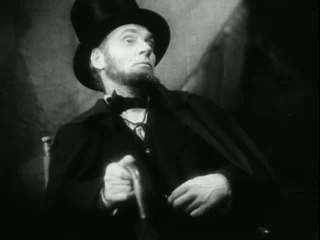
Walter Huston was fifty years old when he played Lincoln, and he was already one of the most respected stage and screen actors in America. His son John Huston would go on to direct The Maltese Falcon, The African Queen, and Chinatown. The father’s career in this period was marked by a specific quality: the ability to make authority seem earned rather than assumed, which is precisely what a Lincoln performance requires.
The challenge of playing Lincoln on screen is that the audience arrives with an image already formed — the monuments, the portraits, the Gettysburg Address in school. Huston doesn’t try to dissolve that image. He works within it, finding the human scale inside the iconography rather than pretending the iconography doesn’t exist. His Lincoln is physically large, verbally deliberate, and emotionally present in a way that early sound performances often weren’t — many actors of the period were still calibrating for stage delivery in a medium that required something more intimate.
The Ann Rutledge scenes are where Huston is most effective. The grief is specific rather than generalised — not Lincoln-as-symbol mourning but a man who has lost a particular person and doesn’t quite know what to do with himself afterward. That specificity is what separates the performance from the hagiographic Lincoln films that came before it.
Una Merkel as Ann Rutledge — The Performance the Film Needs Most
Una Merkel is kind of better known for comedy roles—she was one of the sharper supporting performers in 1930s Hollywood, with a gift for dry timing that made her an essential presence in films that needed someone to cut through the sentiment, without just flattening it. Ann Rutledge in Abraham Lincoln uses almost none of that.
What Merkel does here is quieter and harder: she makes Ann a person of genuine warmth and intelligence in a relatively short amount of screen time, and she makes her death feel like a specific loss rather than a narrative requirement. The film needs you to understand why Lincoln was never quite the same after Ann died. Merkel makes that understanding available without announcing it. It’s a generous performance in a film that could easily have used the role as a plot device and been worse for it.
Henry B. Walthall — The Bridge Between Griffith’s Two Eras
Henry B. Walthall played the Little Colonel in The Birth of a Nation (1915) — the film that made Griffith’s international reputation and remains the most historically contested work in his filmography. His presence here, fifteen years later, as Colonel Marshall in the Civil War sequences, is one of the more loaded casting choices in early sound cinema.
Walthall kind of stands in for the continuity of Griffith’s career across that silent–sound divide, like, a performer who was there for the silent epics and then still stayed in it, but in a diminished role, for the first talkie. His screen presence in Abraham Lincoln is a little reminder that Griffith had been making films for a long time and that a lot of things, changed around him while he was doing it. The thing is, that context isnt spelled out in the film, but it’s there for viewers who come to it with at least some knowledge of the production history .
Historical Accuracy — What the Film Gets Right and What It Doesn’t
The film’s relationship to historical fact is selective in ways that are worth naming, because the inaccuracies are not random at all—they show up as steady decisions about what sort of Lincoln story Griffith and Benét wanted to tell, more or less.
What the film gets substantially right : Lincoln’s early poverty and self-education; the reality of his depression after Ann Rutledge’s death; his engagement that breaks with Mary Todd before they eventually marry; his physical presence and the way contemporaries described his behavior in conversation. Even the emotional feel of the early stretches, lands more true than the dramatic compression seems to promise, at first.
What the film distorts: the Lincoln-Douglas debates are presented as the direct cause of Lincoln’s presidential nomination, which overstates their immediate political effect. The Fort Sumter sequence inverts the historical record of who fired first. General Winfield Scott — in reality the architect of the Union’s early strategic thinking — is depicted as an obstacle to be dismissed. The final composite speech is entirely invented.
The pattern is consistent: the film is most accurate about private Lincoln and least accurate about public Lincoln. The interior life — the grief, the doubt, the weight of command — is handled with genuine care. The political and military record is subordinated to myth. That’s a choice that reflects the 1930 moment as much as it reflects any particular bias in Griffith or Benét.
Where to Watch Abraham Lincoln (1930) Free Online
Abraham Lincoln is in the public domain and freely available across multiple platforms. The Internet Archive has the most reliable copy, and the print quality is reasonable for a 1930 United Artists production.
| Platform | Format | Cost |
|---|---|---|
| Internet Archive | Stream + Download (multiple formats) | Free |
| YouTube | Stream (multiple uploads; quality varies) | Free |
| Tubi | Stream (with ads; often in classic drama collections) | Free |
| Public Domain Movies | Stream | Free |
Abraham Lincoln (1930) on Internet Archive:
Is Abraham Lincoln (1930) in the Public Domain?
Yes. Abraham Lincoln (1930) is in the public domain in the United States. The film’s copyright was not maintained under the renewal requirements applicable to works of its period, and it has been freely and legally available for decades. You can stream it, download it, share it, and screen it without restriction or payment of any kind.
The Internet Archive copy is the most reliable starting point for downloading. Both the streaming embed and the direct MP4 download link above point to verified archive files.
Critical Reception — Then and Now
On release in 1930, Abraham Lincoln received respectful if mixed notices. Critics acknowledged the ambition, praised Huston’s performance, and noted the unevenness of the pacing — particularly in the Civil War sequences, where the film’s large-scale aspirations ran into the constraints of early sound production. It was not a commercial success, which United Artists had been counting on to justify the production cost.
The subsequent critical history has been unkind in ways that are only partly deserved. Its appearance in a list of the fifty worst films ever made reflects the critical climate of a particular moment rather than a sustained analytical judgment. The film has genuine problems — the historical distortions in the second half, the unevenness of transition between the intimate early sections and the broader Civil War canvas — but it also has Walter Huston’s performance, Benét’s dialogue in its best passages, and the specific historical significance of being the first major sound-era Lincoln biopic.
For film historians, Abraham Lincoln matters as a document of Griffith’s late career and as an example of the creative and commercial pressures that the sound transition imposed on directors whose craft had been built entirely in silence. For general viewers, it rewards patience — particularly in the first half, where the film is most personal and most alive. The second half is uneven. The first half is, at its best, genuinely moving.
Frequently Asked Questions — Abraham Lincoln (1930)
Q: What is Abraham Lincoln (1930) about?
The film follows the life of Abraham Lincoln from his frontier childhood in Kentucky through his legal and political career, his presidency, the Civil War, and his assassination at Ford’s Theatre. It dramatises his early love for Ann Rutledge, his marriage to Mary Todd, his debates with Stephen A. Douglas, and his leadership during the Civil War, ending with a composite final speech constructed from the Gettysburg Address and the Second Inaugural.
Q: Is Abraham Lincoln (1930) in the public domain?
Yes. Abraham Lincoln (1930) is in the public domain in the United States. The film’s copyright was not renewed and it has been freely and legally available for decades. You can stream, download, and share it at no cost via the Internet Archive, YouTube, Tubi, and other platforms.
Q: Who directed Abraham Lincoln (1930)?
D.W. Griffith directed the film. It was one of only two sound films Griffith ever made, coming near the end of a career that had begun in the silent era with films including The Birth of a Nation (1915) and Intolerance (1916). Abraham Lincoln was produced and distributed by United Artists, the studio Griffith had co-founded with Chaplin, Pickford, and Fairbanks.
Q: Who plays Abraham Lincoln in the 1930 film?
Walter Huston plays Abraham Lincoln. Huston was fifty years old at the time and already one of the most respected actors in American theatre and film. His performance works by finding the human scale inside the Lincoln iconography — particularly effective in the early sequences involving Ann Rutledge and the depression that follows her death.
Q: Who wrote the screenplay for Abraham Lincoln (1930)?
The screenplay was written by Stephen Vincent Benét and Gerrit Lloyd. Benét was a Pulitzer Prize-winning poet who had won the prize the previous year for John Brown’s Body, an epic narrative poem about the Civil War. His literary instincts are visible throughout, particularly in the dialogue of the earlier sections and in the invented composite final speech before the assassination.
Q: How historically accurate is Abraham Lincoln (1930)?
The film is selectively accurate. It handles the private Lincoln — the Ann Rutledge relationship, the depression, the self-education — with more fidelity than most biopics of the period. It distorts the public Lincoln significantly: the Lincoln-Douglas debates are overstated as the cause of his nomination, Fort Sumter’s sequence of events is inverted, General Winfield Scott is misrepresented, and the final speech is entirely invented. The film is best understood as myth-making rather than historical record.
Q: Who plays Ann Rutledge in the film?
Una Merkel plays Ann Rutledge, Lincoln’s early love whose death from illness sends him into a prolonged depression. Merkel — better known for sharp comedic supporting roles in 1930s Hollywood — plays the part with quiet warmth and makes Ann a genuine presence rather than a narrative device. Her performance is the emotional foundation the film’s first half rests on.
Q: What is the significance of Henry B. Walthall appearing in this film?
Henry B. Walthall had played the lead in Griffith’s The Birth of a Nation (1915) — the film that defined Griffith’s silent career. His appearance here as Colonel Marshall is a direct line between Griffith’s two eras, connecting the silent epics to the first talkie. It’s one of the more historically loaded casting choices in early sound cinema.
Q: Where can I watch Abraham Lincoln (1930) for free?
Abraham Lincoln (1930) is freely available on the Internet Archive, YouTube, Tubi, and various public domain film platforms. The Internet Archive has the most reliable copy for downloading, including a clean 512kb MP4 via direct link.
Q: How does Abraham Lincoln (1930) fit into D.W. Griffith’s career?
It is one of the last significant productions of Griffith’s career and one of only two sound films he directed. Coming after the critical and commercial difficulties of his late silent period, and carrying the additional weight of The Birth of a Nation’s contested legacy, the film represents Griffith attempting to reassert himself in a changed industry. It was not a commercial success, but it demonstrates his ambition intact even as his commercial position was declining.
Related Free Classic Drama and Historical Films
If Abraham Lincoln (1930) sent you further into early sound biopics and public domain historical drama, these are the natural places to keep going:
- Public Domain Horror Movies – Free Classic Scary Films Online
- Public Domain Cartoons
- Bird of Paradise (1932) Full Movie Review, Plot, Cast & Free Classic Romance Film
- Public Domain Movies List – All Free Classic Films (Complete Guide)
Movie Tags
Abraham Lincoln 1930, Abraham Lincoln full movie, watch Abraham Lincoln 1930 free, Abraham Lincoln public domain, DW Griffith director, DW Griffith talkie, Walter Huston Abraham Lincoln, Una Merkel Ann Rutledge, Kay Hammond Mary Todd Lincoln, Ian Keith John Wilkes Booth, Henry B Walthall actor, Stephen Vincent Benet screenplay, Civil War biopic 1930, early sound Hollywood biopic, Ford’s Theatre assassination film, United Artists 1930 drama, American president biopic public domain, free classic historical drama online, DW Griffith sound film, 1930s American history film