
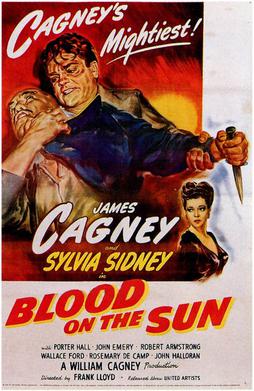
James Cagney trained for months under Ken Kuniyuki, a fifth-degree judo master, insisting on performing his own stunts for a role that made Blood on the Sun — by more than one account — the first American film built around genuine judo combat on screen. He grew so attached to the sport, per his own memoirs, that he kept training long after filming wrapped, until a later back injury from an unrelated cause finally sidelined him. It’s an unusual level of physical commitment for a film shot in 1944 for Cagney’s own fledgling production company, and it shows in the picture’s climactic fight — sloppy, unglamorous, and considerably more convincing than the choreographed judo-adjacent brawls Hollywood would later popularize.
The film itself is built around a genuinely contested piece of history: the “Tanaka Memorial,” a document purporting to lay out Japan’s secret plan for world conquest, first published in China in 1929 and treated by wartime American audiences as gospel — historians have since debated it extensively, with strong evidence suggesting it was itself a piece of Chinese anti-Japanese propaganda. Blood on the Sun takes that contested document and builds a fast, noir-inflected thriller around it, released via United Artists on April 26, 1945 — four days before Adolf Hitler’s death, catching the very last window in which its wartime urgency still made commercial sense. It’s in the public domain today, and you can watch it free right now.
Blood on the Sun 1945 — Movie Overview Table
| Detail | Information |
|---|---|
| Title | Blood on the Sun |
| Release Year | 1945 (filmed 1944; premiered June 28, 1945; released April 26, 1945 per some sources) |
| Country | United States |
| Runtime | 98 minutes |
| Genre | Action, Drama, War, Romance, Espionage Thriller |
| Language | English |
| Format | Black & White (a computer-colorized version was created in 1993) |
| Director | Frank Lloyd |
| Screenplay | Lester Cole, Nathaniel Curtis (adaptation) |
| Story | Garrett Fort |
| Cinematography | Theodor Sparkuhl |
| Music | Miklós Rózsa |
| Art Direction | Wiard Ihnen, A. Roland Fields — won the 1945 Academy Award for Best Art Direction (Black-and-White) |
| Producer | William Cagney |
| Production Company | William Cagney Productions |
| Distributor | United Artists |
| Historical Basis | Fictionalized account built around the disputed “Tanaka Memorial” document |
| Public Domain Status | Entered public domain in 1973 after the copyright claimant failed to renew registration in the film’s 28th year |
| IMDb Rating | 6.6/10 |
| Public Domain | Yes — freely available to watch and download |
Full Cast Table — Blood on the Sun (1945)
| Actor | Role |
|---|---|
| James Cagney | Nick Condon |
| Sylvia Sidney | Iris Hilliard |
| Porter Hall | Arthur Bickett |
| John Emery | Premier Giichi Tanaka |
| Robert Armstrong | Col. Hideki Tojo |
| Wallace Ford | Ollie Miller |
| Rosemary DeCamp | Edith Miller |
| John Halloran | Capt. Oshima |
| Leonard Strong | Hijikata |
| James Bell | Charley Sprague |
| Marvin Miller | Yamada |
| Rhys Williams | Joseph Cassell |
| Frank Puglia | Prince Tatsugi |
| Hugh Beaumont | Johnny Clarke |
James Cagney’s Judo Training — Hollywood’s First On-Screen Martial Art
What kinda sets Blood on the Sun apart from Cagney’s usual tough-guy vehicles is the very specific physical discipline behind all those fight moments. As the DVD sleeve notes say, and as a bunch of later retrospectives also repeat, Cagney trained pretty intensively under Ken Kuniyuki, a fifth-degree judo master, before production even started, and he pushed hard to do his own stunts instead of leaning on a double. One reviewer goes as far as crediting the picture as “the first American film in which there are martial arts (judo) struggles” ,which is honestly a pretty wild but genuinely notable claim considering how judo, karate, and these related disciplines would become sort of core ingredients in American action cinema years and decades later.
Cagney’s own account, drawn from his memoirs, adds a personal coda to the story: “I grew so fond of judo I used it to keep in shape until a back injury I picked up doing something else put me on the sidelines.” Notably, one of his instructors was John Halloran, a former LAPD officer who also plays Capt. Oshima and appears opposite Cagney in the film’s climactic fight — meaning the picture’s final judo battle pits Cagney directly against one of the men who’d actually trained him. Reviewers have consistently praised the resulting fight choreography for its lack of polish: one assessment called the struggle “sloppy and unglamorous,” preferring it to the far more stylized, dance-like fight scenes modern action films tend toward.
The Tanaka Memorial — A Real Historical Document, Almost Certainly a Fake
The film’s entire plot hinges on a document with a genuinely strange real-world history. The Tanaka Memorial purported to be Prime Minister Baron Giichi Tanaka’s secret 1927 strategic blueprint for Japanese world domination, allegedly prepared for Emperor Hirohito and made public only after Tanaka’s death in 1929. One retrospective review calls it plainly “the Japanese equivalent of Mein Kampf,” at least in terms of how it was perceived by contemporary American and Chinese audiences — before noting that the document “has since been debunked as itself being propaganda,” with strong evidence suggesting it was fabricated by Chinese sources as an act of anti-Japanese messaging rather than a genuine leaked Japanese government document.
That layered irony — a wartime American film building high-stakes drama around a document that was itself likely fake propaganda, produced by a film industry itself engaged in wartime propaganda — is exactly the kind of detail that gives Blood on the Sun unusual staying power as a historical curiosity, independent of its merits as straightforward entertainment. The Japanese government denounced the memorial as a forgery at the time; six decades of subsequent historical scholarship has generally sided with that denial, even while the film treats the document as unambiguous, damning fact.
Full Plot Summary — Blood on the Sun (1945)
Nick Condon (James Cagney) is the managing editor of the Tokyo Chronicle, an English-language daily catering to Tokyo’s American business community in the years before World War II. Condon publishes a story revealing the existence of the Tanaka Plan, a document allegedly detailing Japan’s strategy for world conquest — and Japanese officers immediately seize the newspaper in retaliation. Undeterred, Condon manages to obtain the actual Tanaka Plan document itself, setting off a manhunt.
A Murder and a Hidden Document
Japanese secret police, believing Condon’s colleagues Ollie and Edith Miller (Wallace Ford and Rosemary DeCamp) may have discovered the plan themselves — the couple has suddenly come into a great deal of money and is preparing to return to the United States — begin trailing them. When Condon arrives at the docks to see the Millers off, he discovers Edith has been murdered, catching only a glimpse of the killer’s hand, marked by a ring set with a large ruby. Tracking down Ollie afterward, badly injured, Condon manages to obtain the Tanaka Plan from him before Ollie dies.
Premier Tanaka’s Pursuit
Premier Giichi Tanaka (John Emery), desperate to keep his plans secret, dispatches Col. Hideki Tojo (Robert Armstrong), Capt. Oshima (John Halloran), and secret police agent Hijikata (Leonard Strong) to track Condon down by any means necessary. Condon hides the incriminating document behind a portrait of the Emperor — a genuinely clever hiding spot, since Japanese officers searching his residence prove unwilling to disturb or even directly touch the sacred image, allowing the document to go undiscovered even during a thorough search.
Iris Hilliard and the Ruby Ring
Condon meets Iris Hilliard (Sylvia Sidney), a woman of half-American, half-Chinese heritage, and the two grow close despite Condon’s initial suspicion that she may have been the woman present at Edith Miller’s murder. His suspicions deepen when he spots her wearing a ring set with a large ruby — matching the one glimpsed on the killer’s hand — but the truth proves more complicated: Iris has actually been working on behalf of a Japanese politician who wants peace and who was himself present when the Tanaka Plan was originally devised.
The Docks, the Signature, and the Final Escape
Condon resigns from his position after ten days on the story, planning to leave Japan entirely, but before he can depart he meets the politician and Iris at the harbor, where the politician formally signs the document to authenticate it as genuine. Japanese military forces discover the group before they can escape, and in the climax, Iris flees aboard a cargo ship carrying the now-verified Tanaka Plan out of the country, while Condon stays behind to physically fight off his greatest enemy, Capt. Oshima, in a brutal judo battle at the docks. Shot at by plainclothes agents but not killed, Condon makes it to the American Embassy just ahead of the pursuing Japanese officers, who are unable to search him once he’s inside American diplomatic territory — and who, crucially, never find the Tanaka document on him at all.
A Cagney Family Production, Timed to the Very End of the War
Blood on the Sun was produced by William Cagney Productions, the independent company James Cagney’s brother William had established to give the actor more creative control outside the major studio system. One retrospective review notes the film was shot in 1944 but not released via United Artists until April 26, 1945 — four days before Adolf Hitler’s death, meaning a picture built entirely around still-urgent wartime anxieties reached theaters at almost the exact final moment those anxieties still had commercial currency. Despite the razor-thin timing, the film reportedly performed well at the box office regardless.
The production’s craftsmanship earned it lasting recognition beyond its box office performance: Wiard Ihnen and A. Roland Fields won the Academy Award for Best Art Direction (Black-and-White) at the 1945 ceremony, and multiple retrospective reviews single out the film’s moody, highly stylized visual atmosphere as among its strongest assets — a genuinely accomplished piece of studio craftsmanship wrapped around a story built on contested wartime history.
Where to Watch Blood on the Sun (1945) Free Online
Blood on the Sun is in the public domain and legally available across multiple platforms at no cost.
| Platform | Format | Cost |
|---|---|---|
| Internet Archive | Stream + Download (multiple formats) | Free |
| YouTube | Stream | Free |
| Public Domain Movies | Stream | Free |
Blood on the Sun (1945) on Internet Archive:
Is Blood on the Sun (1945) in the Public Domain?
Yes. Blood on the Sun entered the public domain in the United States in 1973, after the film’s copyright claimants failed to renew the registration in the required 28th year following its original publication. You can legally stream, download, share, and screen it without restriction or cost.
Critical Reception — Then and Now
The movie scores a 6.6 out of 10 on IMDb, and the response has stayed fairly warm from that first release on, all the way through more recent reappraisal. Bosley Crowther in his original 1945 New York Times review said the film lands squarely in what he described as the “ time-honored Cagney groove — tough, hard-hitting and explosive, with just enough rudimentary suspense,” and he really singled out Cagney’s dexterity while using judo against his antagonists. Then Variety, in a more modern take, also leaned into that rough-and-tumble persona as it clashes with the picture’s militarist villains, basically crediting the espionage plot for its high stakes, which helps create actual tension even if there are a few overly dramatic flourishes.
Modern reviewers have been more willing to flag the film’s era-bound shortcomings directly. Multiple assessments note that most of the Japanese characters are played by white and British actors in makeup, a casting choice one reviewer bluntly called “a whole lot of yellowfacing that would make Mickey Rooney blush.” Even critics uncomfortable with that aspect of the production have generally still credited Cagney’s performance and the film’s noir-tinged atmosphere for making it, in the words of one retrospective, “an entertaining and even educational experience” about a strange, contested corner of pre-war history — a film best understood today as a compelling wartime artifact rather than a reliable historical account.
Frequently Asked Questions — Blood on the Sun 1945
Q: What is Blood on the Sun (1945) about?
An American newspaper editor in pre-World War II Tokyo, Nick Condon (James Cagney), publishes a story exposing Japan’s alleged secret plan for world conquest, the Tanaka Plan. He’s pursued by Japanese secret police while trying to protect the document and falls in love with Iris Hilliard (Sylvia Sidney), a woman with her own connection to the plot.
Q: Is Blood on the Sun (1945) in the public domain?
Yes. Blood on the Sun entered the public domain in the United States in 1973 after its copyright was not renewed, and it is freely available on the Internet Archive, YouTube, and other public domain film platforms.
Q: Is the Tanaka Memorial in the film a real document?
The Tanaka Memorial was a real document that circulated widely in the late 1920s and 1930s, purporting to be a secret Japanese plan for world conquest. Most historians now believe it was likely a forgery, possibly fabricated as Chinese anti-Japanese propaganda, though it was widely treated as authentic at the time the film was made.
Q: Did James Cagney really train in judo for this film?
Yes. Cagney trained intensively under Ken Kuniyuki, a fifth-degree judo master, and insisted on performing his own stunts. He continued practicing judo for years after filming ended, until a later back injury forced him to stop.
Q: Who produced Blood on the Sun?
The film was produced by William Cagney Productions, an independent company established by James Cagney’s brother William to give the actor greater creative control, and was distributed through United Artists.
Q: Did Blood on the Sun win any awards?
Yes. Wiard Ihnen and A. Roland Fields won the Academy Award for Best Art Direction (Black-and-White) at the 1945 ceremony for their work on the film.
Q: How long is Blood on the Sun?
The film runs approximately 98 minutes.
Q: What did critics say about Blood on the Sun?
Contemporary critics in 1945 praised James Cagney’s tough, energetic performance and the film’s suspenseful espionage plot. Modern reviewers continue to praise Cagney’s charisma and the film’s Oscar-winning art direction, while noting the era-typical practice of casting white and British actors in Japanese roles.
Q: Where can I watch Blood on the Sun (1945) for free?
Blood on the Sun is freely available on the Internet Archive, YouTube, and Public Domain Movies. All versions are legal to stream and download under public domain status.
Related Free Classic War and Espionage Thrillers
If Blood on the Sun (1945) drew you into wartime espionage thrillers or James Cagney’s broader filmography, these are the natural titles to explore next:
- The Hoodlum (1951) Full Movie Review, Plot, Cast & Free Film Noir Crime Classic
- Strange Illusion (1945) Full Movie Review, Plot, Cast & Free Film Noir Classic
- Charlie Chaplin’s “A Film Johnnie” (1914) Full Movie Review, Plot, Cast & Free Silent Comedy Classic
- Public Domain Movies List – All Free Classic Films (Complete Guide)
Movie Tags
Blood on the Sun 1945, Blood on the Sun full movie, watch Blood on the Sun free, Blood on the Sun public domain, James Cagney wartime thriller, James Cagney judo training, Tanaka Memorial document, Tanaka Memorandum history, Sylvia Sidney actress, William Cagney Productions, Frank Lloyd director, Academy Award Best Art Direction 1945, pre-World War II Tokyo film, espionage thriller 1940s, free classic 1940s war film online, anti-Japanese propaganda film, judo fight scene classic movie, United Artists 1945