
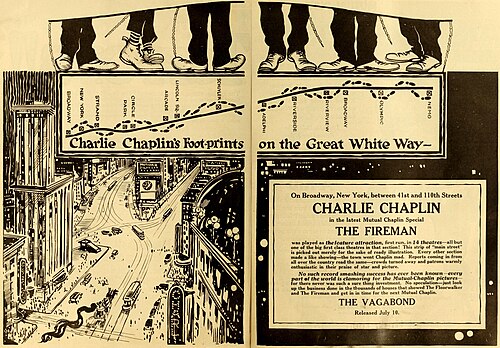
By 1916, Charlie Chaplin was, basically, the highest paid entertainer around, after he signed a contract with Mutual Film Corporation for $670,000 a year— which was almost not believable for the era, and it also handed him nearly total creative control over twelve, two-reel comedies. The Fireman , released on June 12, 1916 , was the second one of that set, and it’s a really interesting snapshot of Chaplin, still sort of working out what “full creative control” should even mean in practice: there’s a film here built mostly on slapstick procedure— reversed film stock, a coffee machine that is dressed up as a fire hose, and a frankly outrageous amount of what biographer John McCabe called “arse-kicking,” rather than the emotional depth that would start to show up, soon, in his best work.
It also features a detail modern audiences tend to find genuinely delightful: Lloyd Bacon, cast here as the scheming father trying to burn down his own house for the insurance money, would go on within two decades to direct 42nd Street (1933) and become one of the most reliable studio directors of Hollywood’s golden age. Chaplin shot much of the film at a real, working Los Angeles fire station, and reportedly got the entire idea simply from walking past it on his way to the studio. It’s in the public domain, and you can watch it free right now.
The Fireman 1916 — Movie Overview Table
| Detail | Information |
|---|---|
| Title | The Fireman |
| Release Year | 1916 (released June 12, 1916) |
| Country | United States |
| Runtime | 24–32 minutes (sources vary; two-reel short) |
| Genre | Silent Comedy, Slapstick |
| Language | Silent, English intertitles |
| Format | Black & White |
| Director | Charlie Chaplin (Edward Brewer, technical director) |
| Screenplay | Charlie Chaplin, Vincent Bryan, Maverick Terrell |
| Cinematography | William C. Foster, Roland Totheroh |
| Film Editing | Charlie Chaplin |
| Producer | Henry P. Caulfield |
| Distributor | Mutual Film Corporation |
| Series | Second of twelve “Mutual Comedies” (1916–1917) |
| Contract Value | Chaplin’s Mutual deal was reportedly worth $670,000 a year, making him the highest-paid entertainer in the world at the time |
| 1932 Sound Reissue | Re-released by RKO Radio Pictures with added music and effects after Van Beuren Studios purchased the Mutual comedies |
| IMDb Rating | 6.9/10 |
| Public Domain | Yes — freely available to watch and download |
Full Cast Table — Charlie Chaplin’s “The Fireman” (1916)
| Actor | Role |
|---|---|
| Charlie Chaplin | Fireman |
| Edna Purviance | Girl (the daughter) |
| Lloyd Bacon | Her Father |
| Eric Campbell | Foreman of the Brigade / Fire Chief |
| Leo White | Owner of Burning House |
| Albert Austin | Fireman |
| John Rand | Fireman |
| James T. Kelley | Fireman |
| Frank J. Coleman | Fireman |
| Charlotte Mineau | (uncredited) |
Lloyd Bacon — The Insurance Schemer Who Became a Hollywood Studio Director
One of the more entertaining footnotes attached to The Fireman is the later career of Lloyd Bacon, cast here as the greedy father plotting to burn down his own home. Bacon would go on to become one of the most prolific and reliably dependable directors of the studio era, eventually helming 42nd Street (1933) for Warner Bros. — a kind of defining film of the whole backstage musical genre — along with dozens of other features across a career that kept rolling into the 1950s.
In 1916, though, Bacon was still just part of Chaplin’s regular stock company at Mutual, working alongside the film’s other recurring folks: Edna Purviance, who showed up in nearly every Chaplin picture of this period as his main partner in scenes, and Eric Campbell, the towering Scottish actor, whose imposing physical presence made him the most fitting comic adversary for Chaplin’s little Tramp across a string of Mutual shorts. It’s a small, pleasant piece of trivia — watching a future A-list studio director play second fiddle to a fire hose gag — but it’s exactly the kind of detail that rewards revisiting these shorts a century later.
Filmed at a Real Fire Station — Chaplin’s Inspiration and Production Details
According to Chaplin biographer John McCabe, the idea for The Fireman came from something almost embarrassingly simple: Chaplin walked past a real Los Angeles fire station near the Mutual studio one day, and the premise followed from there. The production backs up the anecdote with unusually high effort for a two-reeler — the film was shot partly at an actual working fire station, and in a detail that speaks to just how much money and latitude Chaplin now had under his Mutual deal, the production reportedly burned two condemned houses to give the fire sequences real authenticity rather than relying on painted sets or miniature effects.
The film is also a showcase for the technical tricks Chaplin was experimenting with at this stage of his career. Cinematographers William Foster and Roland Totheroh cranked their cameras in reverse for several sequences — Chaplin sliding backward up the fire pole, horses appearing to gallop in reverse, the entire fire brigade racing backward into the station — while Chaplin staged the physical action to match, an early and genuinely clever use of a camera trick that still reads as funny generations later. One retrospective review also notes a smaller, purely visual gag that’s stuck with viewers: the station’s massive water tank doubling, quite literally, as the crew’s coffee and cream dispenser.
Full Plot Summary — Charlie Chaplin’s “The Fireman” (1916)
Charlie plays a hapless, chronically incompetent member of the brigade at Firehouse 23, introduced fast asleep through a whistle call and a fire bell that every other fireman responds to instantly. The film’s opening stretch is essentially a workplace comedy: Charlie mistakes a routine drill bell for an actual fire alarm and single-handedly drives the horse-drawn fire engine out into the street alone, realizes his mistake, and simply backs the entire engine — horses and all — into the station in reverse, thanks to the production’s clever use of reversed film.
The Insurance Scheme
Meanwhile, a wealthy man (Lloyd Bacon) approaches the fire chief (Eric Campbell) with a proposal: if a fire happens to break out at his house, the brigade should simply look the other way, allowing the house to burn so the man can collect on the insurance policy. The chief agrees to the scheme, unaware — or unconcerned — that the man’s daughter (Edna Purviance) isn’t actually clear of the house when the “accidental” fire is meant to happen.
More Read
A Real Fire and an Ignored Warning
Before the scheme can even play out as planned, an entirely unrelated, genuine fire breaks out elsewhere in town. A resident of the burning building desperately tries to alert the firehouse — first triggering the fire alarm, then telephoning the station directly, and finally rushing there in person — and is ignored at every turn by the distracted, disorganized brigade. It’s only Charlie who finally gets the message through to the chief, prompting the company to scramble out and fight the actual blaze.
The insurance scheme collapses into real danger when the father realizes, too late, that his own daughter is still trapped inside his burning house — the very fire he’d arranged to have ignored. Charlie, the film’s least competent fireman for its entire runtime up to this point, becomes its hero in the final stretch, scaling the outside of the burning building by hand to rescue the girl, delivering the rescue-and-redemption beat that Chaplin’s early shorts reliably built toward.
The 1932 Sound Reissue — A Legal Gray Area Chaplin Couldn’t Stop
In 1932, Van Beuren Studios sort of purchased the rights to Chaplin’s Mutual comedies, supposedly for something like $10,000 each, then tacked on a fresh musical score by Gene Rodemich and Winston Sharples, plus synchronized sound effects and after that they re-released the shorts through RKO Radio Pictures as if they were sound-era product. Chaplin, however, had no continued creative involvement in the reissue and no real legal way to block it, yet he still saw his decade-and-a-half old silent comedies get repackaged for a new crowd, without his input. It’s one of those odd, mostly forgotten little footnotes in the business story of one of cinema’s most carefully self-managed careers.
Where to Watch Charlie Chaplin’s “The Fireman” (1916) Free Online
The Fireman is in the public domain and legally available across multiple platforms at no cost.
| Platform | Format | Cost |
|---|---|---|
| Internet Archive | Stream + Download (multiple formats) | Free |
| YouTube | Stream | Free |
| Public Domain Movies | Stream | Free |
Charlie Chaplin’s “The Fireman” (1916) on Internet Archive:
Is Charlie Chaplin’s “The Fireman” (1916) in the Public Domain?
Yes. The Fireman is in the public domain in the United States. Like the rest of Chaplin’s Mutual comedies, its copyright has long since lapsed, meaning you can legally stream, download, share, and screen it without restriction or cost.
Critical Reception — Then and Now
The film manages a 6.9 out of 10 on IMDb, which is pretty respectable, yet the critical vibe around The Fireman is more split than you’d normally see with most Chaplin shorts from this same period. One fan-run review page really leaned into it and said it was “easily the weakest of Chaplin’s Mutual shorts,” basically claiming that its thick reliance on what biographer John McCabe calls “arse-kicking” humor suggests Chaplin was coasting, not pushing new angles. They also argue that putting the beloved “Charlie” persona into the role of genuinely incompetent harms the character’s usual ingenuity, and kind of goes against what usually makes him so resourceful.
Other assessments are considerably warmer. One retrospective called it “another excellent and very elaborately staged comedy” from Chaplin’s Mutual period, praising the reversed-film gags specifically as some of the funniest material in the picture. A viewer encountering Chaplin for the first time through this very short described it as “unexpectedly funny,” even while finding the film’s physical comedy a bit repetitive by the end. That split is fairly representative of the short’s reputation as a whole: solidly crafted, technically inventive, but generally ranked below the emotional highs of later Chaplin work like The Vagabond or Easy Street, both released the same year.
Frequently Asked Questions — The Fireman 1916
Q: What is Charlie Chaplin’s The Fireman (1916) about?
Charlie plays an incompetent fireman at Firehouse 23. A wealthy man arranges with the fire chief to let his own house burn down for the insurance money, unaware his daughter is trapped inside when the fire actually starts. Charlie, despite his bumbling throughout the film, becomes the hero who climbs the burning building to save her.
Q: Is The Fireman (1916) in the public domain?
Yes. The Fireman is in the public domain in the United States and is freely available on the Internet Archive, YouTube, and other public domain film platforms.
Q: Who stars in The Fireman?
Charlie Chaplin stars as the fireman, with Edna Purviance as the daughter, Lloyd Bacon as her father, and Eric Campbell as the fire chief. Bacon later became a major Hollywood director, best known for 42nd Street (1933).
Q: Was The Fireman part of a series?
Yes. The Fireman was the second of twelve short comedies Chaplin made for Mutual Film Corporation between 1916 and 1917, under a contract reportedly worth $670,000 a year that made him the highest-paid entertainer in the world at the time.
Q: Where was The Fireman filmed?
The film was shot partly at a real, working Los Angeles fire station. According to biographer John McCabe, Chaplin got the idea for the film simply from walking past the station near the Mutual studio.
Q: How long is The Fireman?
Sources list the running time between approximately 24 and 32 minutes, as it was released as a two-reel short comedy.
Q: Was The Fireman re-released with sound?
Yes. In 1932, Van Beuren Studios purchased Chaplin’s Mutual comedies and re-released them through RKO Radio Pictures with added music and sound effects. Chaplin had no legal recourse to stop this release.
Q: What did critics say about The Fireman?
Reviews are notably divided for a Chaplin Mutual short. Some critics call it one of the weaker entries in the series due to its reliance on repetitive physical comedy, while others praise its elaborate staging and clever use of reversed film for comic effect.
Q: Where can I watch The Fireman (1916) for free?
The Fireman is freely available on the Internet Archive, YouTube, and Public Domain Movies. All versions are legal to stream and download under public domain status.
Related Free Classic Silent Comedy Films
If The Fireman (1916) drew you into Charlie Chaplin’s Mutual comedies or silent-era slapstick generally, these are the natural titles to explore next:
- Public Domain Cartoons
- His Double Life (1933) Full Movie Review, Plot, Cast & Free Comedy-Drama Classic
- Public Domain Movies List – All Free Classic Films (Complete Guide)
Movie Tags
The Fireman 1916, Charlie Chaplin The Fireman, watch The Fireman free, The Fireman public domain, Charlie Chaplin Mutual comedies, Chaplin silent film short, Edna Purviance actress, Lloyd Bacon director, Lloyd Bacon actor 42nd Street, Eric Campbell actor, Chaplin Mutual Film contract, silent comedy 1916, insurance fraud comedy film, reversed film comedy technique, free classic silent film online, Chaplin fireman short film, Mutual Film Corporation 1916