

The girl in the background of the opening scene of His New Job is not quite sixteen years old. She is sitting at a desk, playing a stenographer, uncredited. She had auditioned for the actual female lead, been turned down — she later admitted she found slapstick comedy tedious and had been deliberately uncooperative in the audition — and was given the background role instead. Her name at the time was Gloria Svensson. She would rename herself Gloria Swanson. Thirty-five years later, as Norma Desmond in Billy Wilder’s Sunset Boulevard (1950), she would perform a silent film impression sequence in which she imitated the very style of the man who’d put her in the background of this short.
The man who couldn’t find a use for her in 1915 had, by 1950, become the archetype she was parodying to define the most famous role of her career. That backstory alone is worth the thirty minutes the film runs. The rest of the film — Charlie Chaplin’s first picture for Essanay Studios, shot in Chicago in January 1915, and the only film he’d ever shoot there — also inaugurates the forty-year working relationship between Chaplin and cinematographer Rollie Totheroh, and contains a pun on the name of Chaplin’s previous employer that is both the entire joke of the title and somehow also funnier for requiring explanation. It is in the public domain. It runs about thirty minutes. The straight-leg kick at the end is genuine comedy gold.
His New Job 1915 — Film Overview Table
| Detail | Information |
|---|---|
| Title | His New Job |
| Release Date | February 1, 1915 |
| Country | United States |
| Runtime | ~30 minutes |
| Genre | Silent Comedy Short, Film-within-a-Film |
| Language | Silent (intertitles) |
| Format | Black & White, Silent |
| Written, Directed, Starring | Charlie Chaplin |
| Chaplin’s Film Number | 36th film; 1st Essanay film |
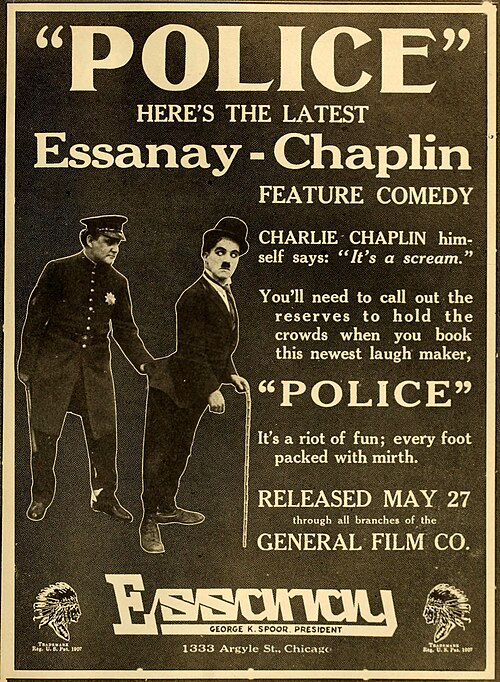
| Studio | Essanay Film Manufacturing Company (“S” and “A” = George Spoor + Gilbert M. Anderson) |
| Filming Location | Essanay Studios, 1333-1345 W. Argyle Street, Chicago (now St. Augustine College) |
| Filming Dates | January 1915 (dead of winter) |
| Only Film at Chicago Studio | Yes — Chaplin relocated to California immediately after |
| Cinematographer | Rollie Totheroh (first film; 40-year working association with Chaplin begins here) |
| Chaplin Salary at Keystone | ~$150–175/week |
| Chaplin Salary at Essanay | $1,250/week |
| First Screen Credit | Yes — first film where Chaplin’s name appeared in the opening credits |
| Preservation | George Eastman House |
| IMDb Rating | 6.0/10 |
| Public Domain | Yes — freely available to watch and download |
Full Cast Table — His New Job (1915)
| Actor | Role |
|---|---|
| Charlie Chaplin | Film Extra |
| Ben Turpin | Film Extra (appears in the afternoon section) |
| Charlotte Mineau | Film Extra |
| Leo White | Actor — Hussar Officer |
| Robert Bolder | Studio President |
| Charles J. Stine | Director |
| Arthur W. Bates | Carpenter |
| Jess Robbins | Cameraman |
| Agnes Ayres | Supporting |
| Gloria Swanson | Stenographer (uncredited extra; future star of Sunset Boulevard) |
Why Chaplin Left Keystone and What Essanay Offered
By the end of 1914, Charlie Chaplin had made over thirty films in a single year for Keystone and become, in the process, the most popular screen comedian in America. Keystone responded by refusing to raise his salary from its existing rate of roughly $150 per week — a calculation that reflected Mack Sennett’s genuine belief that no individual performer was bigger than the studio system producing them. He was wrong. A bidding war ensued among studios eager to steal the thing Sennett wouldn’t pay for.
The Essanay Film Manufacturing Company won the bid at $1,250 per week. The studio took its name from its two founders’ initials: “S” for George Spoor and “A” for Gilbert M. Anderson — better known to audiences as “Broncho Billy,” the first major cowboy film star. Both were film industry pioneers who understood exactly what Chaplin’s popularity was worth. The salary jump — from $150 to $1,250 — represented more than money. It represented the beginning of Chaplin’s recognition that his own name was the most valuable asset in any studio deal he made.
Beyond the money, Essanay offered something Keystone had resisted: genuine creative control. At Keystone, Chaplin had fought continuously against Sennett’s preference for speed and chaos over character and craft. At Essanay, he was given time, authority over his own scripts, and the space to develop the more emotionally nuanced version of the Tramp that would define his peak years. His New Job is the first evidence of that space — a film that begins in a recognizable real-world setting rather than the pure slapstick chaos of Keystone’s world, allowing Chaplin to establish the Tramp against a backdrop of more normal human behavior before the destruction begins.
The Title as Joke, Self-Reference, and Parting Shot
The title His New Job operates on three levels simultaneously, which is either too clever for a comedy short or exactly right for one, depending on your disposition.
Level one: the obvious self-reference. Chaplin himself has a new job at Essanay. The film is about a man starting a new job. These are the same thing. Level two: the Keystone parody. Keystone had a consistent habit of titling its Chaplin shorts with the possessive construction — His Musical Career, His Recreation, His Prehistoric Past, and so forth. Chaplin’s Essanay debut title mimics that naming convention precisely — and was, as reviewers have noted, the last “His” titled film in Chaplin’s entire career. Level three: the in-joke visible on screen. The fictional studio in the film where Charlie gets hired is called “Lockstone” — a direct parody of “Keystone,” the employer he’d just left. The film is, in the words of one reviewer, “a sort of nose-thumbing to his former employer” dressed up as a comedy short. All three levels operate quietly, without being announced, which is the appropriate way to deliver a joke this layered.
Full Plot Summary — His New Job (1915)
Charlie arrives at the offices of the Lodestone Motion Picture Company — note the subtle variation from “Lockstone” to “Lodestone” in different sources, either an inconsistency in the intertitles or a deliberate slight variation — seeking work as a film extra. He sits in the audition queue. The girl next to him is immediately given a contract. A strange-looking man enters and tries to jump the queue. Another man enters and they fight over who is next. Charlie manages to walk onto the film set twice while they are still shooting, which the director finds, understandably, impractical.
Reassigned to work with the carpenter, Charlie wanders into the props room and becomes fixated on a classical female statue. He causes sufficient disruption as a carpenter’s assistant that he is eventually pulled from that role as well and given a chance to act when the scheduled performer doesn’t arrive on time. While waiting for this opportunity, he finds a seltzer bottle and a dice game, both of which generate the predictable consequences.
The Acting Sequence — Systematic Destruction
When Charlie finally gets his chance on camera, what follows is a methodical demolition. He ruins his scene with the veteran actor playing the Hussar Officer, accidentally destroys significant portions of the set through a combination of misplaced energy and misused props, gets people stuck with swords, hits people with mallets, and tears the skirt of the film’s female star. One IMDb review notes, with appropriate awe, that at one point Chaplin appears to be attempting to saw someone’s posterior off.
Ben Turpin — cross-eyed comedian and Essanay’s primary funny man before Chaplin’s arrival — makes his first appearance with Chaplin in the afternoon section of the film. The dynamic between Turpin’s cross-eyed mugging and Chaplin’s more precise physical control is the film’s most interesting comic pairing: two genuinely different comedic styles briefly sharing the same frame. The film ends with the straight-leg kick that multiple reviewers across a century have identified as the sequence’s comic peak.
Rollie Totheroh — Forty Years of Collaboration Begin in January 1915
Rollie Totheroh photographed His New Job — his first film with Chaplin and the beginning of one of the longest and most fruitful director-cinematographer partnerships in Hollywood history. Totheroh would go on to photograph virtually every Chaplin film through the 1940s: The Vagabond, Easy Street, The Immigrant, A Dog’s Life, Shoulder Arms, The Pilgrim, The Gold Rush, The Circus, City Lights, Modern Times, The Great Dictator. The visual language of Chaplin’s greatest films runs through Totheroh’s eye.
The relationship began, as so many significant collaborations do, without anyone recognizing it as such. Totheroh was Essanay’s staff cameraman assigned to the production. Chaplin was new to the studio. A specific technical and personal rapport developed across the filming of His New Job that proved durable enough to survive Chaplin’s move away from Essanay, his subsequent studios, and four decades of film production. The specific visual quality that defines the Chaplin canon — the medium-shot framing that keeps the full body in frame to capture every nuance of physical performance, the patient camera that lets the gag build rather than cutting for emphasis — was developed, refined, and maintained across that entire partnership. It begins here, in a Chicago studio in January 1915.
Gloria Swanson — The Fifteen-Year-Old Extra Who Hated Slapstick
Gloria Svensson — not yet Swanson, not yet famous, sixteen years from Sunset Boulevard — had come to the Essanay lot on W. Argyle Street in 1914 with her aunt Inga, who was friends with studio co-founder George Spoor. A director spotted her on the lot and expanded a crowd scene into something larger; Essanay hired her as a stock player at $3.25 a week. When Chaplin arrived at the end of 1914 and began preparing His New Job, she auditioned for the actual female lead.
She didn’t get it. She later admitted she had been deliberately uncooperative in the audition because she found slapstick comedy tedious. Chaplin, for his part, felt she wasn’t right for the role. The result was a background position as a stenographer in the opening office scene — uncredited, barely visible, easy to miss. Multiple sources note that after filming, Chaplin and Swanson would occasionally drink together at the Green Mill Gardens on Broadway and Lawrence Avenue, a venue that later became the Green Mill Lounge and still exists.
The resonance that Swanson’s appearance here carries is almost entirely retrospective. His New Job is the beginning of Chaplin’s Essanay year and the very first professional screen work of a woman who would become one of silent cinema’s defining stars. Both of them, at this moment, are in Chicago in January 1915, neither quite knowing what comes next. Thirty-five years later, Swanson’s Norma Desmond in Sunset Boulevard performs a sequence imitating the style of silent film comedians — a performance that multiple film historians read as a specific, intentional echo of the Chaplin she’d known at this precise moment in both their careers.
The Tramp Costume Rebuilt on State Street
When Chaplin left Keystone, the studio kept the Tramp’s wardrobe — the outfit that had originated with Chaplin but had been paid for by Sennett’s money was Keystone’s property, not Chaplin’s. Arriving in Chicago to begin production, he had to recreate his own character costume from scratch. He walked up and down State Street buying the component pieces: baggy trousers, tight jacket, derby hat. His biggest problem, according to the account left by the Chaplin Film by Film website, was finding the right pair of oversized shoes to replicate the distinctive walk. This was the first time the Tramp’s costume was Chaplin’s own property rather than his employer’s.
This was also the first film where Chaplin’s name appeared in the opening credits. At Keystone, he had received no screen credit at all — his name would be added to reissues later, but the original releases identified him only by character or role. The credit that appears at the opening of His New Job is, in a small but genuine way, Chaplin asserting ownership of the identity he’d spent a year building at someone else’s studio.
Chaplin in Chicago — The January 1915 That Lasted One Film
Chaplin lived at the Brewster Apartments at Diversey Parkway and Pine Grove while shooting at Essanay’s Chicago studio. The studio itself was at 1333-1345 W. Argyle Street — the building still stands and is now part of St. Augustine College. He reportedly broke the ice with his new Chicago colleagues by performing an outlandish clog dance in full Tramp costume, recalling his days performing as one of the Lancashire Lads on the British music hall stage.
He hated the weather. January in Chicago, when His New Job was filmed, provided conditions that a man who’d spent the previous year in Southern California found entirely objectionable. The accounts of Chaplin’s departure from Essanay’s Chicago studio — whether driven primarily by weather or by the additional factor of the creative constraints the Chicago operation imposed — converge on the same conclusion: he never came back. All subsequent Essanay films were made in California. The studio that had just paid $1,250 per week to bring Chaplin to Chicago found that keeping him there was not part of the negotiation they’d actually won.
Where to Watch His New Job (1915) Free Online
His New Job is in the public domain and legally available across multiple platforms at no cost. A print is preserved at the George Eastman House.
| Platform | Format | Cost |
|---|---|---|
| Internet Archive | Stream + Download (multiple formats) | Free |
| YouTube | Stream (multiple uploads) | Free |
| Public Domain Movies | Stream | Free |
His New Job (1915) on Internet Archive:
Is His New Job (1915) in the Public Domain?
Yeah, “His New Job” (1915) is basically in the public domain in the United States. Like, all those pre 1928 American films where the copyrights weren’t renewed can be watched freely, and this one has been publicly accessible for years and years, probably for decades now. A print is preserved at the George Eastman House, confirming its archival status alongside its public availability.
Critical Reception — Then and Now
The film holds a 6.0 out of 10 on IMDb — a respectable score for a 30-minute silent short from 1915, and one that reflects the genuine division between viewers who find it an essential transitional document and those who find it slightly too long for its material. A reviewer for the trade publication Biograph in 1915 wrote: “There is probably no film comedian in the world more popular with the average picture theater audience than that famous fun-maker Charles Chaplin, whose services have recently been secured by the Essanay Company. The art of Charles Chaplin defies analysis and disarms the critic. Just why he is so funny, it is almost impossible to say, and very probably he could not tell you himself.”
Modern assessment positions the film correctly as transitional: better than the average Keystone short in terms of character development, not yet the Chaplin of The Immigrant or Easy Street — which are less than two years away from this production. One Letterboxd review notes the film “started to drag a bit” in the middle, finding it “about ten minutes too long,” before identifying the ending as genuinely saving the film. Another captures the surprise that defines the film’s current appeal: “The most surprising part of this entire film is Gloria Swanson as an uncredited background role. The very same Gloria Swanson who would later give one of the most iconic performances of all time as Norma Desmond in Sunset Boulevard. It’s astonishing to just stumble upon an incredible moment in time like this.”
That reaction — the specific vertigo of recognizing a future great in the background of someone else’s film, before either person’s future is legible — is what makes His New Job most rewarding in 2025. Not as a comedy landmark, but as a document of a specific January morning in 1915 at a Chicago studio, when at least three trajectories that would define twentieth-century cinema were all in the same room at the same time: Chaplin beginning his Essanay year, Totheroh beginning his forty-year partnership, and a sixteen-year-old who hated slapstick sitting at a stenographer’s desk in the background, waiting for her own story to begin.
Frequently Asked Questions — His New Job 1915
Q: What is His New Job (1915) about?
Charlie Chaplin plays a job-seeker at a film studio who gets hired as a film extra and causes systematic destruction — first as a carpenter’s assistant, then as an unexpected replacement actor. He ruins the scene, destroys the set, and tears the female star’s skirt. The fictional studio is called ‘Lockstone’ — a direct parody of Chaplin’s previous employer, Keystone Studios.
Q: Is His New Job (1915) in the public domain?
Yes. His New Job is in the public domain in the United States. It is freely available on the Internet Archive, YouTube, and Public Domain Movies. A preservation print is held at the George Eastman House.
Q: Was this really Gloria Swanson’s first film?
Yes — His New Job is the first film in which Gloria Swanson appears, playing an uncredited stenographer in the opening office scene. She was not quite 16 years old. She had auditioned for the actual female lead but Chaplin passed on her; she later admitted she had been deliberately uncooperative because she disliked slapstick comedy.
Q: Why did Chaplin leave Keystone for Essanay?
Keystone refused to raise Chaplin’s salary from approximately $150 per week despite his growing popularity. Essanay offered $1,250 per week — more than eight times his Keystone rate. Essanay also offered more creative control over his own films, which mattered as much to Chaplin as the money.
Q: What is the significance of the title His New Job?
The title operates on three levels: a literal reference to Chaplin’s own new job at Essanay; a parody of Keystone’s naming convention for Chaplin’s shorts (His Musical Career, His Prehistoric Past, etc.); and a set-up for the ‘Lockstone’ joke within the film, which is a direct parody of Keystone. It was also the last ‘His’ titled film Chaplin ever made.
Q: Who was Rollie Totheroh and why does this film matter to his career?
Rollie Totheroh was the cinematographer who photographed His New Job — his first film with Chaplin, beginning a 40-year working partnership. Totheroh went on to photograph virtually every major Chaplin film including The Gold Rush, City Lights, Modern Times, and The Great Dictator. The visual language of the classic Chaplin canon runs through the partnership that started with this short.
Q: Was His New Job Charlie Chaplin’s first film where he received screen credit?
Yes. At Keystone, Chaplin received no opening screen credit on original releases (credits were added to later reissues). His New Job is the first film where his name appeared in the opening credits — the beginning of Chaplin’s recognition as a named star rather than an anonymous performer.
Q: Why did Chaplin only make one film in Chicago?
He hated the weather. His New Job was filmed in the dead of winter in January 1915, and Chaplin found Chicago’s cold objectionable enough to relocate all subsequent Essanay productions to California. He never made another film at Essanay’s Chicago studio.
Q: Is Ben Turpin in His New Job?
Yes. Ben Turpin — Essanay’s resident comedian before Chaplin’s arrival — makes his first appearance with Chaplin in the afternoon section of the film. His New Job marks the beginning of their occasional collaborative appearances during Chaplin’s Essanay year.
Q: Where can I watch His New Job (1915) for free?
His New Job is freely available on the Internet Archive, YouTube, and Public Domain Movies. All versions are legal to stream and download under public domain status.
Related Free Classic Silent Films
If His New Job (1915) drew you into Chaplin’s early career and classic silent comedy, these are the natural titles to explore next:
- Public Domain Cartoons
- Public Domain Horror Movies – Free Classic Scary Films Online
- Borderline (1950) Full Movie Review, Plot, Cast & Free Film Noir Crime Classi
- Public Domain Movies List – All Free Classic Films (Complete Guide)
Movie Tags
His New Job 1915, His New Job Chaplin full film, watch His New Job free, His New Job public domain, Charlie Chaplin Essanay Studios, Charlie Chaplin first Essanay film, Charlie Chaplin Chicago filming, Gloria Swanson first film debut, Gloria Swanson Sunset Boulevard connection, Rollie Totheroh cinematographer, Ben Turpin Chaplin film, Essanay Film Manufacturing Company, Keystone to Essanay Chaplin salary, Lockstone parody Keystone, 1915 silent comedy short, Chaplin Chicago studio Argyle Street, Green Mill Gardens Chicago, Charlie Chaplin screen credit first film, silent film studio satire, free classic Chaplin silent film online