
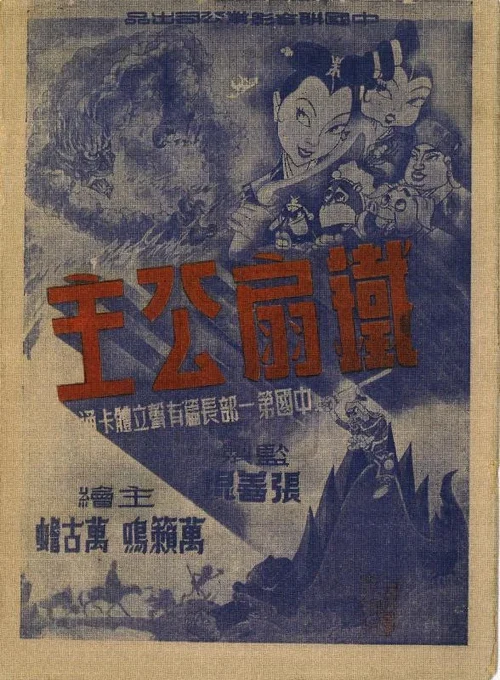
Shanghai, 1941: Japanese forces ringed the city’s foreign enclaves, and film stock was getting scarce. Inside the so-called Orphan Island, two twin brothers finished China’s first animated feature, a Monkey King adventure that took nearly three years to draw. Within a year, Princess Iron Fan had crossed the sea to Japan, where a 16-year-old named Osamu Tezuka watched it and, by most accounts, decided what to do with his life.
Tezuka went on to create Astro Boy. The Japanese Navy, meanwhile, was reportedly so struck by the film that it commissioned Japan’s own first animated feature, Momotaro’s Divine Sea Warriors (1945). The Wan brothers built Princess Iron Fan by studying Disney’s Snow White closely, yet its Chinese flavor is unmistakable. Chinese copyright on the film expired in 1991, and you can watch it free right now, with English subtitles.
Princess Iron Fan 1941 — Movie Overview Table
| Detail | Information |
|---|---|
| Title | Princess Iron Fan (鐵扇公主 / 铁扇公主, Tiě shàn gōngzhǔ) |
| Release Year | 1941 (Shanghai premiere, November 19, 1941) |
| Country | China |
| Runtime | 72–73 minutes |
| Genre | Animation, Fantasy, Adventure, Musical |
| Language | Mandarin Chinese (English subtitles available) |
| Format | Black & White, Animated |
| Directors | Wan Guchan and Wan Laiming (the Wan brothers) |
| Screenplay | Wang Qianbai |
| Based On | An episode from Journey to the West (16th-century Chinese novel) |
| Producer | Zhang Shankun (S.K. Chang), with the Wan brothers |
| Music | Lu Chongren |
| Production Company | Xinhua Film Company |
| Distributor | China United Film Company |
| Significance | First animated feature film made in China, and widely cited as the first in Asia |
| Public Domain | Yes — Chinese copyright expired in 1991; freely available to watch and download |
Voice Cast Table — Princess Iron Fan (1941)
| Voice Actor | Role |
|---|---|
| Bai Hong (白虹) | Princess Iron Fan |
| Han Langen (韩兰根) | Sun Wukong, the Monkey King |
| Yin Xiucen (殷秀岑) | Zhu Bajie (Pigsy) |
| Jiang Ming (姜明) | Tang Monk (Tripitaka) |
| Ge Furong | Sha Wujing (Sandy) |
| Yan Yueling (严月玲) | Voice cast (role not confirmed) |
| Wan Laiming, Wan Dihuan, and others | Additional voices |
Orphan Island Shanghai — The Wan Brothers’ Failed First Attempt
Twins Wan Laiming and Wan Guchan (both born in 1900) had animated since the 1920s, alongside their brothers Wan Chaochen and Wan Dihuan. The 1937 Battle of Shanghai scattered the family. The brothers made anti-Japanese animated shorts in Wuhan and Chongqing, then slipped back to Shanghai in fall 1939.
Disney’s Snow White (1937) convinced them a full-length cartoon could work. In March 1940 they recruited trainee artists for an animated Uproar in Heaven, backed by a cloth manufacturer. Then film stock prices climbed, the investors lost interest, and the project collapsed with more than 600 painted stills lost.
Xinhua Film Company rescued them. Producer Zhang Shankun had a script for Princess Iron Fan ready and set up an animation department with Wan Guchan as its head. His studio built a workspace for about 300 workers, and some 500 people applied for the first round of trainee jobs. One scholar notes that Wan Guchan later recalled the project as a collaboration, with the studio choosing the story before the brothers joined.
Learning from Snow White — Rotoscoping, Clay Models, and a Chinese Princess
The Wan brothers copied Disney’s workflow almost step by step. Live actors performed the action first, and the animators used that footage as a guide, a technique now called rotoscoping. Sculptors made a model of every character so the trainees could draw each one consistently from any angle.
The method saved money, but it left traces: viewers often spot the eyes of the live performers inside the animated faces. The film’s title character also nods to Disney, since Chinese audiences knew Snow White as “Princess Snow White.” Yet the story, the songs, and above all the Monkey King’s cheeky personality are unmistakably Chinese.
According to a film magazine of the time, 200–300 technicians worked for nearly three years. Often-cited production figures include 237 artists and 350,000 yuan, but those numbers vary by source. The finished picture premiered at the Metropol and Astor cinemas in Shanghai on November 19, 1941, and other theaters rushed to book it.

Full Plot Summary — Princess Iron Fan (1941)
The Tang Monk and his three disciples, Sun Wukong the Monkey King, Zhu Bajie (Pigsy), and Sha Wujing (Sandy), reach the Flaming Mountain on their pilgrimage west. Fire blocks the road, and a nearby village is suffering. A villager tells them only one thing can put out the flames: the magic palm-leaf fan of Princess Iron Fan.
A Princess Who Won’t Lend Her Fan
Princess Iron Fan has no reason to help. She is married to the Bull Demon King, and the pilgrims have already offended her family. When Wukong asks politely, she refuses.
The Monkey King turns himself into a tiny insect, slips inside her, and threatens her from within until she hands over a fan. It is a fake, and it makes the fire worse.
Disguises, Double-Crosses, and a Village United
Pigsy takes his turn and disguises himself as the Bull Demon King to steal the real fan. The Bull Demon King then disguises himself as Wukong, tricks Pigsy into giving it back, and the fighting escalates. The film’s hero cannot beat the monster alone.
With help from the villagers, the pilgrims finally subdue the Bull Demon King, take the fan, and put out the fire. They then continue their journey west.
A Wartime Allegory — Why the Villagers Matter
Film historians often read the story as a thinly veiled commentary on China’s war with Japan. Scholars point to two choices that depart from the novel. In the film, the pilgrims fail at first because of quarrels among themselves, and the heavenly help they receive in the novel is replaced by ordinary villagers joining the fight.
In that reading, the Monkey King’s victory with the villagers’ help mirrors a collective Chinese resistance against a larger invader. It’s an interpretation rather than something the film states, but it fits the circumstances: the Wan brothers made the film under Japanese pressure, and Wan Guchan later described their next project as even more openly anti-Japanese.
From Shanghai to Tezuka — The Film That Reached Japan
Princess Iron Fan was exported to Japan in the early 1940s, and its impact there far outlasted the war. The 16-year-old Osamu Tezuka reportedly left medical studies behind to pursue comics and animation after seeing it. He later created Astro Boy, and in 1980 he traveled to China to visit Wan Laiming in person.
The film also pushed Japan’s military toward animation. The Imperial Japanese Navy’s commission of Momotaro’s Divine Sea Warriors (1945) is often traced back to it. Sources disagree on one detail: some say Japan’s military banned the film from being shown there, and others describe its wide influence on Japanese animators.
The Sequel That Never Got Made
The film’s success earned the Wan brothers a chance at a follow-up. They put out an open call for stories and settled on The World of Insects, with a locust army meant to stand in for Japan’s military. They expected to finish within six months.
Then the Pacific War broke out, and Japanese forces occupied Shanghai’s International Settlement. The brothers destroyed the storyboards to avoid trouble, and Xinhua’s animation department was disbanded. Chinese animated features would not return for years, and the Wans regarded their inability to build on Princess Iron Fan as one of their biggest regrets.
Where to Watch Princess Iron Fan (1941) Free Online
Princess Iron Fan is widely available at no cost. Several versions circulate, and some carry fan-made subtitles in English, Chinese, Czech, and Russian. The University of British Columbia’s Chinese Film Classics project also hosts the film with English subtitles by scholar Christopher Rea.
| Platform | Format | Cost |
|---|---|---|
| Internet Archive | Stream + Download (multiple formats and subtitle files) | Free |
| Chinese Film Classics (UBC) | Stream (English subtitles) | Free |
| YouTube | Stream | Free |
Princess Iron Fan (1941) on Internet Archive:
Is Princess Iron Fan (1941) in the Public Domain?
Under Chinese law, which set a 50-year term, the film’s copyright expired in 1991, and it is widely treated as public domain and freely shared. The Internet Archive lists it for free viewing and download. If you plan to screen or redistribute it commercially, check the rules for your own country first, because copyright terms for foreign films vary.
Critical Reception — Then and Now
Chinese film historians treat Princess Iron Fan as the high point of the Wan brothers’ careers and of early Chinese animation. One recent retrospective calls it a peak that later films never surpassed. Critics also credit it with setting the Monkey King’s wit, humor, and power in a form later adaptations kept building on.
Modern reviewers find real laughs in the story, especially Pigsy’s disguise as the Bull Demon King and his boasting. They also point out the obvious Disney influence in the character movements and the rotoscoped faces. Some viewers find the pacing slow and the animation rough by later standards, which is understandable for a film built from scratch in a war zone.
Whatever you make of its craft, the film’s historical weight is hard to dispute. It was the first of its kind in China, it helped start Japan’s animation tradition, and it survived to be shared freely nearly a century later.
Frequently Asked Questions — Princess Iron Fan 1941
Q: What is Princess Iron Fan (1941) about?
The Monkey King and his fellow pilgrims reach the Flaming Mountain and learn that only Princess Iron Fan’s magic fan can put out the flames. When she refuses to lend it, they resort to disguises and tricks, and finally defeat the Bull Demon King with the help of the villagers.
Q: Why is Princess Iron Fan historically important?
It was the first animated feature film made in China, and it is widely cited as the first in Asia. It was made in wartime Shanghai by the Wan brothers.
Q: Who made Princess Iron Fan?
The film was directed by twin brothers Wan Guchan and Wan Laiming and produced with Zhang Shankun at Xinhua Film Company. The screenplay was written by Wang Qianbai.
Q: Is Princess Iron Fan in the public domain?
Under Chinese law, the film’s copyright expired in 1991, 50 years after its release, and it is widely available to watch and download for free, including on the Internet Archive.
Q: Is Princess Iron Fan based on a book?
Yes. The film is a loose adaptation of an episode from Journey to the West, the classic Chinese novel about the Monkey King and the monk Tripitaka.
Q: How did Princess Iron Fan influence Japanese animation?
It reached Japan in the early 1940s and reportedly inspired the teenage Osamu Tezuka to become a comics artist and animator. It is also often credited with prompting the Japanese Navy to commission Momotaro’s Divine Sea Warriors (1945).
Q: Was Princess Iron Fan inspired by Disney?
Yes. The Wan brothers were inspired by Disney’s Snow White and the Seven Dwarfs (1937) and borrowed its production methods, including using live-action reference footage for the animators. The film still has a distinct Chinese style.
Q: How long is Princess Iron Fan?
The film runs about 72 to 73 minutes, depending on the source and print.
Q: Where can I watch Princess Iron Fan (1941) for free?
The film is freely available on the Internet Archive, on YouTube, and through the University of British Columbia’s Chinese Film Classics project, which offers English subtitles.
Related Free Classic Animation and Adventure Films
If Princess Iron Fan (1941) pulled you into early animation and world cinema, these are the natural titles to explore next: