
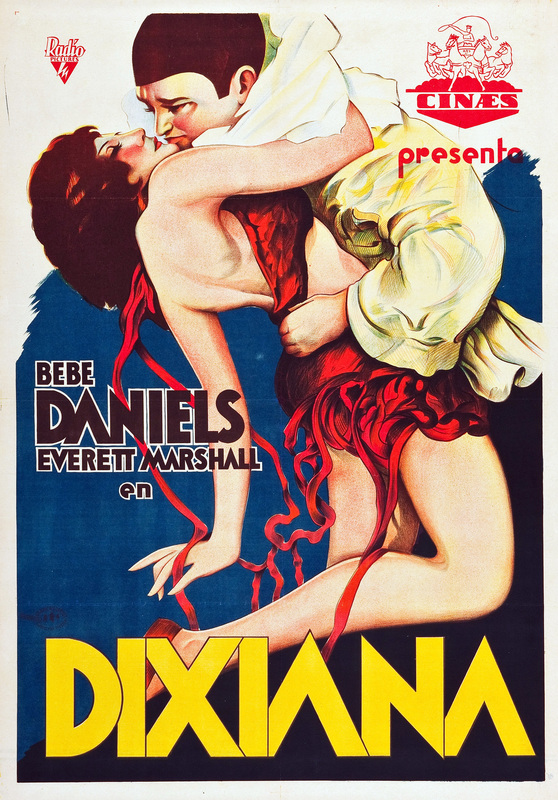
Bill Robinson was fifty-two years old when he made his film debut in Dixiana. He plays a specialty dancer — the role is small, the screen time is brief, and the New York Times reviewer singled him out anyway, noting that his tap dancing “won a genuine round of applause.” He would go on to make four films with Shirley Temple between 1935 and 1938 that made him one of the most recognisable entertainers in American cinema. None of that had happened yet. In 1930 he was a vaudeville star who had never been in a film, and Dixiana is where that changes.
The film around him is a more complicated thing. It was RKO’s attempt to repeat the commercial success of Rio Rita (1929) — same director, most of the same cast, a similar Southern-romantic framework, a Technicolor finale. It lost an estimated $300,000. The market for lavish movie musicals had peaked and collapsed faster than anyone in the industry had anticipated, and Dixiana arrived into that collapse at exactly the wrong moment. It also gave Max Steiner his first screen music credit, featured Wheeler and Woolsey in their third film before they were formally billed as a team, and contains a Technicolor third act that was considered lost for decades until its rediscovery in 1988.
Dixiana 1930 — Movie Overview Table
| Detail | Information |
|---|---|
| Title | Dixiana |
| Release Date | August 1, 1930 |
| Country | United States |
| Runtime | Approx. 100 minutes |
| Genre | Musical, Romantic Drama, Comedy |
| Language | English |
| Format | Black & White with Technicolor finale (final third) |
| Director / Screenplay | Luther Reed (adapted from a story by Anne Caldwell) |
| Production / Distribution | RKO Radio Pictures |
| Music | Max Steiner (first screen credit) |
| Technicolor Sequences | Considered lost for decades; rediscovered 1988 and restored for DVD release |
| Notable Firsts | Bill Robinson’s film debut; Max Steiner’s first screen credit |
| Wheeler & Woolsey | Their third film — not yet formally billed as a team |
| Box Office | Estimated loss of $300,000 — one of RKO’s biggest disappointments of 1930 |
| Public Domain | Yes — entered public domain in 1958; freely available to stream and download |
Full Cast — Dixiana (1930)
| Actor | Role |
|---|---|
| Bebe Daniels | Dixiana Caldwell |
| Everett Marshall | Carl Van Horn |
| Bert Wheeler | Peewee |
| Robert Woolsey | Ginger Dandy |
| Joseph Cawthorn | Cornelius Van Horn |
| Jobyna Howland | Birdie Van Horn |
| Dorothy Lee | Poppy |
| Ralf Harolde | Royal Montague |
| Bill Robinson | Specialty Dancer (film debut) |
| Eugene Jackson | Cupid |
| Eddy Chandler | Blondell |
| Raymond Maurel | Cayetano |
| George Herman | Contortionist |
| Bruce Covington | Company Porter |
RKO’s Attempt to Repeat Rio Rita — Why Dixiana Arrived at the Wrong Moment
Rio Rita (1929) was RKO’s most successful film of the year. It was a lavish musical adaptation of a Broadway hit, shot partly in Technicolor, and it demonstrated that the new sound technology could support not just dialogue pictures but full-scale musical entertainment. RKO’s response was entirely logical: reassemble the components and do it again. Same director in Luther Reed. Same general framework of romantic drama in a Southern setting. Similar deployment of Technicolor for the climactic sequences. A comparable budget and comparable promotional commitment.
What had changed, between Rio Rita‘s release in late 1929 and Dixiana‘s arrival in August 1930, was the market. The musical film had gone through a cycle of enormous popularity and almost equally rapid audience exhaustion in less than two years. Studios had produced musicals in such volume that audiences were visibly tiring of the form, and the films that had seemed innovative in 1929 looked formulaic by mid-1930. Dixiana was a well-constructed product of a formula that the audience had already moved past.
The $300,000 loss was one of the largest RKO absorbed that year, and it contributed to the studio’s decision to pull back sharply from the musical format for the next several years. The film is therefore a document of a specific industrial miscalculation — not a failure of craft exactly, but of timing, and timing in the film business is everything.
Full Plot Summary — Dixiana (1930)
Dixiana Caldwell (Bebe Daniels) is a circus performer in the Antebellum South, working alongside her friends Peewee (Bert Wheeler) and Ginger Dandy (Robert Woolsey). She falls in love with Carl Van Horn (Everett Marshall), the son of a wealthy plantation family, and leaves the circus to travel with him to his family’s estate. Peewee and Ginger follow along — which is both a source of comic relief and, eventually, the source of the plot’s central complication.
The Van Horn Plantation — Class, Scandal, and Disgrace
Carl’s father Cornelius and stepmother Birdie Van Horn (Joseph Cawthorn and Jobyna Howland) are initially delighted by the engagement — they throw a lavish party for the couple. Then Peewee and Ginger, with the particular gift of well-meaning friends, inadvertently reveal Dixiana’s background as a circus performer. For the Van Horns, this is not a minor social detail. It is a scandal. Dixiana is asked to leave.
The social mechanics here are worth noting. Dixiana hasn’t done anything wrong. Carl hasn’t done anything wrong. The disgrace is entirely a matter of class anxiety — the Van Horns’ position in Antebellum Southern society depends on a particular kind of respectability, and a circus performer, however accomplished, doesn’t fit the category. The film presents this without excessive judgment, which gives the conflict more texture than a simple villain-and-victim structure would have.
New Orleans — The Gambling Hall and Royal Montague
Dixiana returns to New Orleans. She tries to reclaim her old position at the Cayetano Circus Theatre, but her abrupt earlier departure has burned that bridge. Desperate for employment, she takes a job at a gambling hall run by Royal Montague (Ralf Harolde) — a man with designs on Dixiana that have nothing to do with her professional skills and everything to do with his plan to financially ruin the Van Horn family.
Montague intends to use Dixiana as part of that plan. The film is somewhat vague about the precise mechanism, but the outline is clear enough: he wants leverage over Carl through Dixiana, and he wants the Van Horn fortune in a state of ruin that he can exploit. It’s a villain’s scheme of the period — serviceable rather than intricate, designed to generate threat rather than to sustain analytical scrutiny.
Mardi Gras — the Queen, the Abduction, and the Duel
Dixiana is crowned Queen of the Mardi Gras — a position that gives the film its most visually elaborate sequences, the Technicolor finale that was considered lost until 1988. Montague absconds with her. Carl challenges him to a duel. Then Dixiana, disguised, appears in Carl’s place — and tricks Montague into revealing his entire scheme in the process of what he thinks is a private conversation with someone else.
That resolution — Dixiana outwitting the villain through disguise and nerve rather than waiting to be rescued — is the film’s most interesting structural choice. She solves her own problem. Carl’s duel challenge is the romantic gesture; Dixiana’s disguised confrontation is the actual plot resolution. The reunion that follows is earned by her agency rather than his heroics.
Bill Robinson’s Film Debut — What One Sequence Tells You About a Career
Bill Robinson — “Bojangles” — was already famous before he walked onto a film set. He had been performing in vaudeville since the 1890s and had developed a specific tap technique, dancing on his toes rather than flat-footed, that was widely considered the most technically refined approach in the form. He was, by the time Dixiana went into production, one of the most celebrated tap dancers in America. He had simply never been in a film.
His appearance in Dixiana as a specialty dancer is brief — the role is essentially a performance showcase rather than a character part — but the New York Times review treats it as one of the film’s genuine highlights. Mordaunt Hall noted that the dancing “won a genuine round of applause,” which in the context of a review that was otherwise fairly critical of the production, is a pointed distinction.
What followed his debut here: four films with Shirley Temple — The Little Colonel (1935), The Littlest Rebel (1935), Just Around the Corner (1938), and Rebecca of Sunnybrook Farm (1938) — that made Robinson one of the most visible Black performers in mainstream Hollywood during the decade. The staircase dance he performed with Temple in The Little Colonel is one of the most discussed sequences in 1930s musical cinema, for reasons that span his artistry and the racial politics of its context simultaneously.
Dixiana is where all of that begins. One brief appearance, one genuine round of applause, and a film career that would run for another two decades.
Max Steiner’s First Screen Credit — Before King Kong, Before Casablanca
Max Steiner received his first screen credit for the music in Dixiana. Within three years he would compose the score for King Kong (1933), which established the template for orchestral film scoring that Hollywood would follow for decades. Within twelve years he would score Casablanca (1942). He would eventually win three Academy Awards for Best Original Score and receive eighteen nominations across a career that ran from the early 1930s to the late 1960s.
None of that was yet visible in 1930. Steiner had been working in theatre orchestration and was transitioning into film music at RKO when Dixiana went into production. His work here is competent in the way that early sound-era film music was competent — functional, supportive of the scenes, not yet the kind of thematically integrated scoring that King Kong would introduce as a new standard for what film music could do.
The credit matters because it marks the beginning of one of the most consequential careers in the history of film music. Dixiana is not a great Steiner score. It is the first Steiner score, and that distinction alone gives it a place in the production history of American cinema.
Wheeler and Woolsey — Before They Were a Team
Bert Wheeler and Robert Woolsey appear in Dixiana as Peewee and Ginger Dandy — the comic relief pairing whose inadvertent disclosure of Dixiana’s background sets the plot in motion. They had appeared together in Rio Rita (1929) and The Cuckoos (1930) before this, but were still being billed separately rather than as a formal comic team. The Wheeler and Woolsey brand — as a named partnership, marketed as such — was still forming.
What the two brought to their comedic pairing was a vaudeville double-act dynamic that translated well to early sound film: Wheeler was small, sweet-natured, and romantically motivated; Woolsey was larger, sharper-tongued, and wore the cigar and glasses that became his signature look. The contrast was legible immediately and generated the kind of visual comedy that didn’t require much setup.
Their run as a formal team at RKO through the early 1930s produced a string of profitable low-budget comedies that kept the studio solvent during a difficult period. The partnership ended with Woolsey’s death in 1938. Dixiana catches them at the beginning of that run — the chemistry already visible, the formal branding not yet applied.
Bebe Daniels — The Star Who Carried the Film
Bebe Daniels had been a significant film presence since the silent era — she’d appeared in dozens of silent comedies and dramas, often opposite Harold Lloyd in his early Hal Roach shorts, before transitioning successfully to sound. Her voice turned out to be an asset rather than a liability, and she had a specific quality on screen that suited the musical romance format: warmth combined with evident capability, the sense that the character could manage her own circumstances rather than simply react to them.
Dixiana Caldwell uses those qualities throughout. The character is not passive — she leaves the circus by choice, she takes the gambling hall job as a practical solution, she disguises herself to confront the villain, she resolves her own situation. Daniels plays all of this without making Dixiana seem implausibly competent; the resourcefulness feels like character rather than plot convenience.
Her career trajectory after Dixiana included 42nd Street (1933), where she played the star performer whose injury sets the film’s central plot in motion. By that point she was at Warner Bros., not RKO, and the musical cycle had recovered from the 1930 collapse into a new and more sophisticated form. Dixiana is a document of the period between those two points — the peak of the first musical wave and the recovery that followed.
The Lost Technicolor Sequences — Rediscovered in 1988
The final third of Dixiana was photographed in two-strip Technicolor — the dominant colour process of the period before three-strip Technicolor became the industry standard in the mid-1930s. These sequences, covering the Mardi Gras climax and the film’s resolution, were considered lost for decades. Film scholars and archivists working with the film knew they had existed from production records and contemporary reviews, but the materials were not locatable in any archive.
Their rediscovery in 1988 was a significant archival event. The restored Technicolor sequences were subsequently included in the DVD release of the film, which means that current viewers have access to a version of Dixiana that most of its contemporary audience would have seen — the full intended experience, rather than the truncated black-and-white version that had been the only accessible form for nearly fifty years.
Two-strip Technicolor produces a specific colour palette — rich in reds and greens, without the full spectrum that three-strip later achieved — that has a visual quality entirely its own. The Mardi Gras sequences in those colours have a warmth and theatricality that black-and-white reproduction couldn’t have captured, and their recovery changes what the film is as a viewing experience rather than just restoring a missing element.
Where to Watch Dixiana (1930) Free Online
Dixiana entered the public domain in 1958 and is freely available across multiple platforms. The restored version including the Technicolor sequences is the preferred version to seek out.
| Platform | Format | Cost |
|---|---|---|
| Internet Archive | Stream + Download (multiple formats) | Free |
| YouTube | Stream (multiple uploads; quality and completeness vary) | Free |
| Tubi | Stream (with ads; often in classic musical collections) | Free |
| Public Domain Movies | Stream | Free |
Dixiana (1930) on Internet Archive:
Is Dixiana (1930) in the Public Domain?
Yes. Dixiana entered the public domain in 1958, when the claimants failed to renew its copyright registration in the required 28th year after publication — the standard mechanism by which many films of this era became freely available. You can stream it, download it, share it, and screen it without restriction or payment. The Internet Archive is the most reliable source for downloading, and the copy there includes the restored Technicolor sequences from the 1988 rediscovery.
Critical Reception — Then and Now
The New York Times review by Mordaunt Hall was the most prominent contemporary notice and set the tone for the film’s reception. Hall found the singing admirable but insufficiently deployed against a story he considered “somewhat futile,” singled out Bill Robinson’s tap dancing as the production’s genuine highlight, and suggested that the film’s promising circus theatre opening raised expectations it subsequently failed to meet. It was a polite but pointed assessment of a production that had not lived up to its ambitions or its budget.
The box office result confirmed the critical ambivalence. The $300,000 loss made Dixiana one of RKO’s most visible commercial failures of 1930, and it contributed to the studio’s retreat from large-scale musicals for the next several years. The film was not alone in this — the entire musical cycle was collapsing simultaneously, and Dixiana was among the casualties rather than the cause.
Modern reassessment has been limited but more specific in its appreciations. Film historians value it primarily for the production footnotes: Robinson’s debut, Steiner’s first credit, the Wheeler and Woolsey pre-team dynamic, the rediscovered Technicolor sequences. As a film experience, it rewards patient viewing in its first half more than its second, and the restored Mardi Gras sequences provide visual pleasure that the original black-and-white release couldn’t have delivered to the audiences who saw it in 1930 — and that the truncated versions available for decades afterward couldn’t deliver either.
Frequently Asked Questions — Dixiana (1930)
Q: What is Dixiana (1930) about?
A circus performer named Dixiana Caldwell falls in love with a Southern aristocrat, Carl Van Horn, and travels with him to his family’s plantation. When her circus background is revealed, she’s asked to leave in disgrace. Returning to New Orleans, she ends up employed by a crooked gambler who intends to ruin Carl’s family. The plot reaches its climax during Mardi Gras, where Dixiana disguises herself to trick the villain into revealing his scheme, leading to her reunion with Carl.
Q: Is Dixiana (1930) in the public domain?
Yes. Dixiana entered the public domain in 1958 when the claimants failed to renew its copyright registration in the required 28th year after publication. It is freely and legally available to stream, download, and share. The Internet Archive, YouTube, and Tubi all carry it at no cost.
Q: Was Dixiana (1930) Bill Robinson’s film debut?
Yes. Bill Robinson — ‘Bojangles’ — made his film debut in Dixiana as a specialty dancer. He was already one of the most celebrated tap dancers in America through decades of vaudeville performance. The New York Times review specifically noted that his dancing ‘won a genuine round of applause.’ He went on to make four films with Shirley Temple in the mid-to-late 1930s, becoming one of the most recognisable performers of the decade.
Q: Was Dixiana Max Steiner’s first film score?
Yes. Dixiana (1930) was the film on which composer Max Steiner received his first screen credit. He would go on to score King Kong (1933), Casablanca (1942), and dozens of other major Hollywood productions, winning three Academy Awards for Best Original Score across a career spanning nearly four decades.
Q: Who directed Dixiana (1930)?
Luther Reed directed and adapted the screenplay from a story by Anne Caldwell. Reed had previously directed Rio Rita (1929), RKO’s most successful film of that year, and Dixiana was RKO’s attempt to repeat that commercial success with a similar cast and format. The attempt resulted in one of the studio’s biggest losses of 1930.
Q: What is the significance of the Technicolor sequences in Dixiana?
The final third of Dixiana was photographed in two-strip Technicolor, covering the Mardi Gras climax and resolution. These sequences were considered lost for decades and were rediscovered in 1988. They were subsequently restored and included in the DVD release, meaning current viewers have access to the film as originally intended — with the colour finale that contemporary audiences would have experienced in 1930.
Q: What is the Wheeler and Woolsey connection to Dixiana?
Bert Wheeler and Robert Woolsey appear in Dixiana as the comic pairing of Peewee and Ginger Dandy. It was their third film together, but they were still being billed separately rather than as the formal Wheeler and Woolsey team. Their partnership at RKO through the early 1930s produced a run of profitable comedies. Robert Woolsey died in 1938, ending the partnership.
Q: Why did Dixiana fail commercially?
Dixiana was released in August 1930 into a market that had experienced rapid audience exhaustion with musical films. The genre had peaked in 1929 and early 1930 after a flood of studio productions, and audiences were visibly tiring of the format by mid-1930. Dixiana was also reviewed as failing to fully deliver on its promising premise. It lost an estimated $300,000, making it one of RKO’s biggest disappointments of the year.
Q: Who plays the villain in Dixiana?
Ralf Harolde plays Royal Montague, the gambling hall operator who employs Dixiana and intends to use her to financially ruin the Van Horn family. Harolde was a reliable Hollywood character actor of the period, frequently cast in villainous or morally compromised roles across crime and drama films of the early 1930s.
Q: Where can I watch Dixiana (1930) for free?
Dixiana is freely available on the Internet Archive, YouTube, Tubi, and various public domain film platforms. The Internet Archive copy includes the restored Technicolor sequences from the 1988 rediscovery. All versions are legal to stream and download under public domain status.
Related Free Classic Musical and Romance Films
If Dixiana (1930) sent you further into early sound musicals and public domain classic Hollywood, these are the natural places to keep going:
- Public Domain Horror Movies – Free Classic Scary Films Online
- Public Domain Cartoons
- Bird of Paradise (1932) Full Movie Review, Plot, Cast & Free Classic Romance Film
- Public Domain Movies List – All Free Classic Films (Complete Guide)
Movie Tags
Dixiana 1930, Dixiana full movie, watch Dixiana 1930 free, Dixiana public domain, Luther Reed director, Bebe Daniels actress, Everett Marshall actor, Wheeler and Woolsey RKO, Bert Wheeler Robert Woolsey, Bill Robinson film debut, Bill Robinson tap dancer, Max Steiner first film score, Max Steiner early career, RKO Radio Pictures 1930, two strip Technicolor musical, lost Technicolor rediscovered 1988, early sound musical film, New Orleans Mardi Gras 1930 film, Antebellum South romance film, free classic Hollywood musical online