
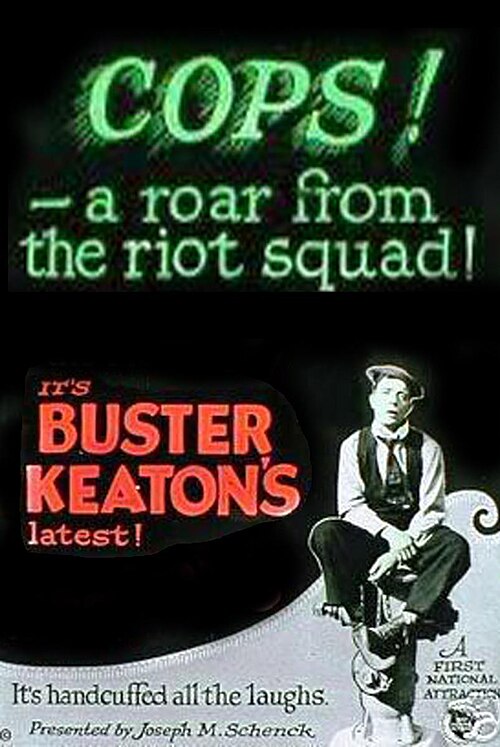
The film ends on, a tombstone . Keaton’s pork pie hat is set, sort of propped on top of it, and then the words “The End” are carved into the stone. It’s about eighteen minutes long, it was made in 1922, and it’s one of those pieces of film comedy that’s, weirdly precise in how it’s built , almost like every beat is measured. The Library of Congress agreed — Cops was chosen for preservation in the National Film Registry in 1997, and they said it was culturally historically, and aesthetically meaningful. That’s the sort of endorsement that usually only shows up for movies people are still seeing a century later, and Cops keeps earning it.
What Buster Keaton and co-director Edward F. Cline made here isn’t a chase movie with a few jokes sprinkled in. It’s something tougher and more intentional: a film about a man whose good intentions end up trapping him in a predicament that punishes him harder the more he attempts to flee. The whole Los Angeles Police Department ends up doing a rolling pursuit of one person, across the city, and the person being chased didn’t really do anything wrong to kick the whole thing off. He just happened to be in the wrong location at the wrong moment, and made a chain of decisions that were, honestly, pretty reasonable, until they turned catastrophic.
The film is in the public domain. So you can watch it for free right now, and the Internet Archive has a tidy copy.
Cops 1922 — Movie Overview Table
| Detail | Information |
|---|---|
| Title | Cops |
| Release Date | March 11, 1922 |
| Country | United States |
| Runtime | Approx. 18 minutes |
| Genre | Silent Comedy, Short Film |
| Language | Silent (English intertitles) |
| Format | Black & White, Silent |
| Directors | Buster Keaton and Edward F. Cline |
| Producer | Joseph M. Schenck |
| Production / Distribution | First National Pictures |
| National Film Registry | Selected 1997 — “culturally, historically, or aesthetically significant” |
| Notable Detail | Filmed during the Fatty Arbuckle trial; ends on a tombstone with Keaton’s hat |
| IMDb | Listed under tt0013027 |
| Public Domain | Yes — freely available to stream and download |
Full Cast — Cops (1922)
| Actor | Role |
|---|---|
| Buster Keaton | The Young Man |
| Joe Roberts | Police Chief |
| Virginia Fox | The Mayor’s Daughter |
| Edward F. Cline | The Hobo |
| Steve Murphy | Con Man selling furniture (uncredited) |
Why Cops Is the Film You Need to Watch If You Think You Don’t Like Silent Comedy
The objection people raise most often against silent comedy is that it feels like a museum piece — something you appreciate historically rather than actually enjoy. Cops demolishes that objection in its first three minutes and keeps demolishing it for the next fifteen. The physical comedy is so precisely calibrated, and the escalation is so well-paced, that the absence of sound becomes irrelevant within moments of the film starting.
What Keaton understood — and what Cops demonstrates more clearly than almost any other film in his catalogue — is that comedy built on mechanical precision is essentially timeless. A joke that depends on a 1922 cultural reference ages. A joke built on the geometry of a man, a moving vehicle, and a street full of police officers does not age. The physics are the same. The tension is the same. The release is the same.
The film runs eighteen minutes. It asks nothing of you except, your attention and what it gives you back is one of those most satisfying bits of long, comic construction in cinema history. And, yeah, that’s not just praise, it’s also basically why the Library of Congress put it in the National Film Registry. Watch it once, and you’ll get it right away, because people are still talking about it a century later.
The Fatty Arbuckle Trial — The Shadow Over the Production
Roscoe “Fatty” Arbuckle was Keaton’s friend, mentor, and also one of the most important figures in his early career. Arbuckle was the comic who sort of ushered Keaton into film—he noticed what Keaton could do on screen, and he gave him the room to develop it. When Arbuckle was arrested in September 1921, and put on trial for the rape and murder of actress Virginia Rappe, Keaton was among the ones who trusted in his innocence and stood by him publicly, at real professional risk.
Cops was filmed during the trial. Arbuckle went through three trials before being acquitted in April 1922 — the jury in the final trial not only acquitted him but issued a written statement of apology. The damage to his career was permanent regardless. He was effectively blacklisted from appearing in films, and the industry that had made him its biggest comedy star walked away from him.

Film historians point to this context when discussing Cops‘ tone — the Kafkaesque quality of a man who has done nothing wrong being pursued and ultimately destroyed by an institutional force that is indifferent to innocence. That reading isn’t forced. The film’s emotional logic maps onto Arbuckle’s situation with a precision that’s hard to attribute entirely to coincidence. The Young Man in Cops is guilty of nothing except existing. The system grinds him down anyway. The tombstone is the punchline, and it’s not entirely funny.
Full Plot Summary — Cops (1922)
The Young Man wants to impress a girl — the Mayor’s Daughter — who has made clear she won’t consider him seriously until he’s a successful businessman. He sets out to become one. Everything that follows is the world’s systematic refusal to allow him to succeed through any fault of his own.
The Con Man, the Wallet, and the Furniture
A con man sells him a load of furniture that was never his to sell — it belongs to a family that’s just been evicted. The Young Man buys it in good faith and pretty much just loads it onto a cart. After that, he has a horse, a cart, and a pile of stolen furniture all together, but no real awareness that any of those three things are a problem. So he sets off to sell it.
On the way, a man drops his wallet from a passing car. The Young Man sees it and picks it up, thinking he’ll return it. The guy in the car is a police officer. And by the time the Young Man reaches the officer to hand back the wallet, the whole chain of odd coincidences has already started stacking up, you know—each normal, honest action making the result worse than if he’d gone the dishonest route in the first place.
The Bomb, the Parade, and the Chase
A police parade is moving through the city. The Young Man’s cart gets caught in it. A passing anarchist — or possibly just a careless pedestrian, the film is usefully ambiguous — drops a lit bomb. It lands on the cart. The Young Man picks it up, lit fuse and all, and does what any reasonable person would do: he throws it away from himself as fast as possible.
It lands in the middle of the police parade and detonates. Every officer in the city is now pursuing one young man in a pork pie hat. What follows is the most famous sequence in the film — Keaton moving through, over, around, and between a city’s worth of police officers with a physical fluency that still looks impossible even when you know how it was done. He uses the cart. He uses buildings. He uses the geometry of crowds. He uses every available surface as both obstacle and solution simultaneously.
The Police Station — and the Ending That Changes Everything
The Young Man manages to herd the entire police force into the police station and lock the door. He has won. Then the Mayor’s Daughter walks past, sees the man she’s been considering as a potential suitor surrounded by the consequences of a citywide chase, and turns away from him with obvious disapproval.
He unlocks the door. The police pull him inside. The film cuts to a tombstone with “The End” carved in it and his hat propped on top. There is no rescue. There is no appeal. The system wins not because it caught him fairly but because the one person whose opinion mattered to him rejected him first, and after that, nothing else seemed worth the effort of escaping.
That ending is what separates Cops from a simple chase comedy. The girl’s disapproval is the actual defeat. The police station is just where he goes afterward.
Buster Keaton’s Physical Genius — What You’re Actually Watching
Keaton came from a vaudeville family. His parents were performers; he was on stage from the age of three and spent his childhood being thrown around as part of a knockabout act. That background produced something unusual: a performer whose relationship with his own body in space was essentially pre-conscious. He didn’t calculate what his body would do in a fall or a leap — he already knew.
What that produces on screen is a quality of physical comedy that looks effortless in the same way that elite athletic performance looks effortless — because the underlying training is so complete that conscious control is no longer required. Keaton doesn’t appear to be performing stunts. He appears to be navigating a world that happens to be unusually hostile to ordinary movement, and finding solutions to it with the same matter-of-fact expression he’d use to solve any other problem.
The deadpan expression is the key to all of it. Comedy built on visible effort asks you to laugh at how hard someone is trying. Keaton’s comedy asks you to laugh at the gap between the chaos happening around him and the complete impassivity with which he responds to it. The bigger the chaos, the funnier the stillness. Cops gives him the biggest chaos he’d worked with up to that point in his career — an entire city’s police force — and his expression doesn’t change once.
Edward F. Cline — The Co-Director Who Kept Up
Edward F. Cline co-directed Cops and also appears in it as the Hobo — a small role, but one that puts the director physically inside the production he’s shaping. Cline was Keaton’s primary collaborator across the short film period, co-directing most of the two-reel comedies that Keaton made between 1920 and 1922. His contribution is kinda hard to disentangle cleanly from Keaton’s own— they worked closely enough that the authorship question is genuinely complex, but the fact that their partnership produced such consistent work suggests a creative relationship that went beyond just having a second pair of eyes on set. Like, it felt more intertwined than “helpful extras” in the margins or whatever.
Cline went on to direct W.C. Fields in a few movies in the 1930s and 40s— My Little Chickadee, (1940) The Bank Dick (1940), Never Give a Sucker an Even Break (1941)— which kind of shows that his talent was less about steering , and more about dealing with comedians that had strong private thoughts and wanted a director who could back them up instead of overriding them. Keaton and Fields aren’t really the same kind of act , but they do share this thing where they want breathing room, not constant direction, and Cline seemed to understand how to hand that breathing room out to both of them.
The National Film Registry — What the Preservation Means
Every year the Library of Congress picks films for the National Film Registry, pretty much because they feel the movie has some cultural, historical, or aesthetic gravity. This kind of label has real pull — it suggests the film will be kept on purpose, not just left to wear out slowly, and it also signals a neat institutional call that the work is worth saving, like really worth it.
Cops was chosen in 1997. That same year’s group of titles included Blade Runner, The Deer Hunter, Gone with the Wind, Imitation of Life, and Sullivan’s Travels. So yeah, that is the crowd Keaton’s eighteen minute comedy bit ends up in. It isnt treated like some side note, not filed with other silent era curiosities, but set right next to feature length films that are widely agreed to matter, stretching across American cinema history.
The choice also lines up with the broader critical rethinking of Keaton’s output that had been quietly simmering since the 1980s into the 90s. For a long stretch after his top years, Keaton’s name got pushed down by Chaplin’s — partly because Chaplin promoted his own legacy like a machine, while Keaton’s got shaped by other people, and often not all that carefully, or at least not consistently. The Registry selection acts like one concrete sign that the balance was starting to shift back.
Joe Roberts as the Police Chief — Keaton’s Most Reliable Foil
Joe Roberts played the heavy in a run of Keaton short films that constitutes one of the more productive comedic pairings in early cinema. He was physically enormous — well over six feet, built heavily — and that size was the point. Keaton at five foot five, moving quickly and precisely, against Roberts at whatever size he actually was and moving with the inevitable momentum of a large man who has decided something is going to happen: that physical contrast generated comedy through geometry alone.
As the Police Chief in Cops, Roberts represents institutional authority in its most physical form. He’s not clever. He doesn’t need to be. He has the entire police force behind him and the weight of official power, and Keaton’s Young Man has only his own ingenuity. The fact that ingenuity almost wins — and that it fails not because the Police Chief outsmarts anyone but because the girl walks away — is where the film’s real argument lives.
Roberts died in 1923, the year after Cops was released. His run of work with Keaton across the short film period is the primary record of what he could do, and it’s a strong one.
Where to Watch Cops 1922 Free Online
Cops is in the public domain and freely available across multiple platforms. For an eighteen-minute silent comedy short, the Internet Archive has the most complete and reliable version.
| Platform | Format | Cost |
|---|---|---|
| Internet Archive | Stream + Download (multiple formats) | Free |
| YouTube | Stream (multiple uploads; quality varies) | Free |
| Tubi | Stream (often in Keaton and silent comedy collections) | Free |
| Public Domain Movies | Stream | Free |
Cops 1922 on Internet Archive:
Is Cops (1922) in the Public Domain?
Yes , Cops 1922 is public domain in the United States, and kinda, generally speaking , films from 1922 are safe from copyright worries under current US rules. Basically anything that was published before January 1, 1928 went into the public domain by January 1, 2024 at the latest, so most earlier silent shorts like this one have been out there, openly, for decades already. So you can stream it, download it, pass it along, and show it on screen freely, no restrictions and no special payment involved.
If you want the simplest and most dependable place to start, the Internet Archive copy is usually the best bet for grabbing a file . They tend to offer several formats, and the picture quality is about as good as the surviving prints will allow for something made back in 1922.
Critical Reception — Then and Now
In 1922, Cops was received as a strong entry in Keaton’s short film output — well-reviewed by the trade publications that covered comedy shorts, appreciated by audiences who were already following Keaton’s work. The critical apparatus for evaluating short comedy films in depth simply wasn’t what it would later become, and the film moved through its release cycle as a successful product rather than as the landmark it’s now recognised to be.
The modern critical consensus is basically unanimous or so it seems. Cops shows up on almost every serious list of the greatest short films ever, and also on many lists of the best comedy films of any length. Film scholars usually cite its structural neatness , its almost tender emotional weight under the physical joke work , and the whole Arbuckle trial backdrop as reasons it lands among the most layered and resonant pieces of the silent era. The National Film Registry selection kind of formalised what critics had been implying for decades already.
What strikes viewers most often on a first watch — especially viewers who come to it expecting something that needs to be appreciated rather than enjoyed — is how funny it still is. The laughs aren’t historical. They’re immediate. That’s the mark of something built on principles that don’t expire.
Frequently Asked Questions — Cops (1922)
Q: What is Cops (1922) about?
A young man (Buster Keaton) trying to impress a girl accidentally ends up being chased through the city by the entire Los Angeles Police Department after an anarchist’s bomb lands on his cart during a police parade and he throws it into the procession. Despite his ingenuity in evading the chase, he ultimately surrenders to the police after the girl he was trying to impress rejects him anyway. The film ends on a tombstone bearing his hat.
Q: Is Cops (1922) in the public domain?
Yes. Cops (1922) is fully in the public domain in the United States. Films from 1922 are free of copyright, and this one has been openly available for decades. You can legally stream, download, and share it for free on the Internet Archive, YouTube, Tubi, and other platforms.
Q: Who directed Cops (1922)?
Buster Keaton and Edward F. Cline co-directed Cops. Cline also appears in the film as the Hobo. The two collaborated on most of Keaton’s short film output between 1920 and 1922, producing some of the strongest work in the silent comedy short format.
Q: Why is Cops considered one of Keaton’s best films?
Cops is considered one of Keaton’s best — and one of the best short films ever made — because of its structural precision, its escalating logic that remains internally consistent throughout, its Kafkaesque emotional undertone, and the ending, which reframes the entire chase as secondary to a more personal rejection. It was selected for the National Film Registry in 1997 as culturally, historically, and aesthetically significant.
Q: What is the connection between Cops and the Fatty Arbuckle trial?
Cops was filmed during the rape-and-murder trial of Roscoe ‘Fatty’ Arbuckle, Keaton’s friend and mentor who had brought him into film. Keaton stood by Arbuckle publicly throughout the trials. Film historians note that the film’s Kafkaesque tone — a man whose good intentions produce only worse outcomes, pursued by an institutional force indifferent to innocence — reflects the circumstances of the trial with a precision that’s hard to attribute entirely to coincidence.
Q: How long is Cops (1922)?
Cops runs approximately 18 minutes. It is a two-reel silent comedy short, which was the standard format for Keaton’s output during the First National Pictures period. The National Film Registry selection makes it one of the shortest films in the Registry to receive that designation.
Q: What happens at the end of Cops (1922)?
Keaton’s character successfully locks the entire police force inside the police station. The girl he has been trying to impress then walks past, sees him, and gives him the cold shoulder. He unlocks the police station door and is immediately pulled inside by the police. The film’s final image is a tombstone bearing his pork pie hat and the words ‘The End’ — suggesting he does not survive the arrest.
Q: Was Cops selected for the National Film Registry?
Yes. Cops was selected for preservation in the United States National Film Registry by the Library of Congress in 1997, deemed culturally, historically, and aesthetically significant. That year’s class also included Blade Runner, The Deer Hunter, and Gone with the Wind — giving a sense of the company the eighteen-minute comedy short keeps in the Registry.
Q: Where can I watch Cops (1922) for free?
Cops is freely available on the Internet Archive, YouTube, Tubi, and various public domain film platforms. All versions are legal to stream and download. The Internet Archive has the most complete and reliable copy for downloading, in multiple formats.
Q: How does Cops compare to other Buster Keaton films?
Cops is generally ranked among Keaton’s finest short films and in the top tier of his overall filmography. It is frequently discussed alongside The General (1926) and Sherlock Jr. (1924) as a primary example of what Keaton’s work could achieve. Critics tend to argue that Cops demonstrates, in compressed form, every quality that makes Keaton’s best features great: physical invention, structural discipline, deadpan emotional depth, and an ending that earns its weight.
Related Free Classic Silent and Comedy Films
If Cops (1922) sent you further into Buster Keaton and early silent comedy, these are the natural places to keep going:
- Public Domain Horror Movies – Free Classic Scary Films Online
- Public Domain Cartoons
- Bird of Paradise (1932) Full Movie Review, Plot, Cast & Free Classic Romance Film
- Public Domain Movies List – All Free Classic Films (Complete Guide)
Movie Tags
Cops 1922, Cops Buster Keaton, watch Cops 1922 free, Cops public domain, Buster Keaton short films, Buster Keaton silent comedy, Buster Keaton police chase, Edward F. Cline director, Joe Roberts actor, Virginia Fox actress, Fatty Arbuckle trial context, National Film Registry 1997, Library of Congress film preservation, silent comedy public domain, First National Pictures 1922, Buster Keaton filmography, Kafka silent film, free Buster Keaton movie online, best silent comedy short films, 1920s silent film public domain