
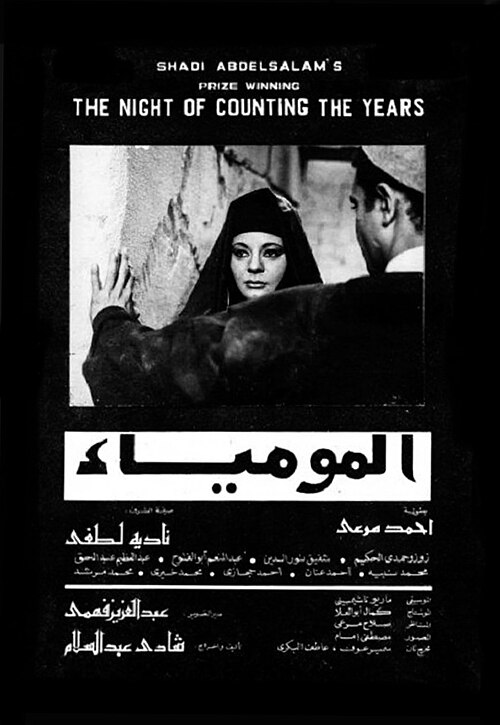
The Mummy (1969) is a haunting Egyptian drama, and is also called The Night of Counting the Years (1969), which talks of a desert tribe that secretly looted royal mummies, and a young man who is torn between his people and his nation and its history. The Night of Counting the Years full movie is regarded as one of the most significant Egyptian films of all time and is currently in the public domain as a restored free classic movie and public domain movie available via archives and film-heritage projects.
Movie Background Table
Movie Cast Table
Full Plot Summary
The Night of Counting the Years 1969 movie takes place in the year 1881 in the Egyptian land of the upper region right before the British colony of the land. It occurs in a desert tribe which lives nearby Thebes which has preserved a secret royal grave over the years.
Death of the tribal leader
The movie begins with a bleak, ritualized funeral of Selim, the chief of Horabat tribe. His body is carried by men over the rocky path to a circle of white funereal obelisks, where the men sing in a slow hypnotic time. In the aftermath of the burial, the elders of the tribe get two sons of Selim: the elder brother who is more confident and the younger brother Wannis who is more hesitant.
The secret of the family is unveiled by the elders. Their tribe has long been familiar with the whereabouts of a great royal tomb a hoard of pharaonic mummies and treasures long buried in the cliffs. It is an oral tradition and a secret that is transmitted between leaders. The tribe constantly invades the tomb and sells artifacts to one of the middleman traders known as Ayoub and the illicit trade has taken the place of their primary source of livelihood particularly during famine.
It is explained to the brothers that their father had died, and they now had to be responsible in the management and exploitation of this legacy. Their mother backs their elders and requires her sons to keep the tradition without any doubts.
Discovery of the mummy cache
The brothers make an overnight trip through small passages and caves to the secret tomb led by an older brother. This is shot by Abdel Salam as a sequence of mazes – tunnels of rock, darkness, and cut rock – which are almost unreal. They strike the inner chamber, and inside it are the bodies of the royalties mummified and lying in coffins and heaps, still wrapped and mostly unopened.
The elder brother is immediately taken aback with the sight. He is burdened by the activity of what they have been up to: plundering the ancient dead of his country and supplying a black market in antiquities. He advises the elders to leave the dead in peace and he does not want to continue with the looting since according to him, it is a betrayal of the Egyptian past.
The mother is harshly responded to by the clan. The mother informs her elder son that since he disowns the tribe way, she does not have a name to call him. He turns into a stranger in his family.
Tension, betrayal, and death
The eldest brother attempts to get out of the place, which will provide him with a chance to forget about the secret and the requirements of the tribe. He is killed mysteriously in a boat. The boat has a painted mark the hands of butterfly shape signify more of tribal signs and give strength to the fog of ambiguity in the film.
When the elder brother dies, the pressure is changed to Wannis. He cannot tell, as he is caught between being scared of the elders, his mother, and the increasing awareness that whatever they are engaging in is wrong. He observes the tribe being active in its trade with Ayoub, and selling funerary items and coffin boards, which obviously belong in a museum, and not the black market.
In the meantime the Egyptian Antiquities Service in Cairo, under the direction of characters who are based on real-life Egyptologists Gaston Maspero and Ahmed Kamal (played by Maspero and Kamal respectively in the film) have observed a flow of high-quality royal artifacts coming into the market. They have a hunch that somewhere close to Thebes, there is a hitherto unknown tomb being ransacked and they dispatch an expedition all the way to Thebes.
The expedition of Cairo comes.
Maspero and Kamal come by boat and they carry with them a squad of officials and guards. They interrogate the locals and start eliminating the potential origin of the artifacts. Their existence disrupts the situation in the Horabat tribe: in case the authorities find the tomb, the tribe will lose its primary income and probably be punished.
Ayoub who is torn between the authorities and the tribe continues to demand more treasures to sell and this depicts nothing but pure greediness and the outer world that is exploiting Egypt and its heritage. The elders continue to say that the only way the tribe is going to survive is through the secret trade, however, something that started as an inheritance is obviously now theft.
Wannis is torn between two things. On the one hand is his mother, the older people and the burden of tradition. His conscience and the feeling that the mummies and artifacts belong to a national story and not a tribal one is on the other side. He also finds out the way the fear and secrecy have corrupted the relationships within the tribe.
Wannis’ decision
Wannis breaks down after being assaulted by a merchant when he declines to sell out a very valuable object. Having understood that the tribe is caught in the cycle of dependency and the disgrace, he chooses to do something.
He approaches the representatives of the Antiquities Service and shows them where the tomb is. By so doing, he is betraying his clan secret but he is doing justice to the kings and the bigger history that they are alluding to.
The police trace him over the same mazes back to the hideout. Solemnly they start the business of removing the royal mummies and treasures as a precaution. It is slow and ritualist, rather a second bury than a police raid.
The movie concludes in a vague manner. The ancient dead are no longer exposed to further plundering and the history of Egypt is no longer in the hands of a single tribe but in the care of the national institutions. But Wannis is not part of his community anymore and the opposition between the country world and the new state is not settled. The quest of a new Egyptian identity, striking a balance between pharaonic past, local customs and emerging national frameworks is incomplete.
Genre and Key Themes
The Night of Counting the Years is a slow, melodramatic play with very powerful mysterious and historical allegoric undertones. It is less jump scares and mummy horror and more of memory, guilt and what inheritance means.
Major themes include:
The national identity and heritage.
The mummies and artifacts are used in the film as an indication of a forgotten or rather, lost Egyptian identity that has been forgotten, misinterpreted or sold off. The dispute as to who owns this past, tribe, state, or foreign buyers is a reflection of greater issues concerning the connection of modern Egypt to its ancient origins.
Tradition vs. conscience
Wannis and his brother are the representatives of a younger generation that had to make a painful decision: to follow the tribe and go on desecrating the dead or disobey the tradition and face the danger of being sent away, in honor of the greater morality and national cause.
City vs. countryside
The archaeologists of Cairo are rational, centralizing forces, and the Horabat are closed, semi-mythic rural people. The movie does not give an answer as to which position is correct, and one gets a feeling of tension between local governance and national control.
The weight of the dead
The royal mummies are not monsters; they have not spoken a word. Their appearance, based on the desert backdrop, and the classical Arabic conversation, sets an impression that the past is ever-present and it is always right and watching the living.
Ambiguity and silence
A lot of vital reasons and occurrences (such as the murder of the elder brother) remain incompletely explained. This ambiguity makes the audience sit up uneasily just like Egypt does in trying to find answers about the past and who I am.
The visual and formal aspects of the film are said to be dreamy. Its leisurely rhythm, the compositions shot through with care and its weird camera angles transform cliffs, corridors, courtyards into symbolic spaces and not mere places. This feeling of unreality is enhanced by the sparse, uneasy score by Mario Nascimbene.
The Night of Counting the Years (1969) Full Movie Watch and Download
Watch The Night of Counting the Years (1969) on Internet Archive:
🏛️ See Also
This Is the Army (1943) – Irving Berlin WWII Musical Classic | Free Public Domain Full Movie in HD
The North Star (1943) – Powerful WWII Resistance Drama | Free Public Domain Full Movie in HD
Between Showers (1914) – Charlie Chaplin Silent Comedy Short | Free Public Domain Full Movie Online
Popeye: Assault and Flattery (1956) – Classic Popeye vs Bluto Courtroom Cartoon | Free Public Domain Full Movie
Movie Review
The film Night of Counting the Years 1969 is generally considered by the critics and other scholars as one of the best Egyptian movies ever produced, and to most people as the most significant of all. It is not a typical mummy movie, rather images, a lack of dialogue, and moral dilemmas combine into an experience of a poem.
The direction of Shadi Abdel Salam is accurate and restrained. All the shots are full of the calmness of a painting white tombstones on blue sky, the columns of people going through the passes between the rocks, the torchlight that illuminates the painted coffins. The cinematography by Abdel Aziz Fahmi and production design by Salah Marei collide with each other to cause the ancient and modern Egypt to pass through the same frame.
Acting is suppressed yet strong. Wannis by Ahmed Marei is silent and often perplexed but his inner turmoil is on his face and body language. This is contrasted more sharply and openly by Ahmad Hegazi and his older brother. The mother of Zouzou Hamdy El-Hakim is the personification of the grave power of convention, Gaby Karraz (Maspero) and Mohamed Khairi (Kamal) make the authorities of Cairo see their task as an obligation and an exploration but not a mission of heroism.
The classical Arabic language is used to make the dialogues seem high and a bit surreal, this may be difficult to some audience but altogether appropriate to the ritualistic nature of the film. Together with haunting music by Nascimbene and extremely careful editing, it forms a rhythm that is more akin to a solemn ceremony rather than the fast-moving drama.
To the contemporary viewer finding The Night of Counting the Years in its entirety as both a free classic film and a free public domain film on such sites as the Internet Archive, expectations are, indeed, a factor. Slow pacing may be unappealing to the action or traditional horror seekers. It is, though, frequently spellbinding to those who have an interest in film history or Arab cinema, or even questions of cultural heritage, a unique film that attempts to reflect on the idea of inheriting a past through the use of the medium of cinema.
Movie Tags
The Night of Counting the Years full movie, The Night of Counting the Years 1969 film, The Mummy Al‑Mummia Egyptian movie, Shadi Abdel Salam film, Egyptian classic cinema, Egyptian mummy film, Deir el‑Bahari royal mummies, Egyptian national identity drama, Cairo vs Upper Egypt film, Mario Nascimbene score, Ahmed Marei Wannis, free classic movie, public domain movie, restored Egyptian film, World Cinema Project restoration