
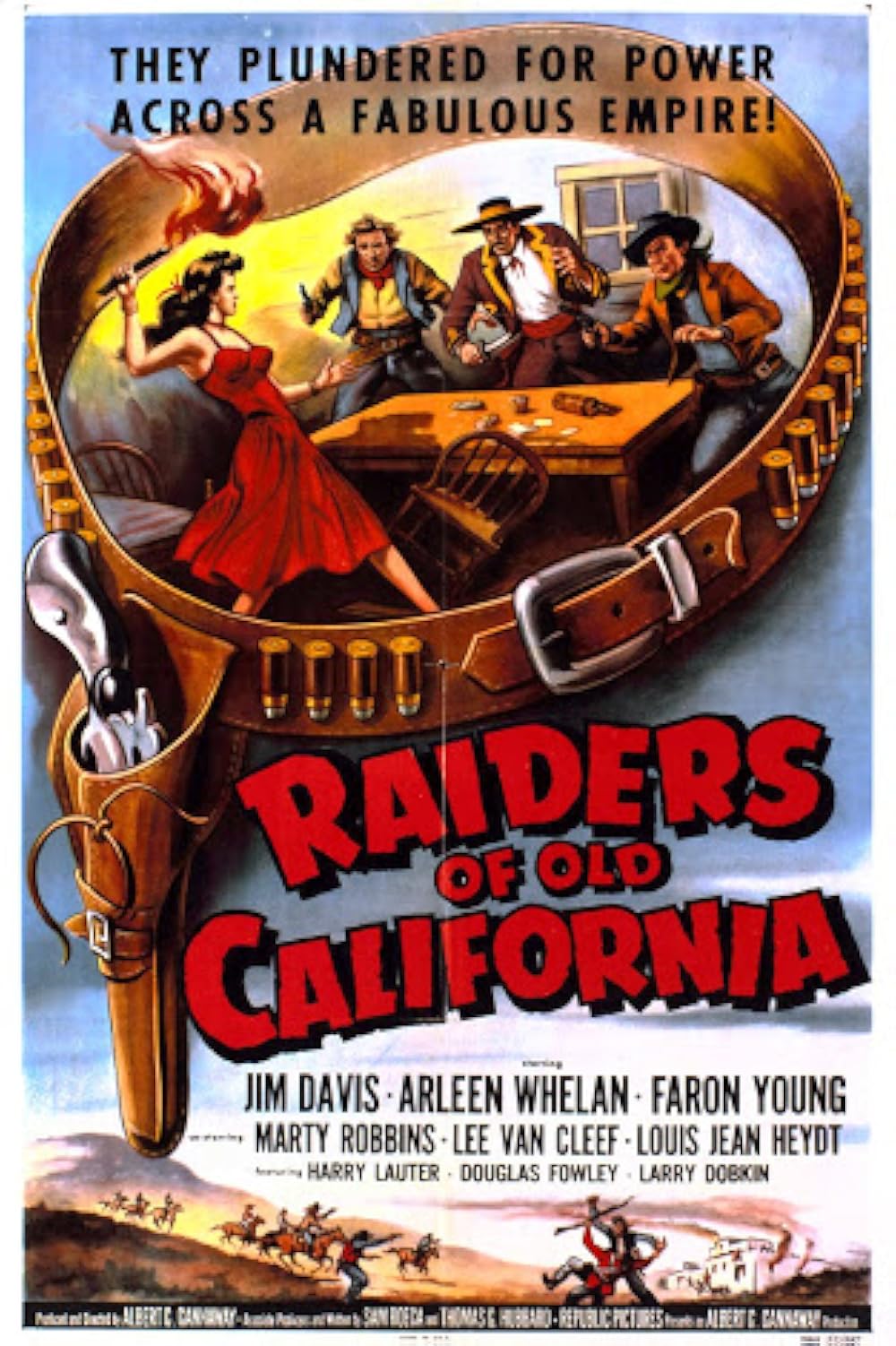
Raiders of Old California 1957 stars Lee Van Cleef, Faron Young & Marty Robbins. Full plot, cast table, historical context & where to watch free online.
Raiders of Old California (1957) – The B-Western With a Grand Ole Opry Lineup | Full Review, Cast & Where to Watch Free
Genre: Western | Runtime: 72 minutes | Rating: Approved | IMDb: 5.7/10
Most B-westerns from the 1950s are forgotten before the credits finish rolling. Raiders of Old California (1957) is not quite most B-westerns. It puts two of country music’s biggest stars of the era — Faron Young and Marty Robbins — into a story about land theft, wartime extortion, and frontier justice. It also gives Lee Van Cleef one of his meatiest pre-spaghetti roles as a killer with a cold, methodical edge. Neither Young nor Robbins picks up a guitar. Neither needs to. The film earns its 72 minutes through action, a sharp villain, and a thematic boldness that catches most viewers off guard for a 1957 Republic Pictures production.
Raiders of Old California 1957 — Movie Overview Table
| Detail | Information |
|---|---|
| Title | Raiders of Old California |
| Release Year | 1957 |
| Runtime | 72 minutes |
| Country | United States |
| Language | English |
| Director | Albert C. Gannaway |
| Producer | Albert C. Gannaway |
| Screenplay | Samuel Roeca, Tom Hubbard |
| Narrator | Gerald Mohr (uncredited) |
| Studio | Albert C. Gannaway Productions |
| Distributor | Republic Pictures |
| Filmed In | Kanab, Utah |
| Genre | Western / B-Western |
| Color | Black & White |
| MPAA Rating | Approved |
| IMDb Rating | 5.7/10 |
| Public Domain | Yes — freely available to watch and download |
Full Cast Table — Raiders of Old California (1957)
| Actor | Role |
|---|---|
| Jim Davis | Capt. Angus Clyde McKane |
| Arleen Whelan | Julie Johnson |
| Faron Young | Marshal Faron Young |
| Marty Robbins | Cpl. Timothy Boyle |
| Lee Van Cleef | Sgt. Damon Pardee |
| Louis Jean Heydt | Judge Ward Young |
| Harry Lauter | Lt. Scott Johnson |
| Douglas Fowley | Sheriff |
| Lawrence Dobkin | Don Miguel Sebastian (billed as Larry Dobkin) |
| Bill Coontz | Turk |
| Don Diamond | Pepe |
| Rick Vallin | Burt (billed as Ric Vallon) |
| Tom Hubbard | Emmet |
| Edward Colmans | Diego (uncredited) |
| Gerald Mohr | Narrator (uncredited) |
The People Who Made This Film — And What Makes the Cast So Unusual
Albert C. Gannaway — A Director Who Knew His Audience
Albert C. Gannaway built his career at the intersection of country music and B-westerns, a combination that was commercially reliable in the mid-1950s even if it rarely produced films with lasting reputations. His most prominent credit before Raiders of Old California was producing The Grand Ole Opry (1940), a feature film showcasing the Nashville institution’s roster of performers.
He directed Raiders of Old California and The Badge of Marshal Brennan back-to-back in Kanab, Utah, and except for Faron Young, the same core cast appears in both films. That production efficiency — shooting two westerns consecutively with the same crew and most of the same actors — was standard operating procedure at the budget level Republic Pictures occupied by 1957.
Raiders of Old California stands as Gannaway’s most-watched surviving film, though even that distinction is modest.
Jim Davis — Before Dallas, There Was McKane
Jim Davis plays Captain Angus Clyde McKane, the film’s lead villain. In 1957 Davis was a working character actor with a long string of western credits behind him, reliable and capable if not quite a household name. Audiences today recognize him primarily as Jock Ewing in Dallas (1978–1981), the CBS prime-time soap opera that made him genuinely famous in the final years of his career.
His performance as McKane in Raiders shows exactly why producers kept casting him in authority roles: he projects physical confidence and convincing menace without needing to overplay either quality. McKane is not a ranting villain — he is a calculating one, which makes him more effective.


Lee Van Cleef — The Real Reason This Film Gets Watched
Lee Van Cleef gets the kind of part he was born for in Raiders of Old California, and lets him show off his typecast malevolence with real flair. He gets more screen time than any of the principals, and he eats it up with a spoon, whether quietly threatening his victims or administering a beating with psychotic pleasure.
This was an unusually prominent role for Van Cleef, who played the heavy in dozens of 1950s westerns. At one point he smashes a man’s hands with a rock so he’ll fall off a cliff to his death.
In 1957 Van Cleef had already appeared in High Noon (1952) alongside Gary Cooper, but had spent most of the intervening years in supporting villain roles across television and low-budget westerns. His Italian spaghetti western career — the one that made him internationally famous — was still a decade away. For a Few Dollars More (1965) and The Good, the Bad and the Ugly (1966) would redefine him entirely. Raiders of Old California captures him in the pre-Leone period at his cold, controlled 1950s best.
Faron Young — Country Star Turned Marshal
Faron Young was one of the biggest names in country music by 1957. His recording of “Hello Walls” (1961) would become one of the defining country singles of the early 1960s, and his career on the Grand Ole Opry stage was already well established when he stepped in front of Gannaway’s camera.
Playing Marshal Faron Young — the character shares his own name — he handles the role as if he had made a hundred movies. The choice to cast Young under his own name gives the film an unusual quality: it reads simultaneously as a western narrative and as a star vehicle built around a performer’s existing public identity.
Neither Young nor Robbins sings a single note in the film — though neither Faron Young nor Marty Robbins sings a note, a decision that puzzled audiences and critics alike. For a production coming from the director of The Grand Ole Opry, the absence of any musical performances from its two biggest musical names is a notable omission.
Marty Robbins — Before “El Paso,” There Was Boyle
Marty Robbins appears as Corporal Timothy Boyle, one of McKane’s henchmen who gradually turns against his commanding officer. Robbins would go on to record “El Paso” in 1959 — a western narrative ballad that won the Grammy Award for Best Country & Western Recording and became one of the most iconic country songs of the 20th century. It was a song that showed he understood western storytelling deeply.
In Raiders of Old California, two years before “El Paso,” Robbins plays a man trapped inside a western story of his own. His performance is limited — the screenplay gives Boyle a relatively brief arc — but his physical presence and natural ease in the setting register on screen.
Arleen Whelan — A Final Performance
Raiders of Old California was the final film appearance of Arleen Whelan, who retired from acting in 1957. She had worked steadily through the 1940s and 1950s, appearing in films at 20th Century Fox and Republic Pictures before choosing to step away from the industry entirely.
Her role as Julie Johnson — the wife of the reluctant witness Scott Johnson — gives her little to do beyond react to the film’s escalating danger, but her presence adds a professional credibility to scenes that might otherwise lean too heavily on the western formula.
Full Plot Summary — Raiders of Old California (1957)
The film opens at the tail end of the Mexican-American War. Captain Angus McKane of the U.S. Army accepts the surrender of Mexican officer Don Miguel Sebastian. Rather than treat Sebastian with the dignity due a surrendered officer, McKane immediately exploits the moment.
He forces Sebastian — under direct threat of death — to sign over his massive Spanish land grant. Three of McKane’s men witness the transaction: Sergeant Damon Pardee, Corporal Timothy Boyle, and Lieutenant Scott Johnson. The land now belongs to McKane, and Sebastian, left alive but dispossessed, disappears from the area.
Three Years Later — McKane Owns the County
Three years after the war, McKane has converted his stolen land grant into a full operation. He drives Mexican farming families off land they have worked for generations. He controls the local law enforcement. He is, in the language one character uses, the county itself.
Reports of the land disputes travel east and reach Judge Ward Young. He travels west with his son, Marshal Faron Young, to investigate. From the moment they arrive, McKane’s hold on the territory becomes apparent — the local sheriff operates under McKane’s authority rather than any legitimate judicial framework.
Johnson Turns — And Pardee Moves
The father-son team identify Scott Johnson as the key witness to the original land fraud. Johnson knows the transaction was extorted, not voluntary. He has stayed silent out of fear for his wife Julie. After the Youngs press him, Johnson finally agrees to testify.
Pardee moves to silence him. McKane’s men ambush the lawmen on the road, and Johnson takes a serious wound in the attack. Before losing consciousness, he directs them toward Sebastian — who, it turns out, did not leave the territory. Sebastian is alive, living in a small town under the identity of a Catholic priest.
Pardee separately interrogates an old farmer named Diego, who knew Sebastian from the war years. Diego confirms Sebastian’s survival — and then Pardee kills him.
The Priest and the Stampede
Marshal Young tracks the dying Boyle to a town priest. Boyle, before he dies, identifies the priest as Sebastian himself. Sebastian has been hiding in plain sight, building a quiet life while McKane built an empire on stolen ground.
When Sebastian agrees to testify at trial, McKane sends men to eliminate him. Sebastian evades them through an underground passage beneath the building. The trap fails.
McKane’s response is to escalate beyond the individual. He plans a cattle stampede directly through the town where the trial is scheduled — a physical act of destruction aimed at terrorizing every witness and officer of the court into silence.
The Trial and Its Outcome
The trial proceeds before the stampede reaches it. Sebastian testifies clearly: he was forced to sign the land grant under threat of death, and the witnesses were not neutral parties but McKane’s own soldiers. Johnson used to refuse to sign, he had been forced.
Judge Young rules the grant entirely illegal — McKane’s transaction with Sebastian constituted bargaining with an enemy combatant during wartime, which invalidates the legal instrument entirely. McKane will face a court-martial.
The court erupts as the stampede arrives. In the chaos, McKane himself is caught in the crush of cattle and killed. The sheriff dies in the same stampede. With McKane gone and the legal finding clear, Sebastian steps forward and deeds his land directly to the farming families who worked it — the same families McKane spent three years driving off.
What Makes This Film Unusual for 1957
Most western films of the mid-1950s operated within a fixed moral universe where American expansion was self-evidently just and Mexican landowners were either background figures or convenient villains. Raiders of Old California inverts that structure entirely.
The film is unusual in that it shows Mexicans being attacked by white men, making the Mexican settlers the aggrieved parties in a land rights dispute where the American military officer is the unambiguous villain.
Sebastian — the Mexican general, the dispossessed landowner, the disguised priest — is the film’s moral anchor. The American judge and marshal function as agents of justice precisely because they hold McKane’s actions to legal account under American law. The ending, where Sebastian gives the land to the farmers rather than keeping it himself, suggests a vision of post-war California where honest law can correct wartime theft.
For a Republic Pictures B-western released in 1957, that’s a genuinely progressive narrative position.
The Historical Anachronism Problem
Critics and audiences who know their military history immediately notice the film’s uniform problem. The story is set in the years immediately following the Mexican-American War (1846–1848). The uniforms McKane and his soldiers wear, however, are from the Civil War era — roughly a generation later. The firearms are even further out of period, including Colt revolvers and repeating rifles that wouldn’t appear until the 1870s.
The disparity between the film’s setting and its costumes and weapons has been frequently noted — but the story moves otherwise well, with superb action and highly professional stuntwork.
Director Gannaway either didn’t notice the anachronisms or couldn’t afford to correct them. Either way, viewers who can bracket the costuming errors find the story itself historically plausible in its basic outline — the post-war land fraud dynamics the film depicts were real phenomena in 1840s and 1850s California.
Where to Watch Raiders of Old California (1957) Free Online
Raiders of Old California is in the public domain and freely available across multiple platforms.
| Platform | Format | Cost |
|---|---|---|
| Internet Archive | Stream + Download (MP4, H.264, OGG) | Free |
| YouTube | Stream | Free |
| Public Domain Movies | Stream | Free |
| Tubi | Stream | Free |
| Amazon Prime Video | Rental / Purchase | Paid |
Night in the Show 1915 on Internet Archive:
Is Raiders of Old California in the Public Domain?
Yes. Raiders of Old California entered the public domain after its copyright was not renewed under the pre-1978 U.S. copyright system. All films produced before 1978 that were not actively renewed after their initial 28-year copyright term are now in the public domain in the United States.
You can legally stream, download, share, and screen this film without restriction or payment.
Critical Reception — What Audiences Actually Said
Raiders of Old California holds a 5.7 out of 10 on IMDb — a fair score for what it is. The film divides viewers primarily along one question: whether Lee Van Cleef’s performance is enough to carry a B-western with a modest screenplay and obvious budget constraints.
For Van Cleef fans, the answer is almost always yes. Van Cleef was one of the real pleasures of 1950s movies, and his later European stardom only proved that he was better at supporting a picture than starring in it.
Criticism focuses on the costume anachronisms, the underuse of Faron Young’s and Marty Robbins’ musical identities, and some structural confusion in the middle act. The film’s stunt sequences — horseback chases, the cattle stampede finale — draw consistent praise, particularly given the production’s evident budget limitations.
The thematic angle — American military corruption as the villain, Mexican land rights as the moral center — earns the film recurring credit as more thoughtful than its B-western classification suggests.
Frequently Asked Questions — Raiders of Old California 1957
Q: What is Raiders of Old California about?
A corrupt former U.S. Army captain named McKane seizes a Spanish land grant through wartime extortion after the Mexican-American War. Three years later, a federal judge and his marshal son investigate the land theft and work to bring McKane to justice, using a surviving witness and the original Mexican landowner — now living as a Catholic priest — to build their case.
Q: Who are the main stars of Raiders of Old California 1957?
The primary cast includes Jim Davis as the villain McKane, Lee Van Cleef as his enforcer Pardee, Faron Young as Marshal Faron Young, Marty Robbins as the treacherous Corporal Boyle, and Arleen Whelan as Julie Johnson. Lawrence Dobkin plays Don Miguel Sebastian, the dispossessed Mexican landowner.
Q: Is Lee Van Cleef in Raiders of Old California?
Yes. Van Cleef plays Sergeant Damon Pardee, McKane’s primary enforcer. He receives more screen time than most of the principal cast and delivers one of his most fully realized pre-spaghetti western performances. The role is considered essential viewing for Van Cleef fans.
Q: Do Faron Young or Marty Robbins sing in the film?
No. Neither Young nor Robbins performs any music in the film despite both being major country music stars at the time. The decision has puzzled viewers ever since, particularly given that director Gannaway’s previous work had centered directly on country music performance.
Q: Who directed Raiders of Old California?
Albert C. Gannaway directed and produced the film. He shot it back-to-back with The Badge of Marshal Brennan (1957) in Kanab, Utah, using largely the same cast and crew for both productions.
Q: Where was Raiders of Old California filmed?
The film was shot in Kanab, Utah — a location frequently used by Republic Pictures for its western productions during the 1940s and 1950s.
Q: Is Raiders of Old California historically accurate?
The broad storyline — post-Mexican-American War land fraud and the displacement of Mexican farming families in California — reflects real historical dynamics. The film’s costumes and weapons, however, are from the Civil War era and later, not the 1840s period the story depicts. It’s historically motivated but not historically accurate in its production details.
Q: Was this Arleen Whelan’s last film?
Yes. Raiders of Old California was Arleen Whelan’s final film appearance. She retired from acting entirely in 1957 after a career spanning roughly two decades.
Q: What is the IMDb rating for Raiders of Old California 1957?
The film holds a 5.7 out of 10 on IMDb, reflecting solid B-western entertainment value without the production quality or screenplay depth to push it into more widely celebrated territory.
Q: Where can I watch Raiders of Old California for free?
The film is freely and legally available on the Internet Archive, YouTube, Tubi, and Public Domain Movies. All versions are in the public domain.
Related Free Classic Films
If Raiders of Old California (1957) worked for you, these classic films in the same territory are worth exploring:
- War Goddess (1973) – Terence Young’s Amazon Sword-and-Sandal Epic | Full Review, Cast & Where to Watch
- Guest in the House (1944) – Anne Baxter Film‑Noir Drama | Full Public Domain Classic Movie Online Free
- Public Domain Horror Movies – Free Classic Scary Films Online
- Public Domain Movies List – All Free Classic Films (Complete Guide)
Movie Tags
Raiders of Old California 1957, Raiders of Old California full movie, Raiders of Old California free online, Raiders of Old California watch free, Lee Van Cleef 1957 western, Faron Young western film, Marty Robbins movie, Jim Davis western, Albert C. Gannaway director, Republic Pictures 1957 western, B-western 1957, Mexican-American War western, public domain western film, free classic western online, Raiders of Old California Internet Archive, classic 1950s western, black and white western 1957