
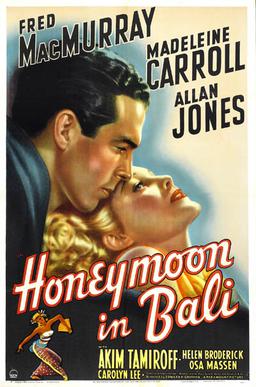
The film was nearly made with Merle Oberon. Paramount announced it in 1936, shelved it, rebuilt it, and released it in September 1939 with a British blonde who had already survived a kidnapping conviction in a Hitchcock picture and would spend the next several years walking away from Hollywood entirely to run supply lines through occupied France. That’s the actress playing the career woman who can’t decide whether she wants Bill Burnett.
The film is Honeymoon in Bali — also released as My Love for Yours, Husbands or Lovers, and occasionally just filed under whatever the public domain bin happened to be labeled that week. What it actually is, in 1939 terms, is a Paramount romantic comedy built around a structural hook that most films of its type didn’t bother with: a fortune teller who is correct. Not symbolic. Not dreamlike. Factually, sequentially, provably correct, and the film knows it, and uses that foreknowledge as its entire dramatic engine.
Virginia Van Upp wrote it. Edward H. Griffith directed it. Fred MacMurray plays the man from Bali with the rice-knife scar on his arm. Akim Tamiroff plays a window washer who functions as a Greek chorus on every floor of Gail Allen’s department store. And the 95 minutes between the fortune telling and the resolution hold a genuine argument — one that 1939 audiences apparently found delightful and 2026 audiences will find considerably more complicated — about whether a woman who has everything should want more.
Honeymoon in Bali 1939 — Movie Overview Table
| Detail | Information |
|---|---|
| Title | Honeymoon in Bali |
| Alternate Titles | My Love for Yours (video title); Husbands or Lovers (UK) |
| Release Date | September 29, 1939 |
| Country | United States |
| Runtime | 95 minutes |
| Genre | Romantic Comedy, Music |
| Language | English |
| Format | Black & White, Sound |
| Director | Edward H. Griffith |
| Producer | Jeff Lazarus |
| Screenplay | Virginia Van Upp |
| Source Material | “Our Miss Keane” by Grace Sartwell Mason (The Saturday Evening Post, May 1923); “Free Woman” by Katharine Brush (Redbook, Nov–Dec 1936) |
| Cinematography | Ted Tetzlaff; Charles Schoenbaum |
| Editor | Eda Warren |
| Costume Design | Edith Head |
| Music | Friedrich Hollaender |
| Production Studio / Distributor | Paramount Pictures |
| Original Development | Announced 1936 with Merle Oberon attached; rebuilt and recast before production |
| IMDb Rating | 6.3/10 |
| Public Domain | Yes — freely available to stream and download |
Full Cast — Honeymoon in Bali (1939)
| Actor | Role |
|---|---|
| Fred MacMurray | Bill ‘Willie’ Burnett |
| Madeleine Carroll | Gail Allen |
| Allan Jones | Eric Sinclair |
| Akim Tamiroff | Tony, the Window Washer |
| Helen Broderick | Lorna ‘Smitty’ Smith |
| Osa Massen | Noel Van Ness |
| Carolyn Lee | Rosie |
| Astrid Allwyn | Fortune Teller |
| Georgia Caine | Miss Stone, Gail’s Secretary |
| Benny Bartlett | Jack, the Singing Telegram Boy |
| Monty Woolley | Lorna’s Publisher |
| Charles Lane | Photographer |
| Janet Waldo & Luana Walters | Fortune Teller’s Companions |
The Film Paramount Nearly Made With Someone Else
The project had been sitting at Paramount since 1936, when the studio announced it as a vehicle for Merle Oberon, based on Grace Sartwell Mason’s 1923 Saturday Evening Post story “Our Miss Keane.” It didn’t happen. Oberon moved on. The property sat. By the time Virginia Van Upp came in to write the screenplay — grafting Katharine Brush’s 1936 Redbook story “Free Woman” onto the original source material — the whole concept had shifted: less department store romance, more genuine argument about what a woman of professional standing should actually want from her life.
Van Upp wrote Gail Allen as someone who genuinely has it together. She runs a Fifth Avenue department store. She has her own apartment, her own decisions, her own sense of what the future is supposed to look like. The film doesn’t present her independence as a delusion or a phase — at least not initially. It presents it as an achieved position that the plot is going to put under serious pressure, and the pressure comes with a supernatural timestamp attached. That’s the fortune teller. That’s the structural device Van Upp uses to make the whole thing into something other than a standard screwball chase.
The film was released September 29, 1939 — four weeks after Germany invaded Poland. American audiences were watching a 95-minute Paramount comedy about a career woman choosing between independence and Bali while Europe was already burning. The Los Angeles Times called it “Light, Romantic Comedy.” The Washington Post called it “Delightfully Easy to Take.” Both were accurate. Neither was the whole story.
Virginia Van Upp — The Screenwriter Who Wrote Women Who Meant It
Virginia Van Upp is one of those pretty remarkable careers in Hollywood that most people have not really heard of. She began as a child actress in the silent era, then worked her way through script supervision, film editing and casting direction, and kind of arrived at Paramount in 1934 as a screenwriter. By 1939 she’d carved out a real specialty, romantic comedies built around women with actual jobs, clear ambitions, and interior lives, the kind the plot can’t just dissolve with a single kiss.
The Hazlitt profile of her work put it directly: she wrote career women with “boyish names and serious professions — psychiatrists, entrepreneurs, and politicians.” Gail Allen fits the template. But what Van Upp understood about the romantic comedy form is that the tension only works if the woman’s position is genuinely defensible — if the audience can see, clearly, what she would be giving up. A Gail Allen who was secretly miserable would be a different film. Van Upp writes her as someone who has made deliberate choices and is living with them contentedly, right up until the fortune teller says otherwise.
She wrote both Honeymoon in Bali and Café Society — both for Carroll and MacMurray, both for the same director, both in the same year. That’s the kind of output rhythm Paramount expected. What’s worth knowing is that Van Upp wasn’t just filling a slot: she wrote the best lines for her female leads because she understood what those characters actually had at stake. She later produced Gilda (1946) and shaped Rita Hayworth’s career from inside the Columbia executive structure. Honeymoon in Bali is the middle of that arc, not a footnote to it.
Full Plot Summary — Honeymoon in Bali (1939)
On a rainy autumn afternoon in New York City, Gail Allen (Madeleine Carroll) — the executive head of a major Fifth Avenue department store — meets her best friend and second cousin Lorna (Helen Broderick) for tea. Lorna, who writes South Seas romance novels and is apparently always right about everything, has brought a fortune teller. The reading begins as vague prediction, then gets specific: a child, a man whose arm was cut by a native’s rice knife, an unexpected turn down an unfamiliar street that changes everything.
Gail doesn’t believe any of it. She leaves, takes an unplanned turn, and walks directly into a shop selling sailboat models. The man inside — Bill Burnett (Fred MacMurray), a resident of Bali visiting New York — has a scar on his arm from exactly the tool the fortune teller described. The predictions have begun.
Bill Proposes. Gail Declines. Rosie Arrives.
Bill falls hard and immediately. He proposes. Gail declines — she has a life, a career, and no intention of relocating to a cocoa plantation in Bali to become someone’s wife. Bill goes back to Bali. Then Rosie (Carolyn Lee) arrives: an orphaned girl Gail briefly becomes guardian to, who demonstrates, scene by scene and with considerable charm, that a child might actually belong in Gail’s life. Meanwhile Tony the window washer (Akim Tamiroff) shows up on every floor of the department store dispensing philosophical commentary on love, independence, and what people actually want versus what they tell themselves they want.
The window washer is not a minor character. He is, structurally, the film’s moral corrective — the figure who tells Gail what she doesn’t want to hear with just enough warmth that she can’t dismiss it. Van Upp positions him as a bookend: he appears at the film’s opening and its close, and his final conversation with Gail is the one that actually shifts her decision.
Nassau, Eric Sinclair, and the Misunderstanding That Sends Her to Bali
Gail goes to Nassau. Bill follows. Things develop toward resolution — and then Gail sees something that convinces her Bill loves someone else. She goes back to New York. Bill, interpreting her departure as a final refusal, agrees to marry Noel Van Ness (Osa Massen), his employer’s daughter in Bali. Throughout all of this, Eric Sinclair (Allan Jones) — a Metropolitan Opera tenor who loves Gail with considerably less ambiguity than Bill does — provides romantic competition, several operatic performances, and a neat demonstration of what Gail doesn’t want even when it’s offering itself clearly.
Eric sings. He sings well. Allan Jones was borrowed from Universal in a studio talent swap — Paramount loaned Bing Crosby; Universal sent Jones. The result is a genuine vocal performance in a film that already has a musical designation in its genre tags, and the operatic selection he delivers — “O Paradiso” from Meyerbeer’s L’Africana — is not incidental. It’s the kind of music that makes a choice feel permanent.
The Fortune Teller Was Right. All of It.
Gail goes to Bali. She arrives to tell Bill she loves him. She discovers he is engaged to Noel. She leaves again. The misunderstanding from Nassau is eventually clarified. The predictions from the opening scene have by now all come true in sequence — the man, the rice knife scar, the child, the unexpected turn that changed everything. The film resolves in New York, not in Bali, which is partly the joke of the title and partly a reminder that the fortune teller specified the change, not the destination.
Madeleine Carroll — The Star Who Walked Away From Hollywood
Madeleine Carroll’s presence in Honeymoon in Bali shows up right around the middle of a career, with an ending that, honestly, almost no other Hollywood star from her era matched. Back then, for this film, she was one of Paramount’s most dependable leading women—British, composed, able to handle ice-cold competence and then, in nearby scenes, shift into real warmth. It’s like she could do both without much fuss, or maybe with just the right kind of fuss. Her earlier work includes Hitchcock’s The 39 Steps (1935) and Secret Agent (1936), where she had already demonstrated that she didn’t need the camera to make things easy for her.
Carroll and MacMurray made this film as their second pairing in 1939 alone — Café Society had come out in February of the same year, also directed by Edward H. Griffith, also written by Virginia Van Upp. The same director, the same writer, the same two leads, twice in one calendar year. That’s not coincidence; that’s a studio betting on a combination that worked.
She made a handful more films through 1942, then stopped. During World War II, Carroll worked overseas liaising between American forces and the French Resistance. In 1946, France awarded her the Legion of Honour for her service. She returned to Hollywood for one final film in 1949 and then withdrew permanently. The woman playing Gail Allen — the career woman deciding whether independence is enough — retired from the career that made the question worth asking, for reasons that had nothing to do with the question the film was posing.
Fred MacMurray Before Double Indemnity Changed Everything
Fred MacMurray in 1939 was, straightforwardly, Paramount’s leading man for exactly this kind of picture — charm and physicality, a little rough at the edges, not threatening enough to close off sympathy, not smooth enough to read as a fantasy. He plays Bill Burnett as a man completely without guile: what he wants, he says; how he feels, he shows. The performance isn’t complex, but it’s exactly as complex as the role requires.
Five years later, Billy Wilder put MacMurray in Double Indemnity (1944) and the entire “good-natured Paramount leading man” persona cracked open to reveal something considerably darker underneath. It is, retrospectively, one of the great casting reversals in studio-era Hollywood — and it works precisely because the audience trusted him from pictures like this one. Honeymoon in Bali is part of the bank of goodwill that Double Indemnity spent.
By 1939 he had already appeared with Claudette Colbert, Carole Lombard, Barbara Stanwyck, and now Carroll — which is a list that describes the best leading women of the decade — and he held his own in all of them. The Alt Film Guide piece on MacMurray put it well: he was Paramount’s idea of a “working-class hunk,” which in practice meant he could be placed opposite a genuinely distinguished actress and not disappear. He doesn’t disappear here either.
The Supporting Cast — What’s Actually Going On Around the Edges
Helen Broderick as Lorna gets most of the film’s best lines, which is how films like this have always worked: the best friend gets the wit while the lead gets the drama. Broderick was a veteran of stage and screen comedy, and her delivery is dry enough that the quips land without telegraphing. The line that made it into the production notes — “There’s not a wall between freedom and loneliness, you can fall into it without warning” — belongs to her.
Monty Woolley appears briefly as Lorna’s publisher. This is three years before Woolley became genuinely famous for The Man Who Came to Dinner (1942) — another in the long series of “if you watch carefully, this is where certain careers were” moments that public domain cinema preserves by accident. Carolyn Lee as Rosie is the child performance that multiple reviewers singled out as the film’s most reliable source of warmth. She has very few screen credits, which remains genuinely puzzling to anyone who watches her work here.
And Akim Tamiroff as Tony the window washer is playing one of the stranger roles in the film. He is not quite comic relief, not quite philosophical advisor — he’s the character the film needs to get Gail from one emotional position to another when the plot alone isn’t enough to do it. That the IMDb reviewer who called him “very droll” and a “perfect bookend” was right doesn’t diminish how unusual a structural function that is for a man washing windows on the 14th floor.
Where to Watch Honeymoon in Bali (1939) Free Online
Honeymoon in Bali is in the public domain and legally available across multiple platforms at no cost. Print quality varies across uploads.
| Platform | Format | Cost |
|---|---|---|
| Internet Archive | Stream + Download (multiple formats) | Free |
| YouTube | Stream (multiple uploads; quality varies) | Free |
| Tubi | Stream (with ads) | Free |
| Public Domain Movies | Stream | Free |
Honeymoon in Bali (1939) on Internet Archive:
Is Honeymoon in Bali (1939) in the Public Domain?
Yes. Honeymoon in Bali is basically in the public domain in the United States, so the rights story is a little different. The film’s copyright was not renewed by the original rights holder and that’s why it can be streamed freely, downloaded too, shared around, and screened publicly without any kind of permission or extra payment. So you see it floating under a few different titles like My Love for Yours, Husbands or Lovers, across a lot of platforms, and even in budget DVD releases, sometimes with varying print quality.
The Internet Archive carries the most complete and reliable version for downloading and reuse.
Critical Reception — Then and Now
Contemporary reviews were positive, if not effusive. The Washington Post on October 5, 1939: “‘Honeymoon in Bali’ Is Delightfully Easy To Take!” The Los Angeles Times on October 13: “‘Honeymoon in Bali’ Light, Romantic Comedy.” Both assessments are accurate and both undersell the film slightly. “Light” in 1939 trade review language was not a criticism — it was a category, and this film occupied it with clear professional competence.
Modern reception sits at 6.3 out of 10 on IMDb — a score shaped by the division between viewers who find the romantic comedy resolution genuinely satisfying and viewers who find the film’s central argument, that Gail should reconsider her independence, ideologically irritating. Both responses are legitimate. The Neglected Films blog put the film’s status precisely: it’s a picture that “has slipped” from visibility despite belonging to the same Paramount production context as Easy Living and Midnight — films that have retained critical standing.
What holds up is Van Upp’s structure and the Carroll performance. The fortune teller framing gives the film a coherence that most romantic comedies of the period don’t bother with — the sense that what you’re watching was always going to happen, and that the drama lies entirely in how it happens and what it costs. That’s a more sophisticated mechanism than the genre typically uses. It still works.
Frequently Asked Questions — Honeymoon in Bali (1939)
Q: What is Honeymoon in Bali (1939) about?
A successful Manhattan department store executive (Madeleine Carroll) has her fortune told, dismisses the prediction, and then watches every element of it come true — including a man from Bali with a rice-knife scar, an orphaned girl, and an unexpected turn that changes her life. The film follows her resistance and eventual capitulation over 95 minutes, structured around the fortune teller’s original predictions as a running dramatic framework.
Q: Is Honeymoon in Bali (1939) in the public domain?
Yes. Honeymoon in Bali is in the public domain in the United States. The original copyright was not renewed, making the film freely available to stream, download, and share. The Internet Archive, YouTube, and Tubi all carry it at no cost, usually under the alternate title My Love for Yours.
Q: Who directed Honeymoon in Bali?
Edward H. Griffith directed the film. He also directed Madeleine Carroll and Fred MacMurray’s earlier 1939 pairing, Café Society — both written by Virginia Van Upp, both produced by Jeff Lazarus, both at Paramount. Griffith was a reliable director of Paramount light comedies through the late 1930s and early 1940s.
Q: Who wrote the screenplay for Honeymoon in Bali?
Virginia Van Upp wrote the screenplay, adapting two source stories: ‘Our Miss Keane’ by Grace Sartwell Mason (The Saturday Evening Post, 1923) and ‘Free Woman’ by Katharine Brush (Redbook, 1936). Van Upp was Paramount’s leading writer of romantic comedies built around professional women, and later produced Gilda (1946) at Columbia.
Q: Why does the film have so many alternate titles?
Honeymoon in Bali was released under different titles in different markets: Husbands or Lovers in the UK, and My Love for Yours as a video/reissue title. The multiple-title circulation is common for public domain films, which can be repackaged and redistributed freely, often under whichever title the distributor preferred.
Q: Who plays the window washer in Honeymoon in Bali?
Akim Tamiroff plays Tony, the philosophical window washer who appears across multiple floors of Gail’s department store dispensing advice on love and independence. He functions structurally as a Greek chorus — and his final conversation with Gail is the one that actually shifts her decision. Tamiroff was an Oscar-nominated character actor known for his versatility across comic and dramatic roles.
Q: What happened to Madeleine Carroll after Honeymoon in Bali?
Carroll made several more films through the early 1940s, then withdrew from acting to serve overseas during World War II — liaising between American forces and the French Resistance. France awarded her the Legion of Honour in 1946 for her contributions. She returned briefly for one final film in 1949, then retired from Hollywood permanently.
Q: Who is Allan Jones and what is his role in the film?
Allan Jones plays Eric Sinclair, a Metropolitan Opera tenor who is also in love with Gail. He sings ‘O Paradiso’ from Meyerbeer’s L’Africana and provides musical competition to MacMurray’s Bill. Jones was on loan from Universal Studios — Paramount traded Bing Crosby’s services for two Universal productions in exchange for Jones’s appearance here.
Q: Was Honeymoon in Bali originally planned for a different actress?
Yes. Paramount announced the film in 1936 with Merle Oberon attached to star, based on Grace Sartwell Mason’s Saturday Evening Post story. The project was shelved, reworked with an additional source story by Katharine Brush, and eventually made with Madeleine Carroll in the lead. Oberon did not appear in the finished film.
Q: Where can I watch Honeymoon in Bali (1939) for free?
Honeymoon in Bali is freely available on the Internet Archive (listed as My Love for Yours), YouTube, Tubi, and public domain film platforms. All versions are legal to stream and download under the film’s public domain status in the United States.
Related Free Classic Romance and Comedy Films
If Honeymoon in Bali (1939) sent you further into late-Depression-era romantic comedy, these are the natural directions to keep going:
- Public Domain Cartoons
- Public Domain Horror Movies – Free Classic Scary Films Online
- Bird of Paradise (1932) Full Movie Review, Plot, Cast & Free Classic Romance Film
- Public Domain Movies List – All Free Classic Films (Complete Guide)
Movie Tags
Honeymoon in Bali 1939, My Love for Yours 1939, Honeymoon in Bali full movie, watch Honeymoon in Bali free, Honeymoon in Bali public domain, Fred MacMurray 1939, Madeleine Carroll Paramount, Fred MacMurray Madeleine Carroll, Virginia Van Upp screenwriter, Edward H Griffith director, Akim Tamiroff actor, Allan Jones tenor, Helen Broderick actress, Monty Woolley early films, Carolyn Lee actress, Paramount romantic comedy 1930s, 1939 classic comedy romance, free classic Paramount film, pre-war Hollywood comedy, public domain romance movie free