
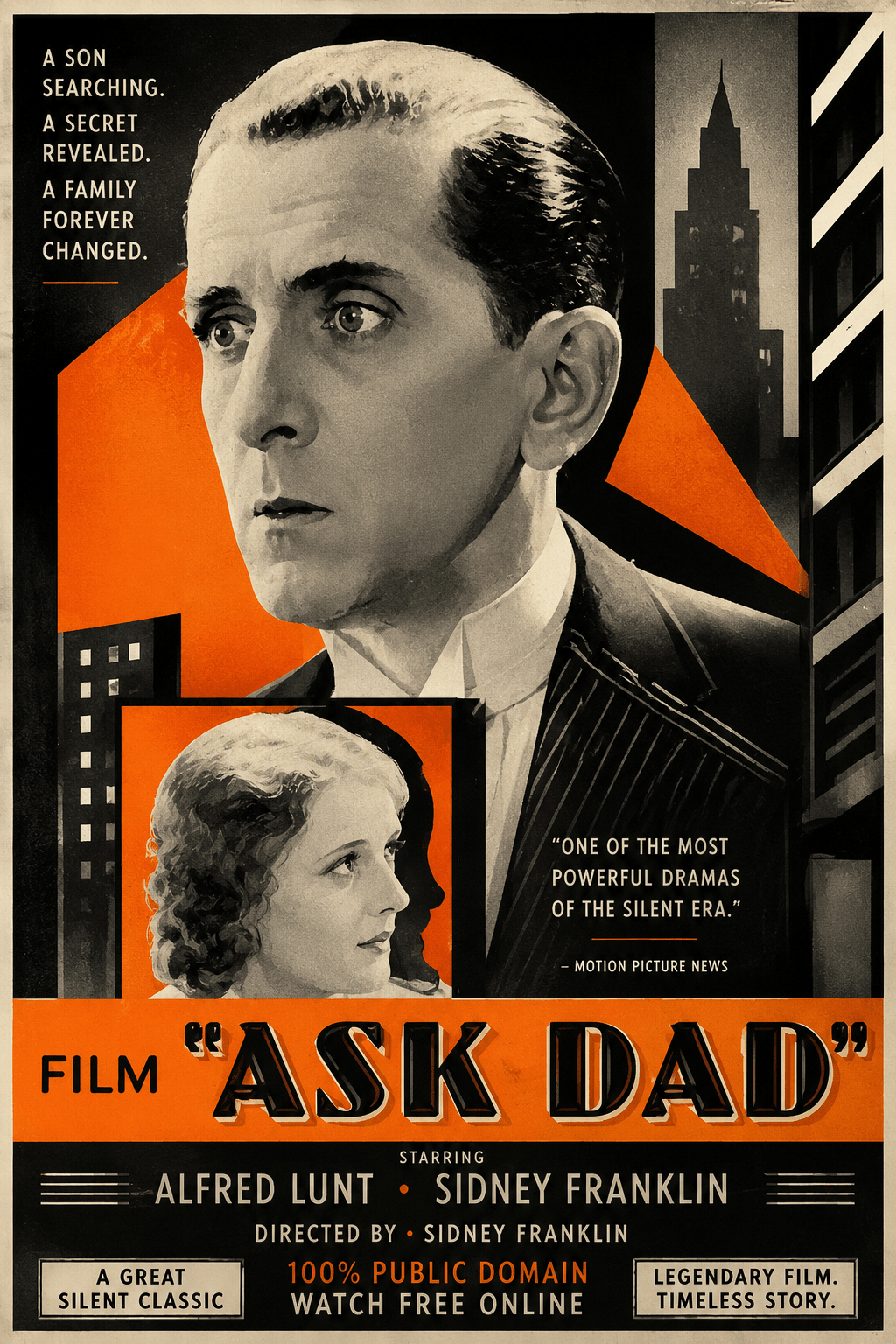
Edward Everett Horton was the most reliable comic character actor in early sound Hollywood, and the reason for that reliability is visible in every film he made — including this one, a Pre-Code short from 1929 that most people have never heard of and that runs for perhaps fifteen minutes. The character he plays is always some variation on the same man: intelligent, anxious, a little too aware of social expectations, and constitutionally unable to navigate any situation without making it considerably worse than it needed to be.
He played that man in Fred Astaire films, in Frank Capra films, in dozens of shorts and features across four decades. In Ask Dad he plays him in a domestic comedy produced by Coronet Comedies under producer E.W. Hammons, and he plays him with exactly the same precision he brought to everything else.
The film is 1929. Sound is new. Pre-Code Hollywood is in full operation — which means the industry’s content was not yet subject to the systematic censorship that the Production Code enforcement would impose after 1934. That context matters less for a short domestic comedy than it would for a drama or a crime picture, but it does mean that the film operates with a lightness and a directness that the mid-1930s version of Hollywood would have handled more carefully. The title is the premise: a son asks his father something. What follows is Horton managing the situation with characteristic ineptitude and complete conviction.
Ask Dad 1929 — Movie Overview Table
| Detail | Information |
|---|---|
| Title | Ask Dad |
| Release Date | 1929 |
| Country | United States |
| Genre | Pre-Code Comedy, Short Film |
| Language | English |
| Format | Sound (early talkie era) |
| Director | Hugh Faulcon |
| Producer | E.W. Hammons |
| Production Company | Coronet Comedies |
| Era | Pre-Code Hollywood (before 1934 Production Code enforcement) |
| Notable | Early sound-era short featuring Edward Everett Horton; Winston Miller later became a prominent Hollywood screenwriter |
| IMDb | Listed under tt0349106 |
| Public Domain | Yes — freely available to stream and download |
Full Cast — Ask Dad (1929)
| Actor | Role |
|---|---|
| Edward Everett Horton | Dad |
| Winston Miller | Tommy |
| Ruth Renick | Miss Grace Wilson |
Edward Everett Horton in 1929 — What He Was Before He Was Famous
By 1929, Edward Everett Horton had been performing professionally for nearly two decades. He’d started in theatre, built a stage career in New York and Los Angeles, and made his first silent film appearances in the early 1920s. The transition to sound that transformed or ended the careers of many silent performers was, for Horton, a straightforward step — his gift was verbal as much as physical, and a medium that could capture both put him in a considerably stronger position than the one he’d occupied without dialogue.
Ask Dad sits right at the beginning of that transition period — 1929, when sound was still new enough that studios were figuring out what to do with it, and short comedy films were one of the primary testing grounds. Coronet Comedies, operating under producer E.W. Hammons, was among the companies producing these shorts in volume, and Horton was exactly the kind of performer they needed: reliable, technically precise, and capable of generating comedy without requiring elaborate setups or expensive production values.
What Horton brought to a short comedy in 1929, is what he brought to everything, a particular physical vocabulary of flustered intelligence. He moves through scenes like every object and social situation is just a little more complicated than it looks to anyone else, and his reaction to all that complexity is always to push harder, which, no surprise makes things worse. That whole pattern doesn’t really ask for a big budget or some ornate storyline. It requires an actor who can execute it with complete conviction, and Horton never failed to provide that.
The Premise — Dad, Tommy, and Miss Grace Wilson
The setup is contained entirely in the title and the three-person cast list. A son named Tommy (Winston Miller) needs to ask his father (Horton) something. The presence of Miss Grace Wilson (Ruth Renick) in the cast establishes the subject of that question with reasonable clarity — Tommy wants advice about a girl, or wants to introduce a girl to his father, or wants his father to help him with a situation involving a girl. The domestic comedy short of the late 1920s didn’t deal in complex dramatic architecture. It dealt in situations.
What makes the situation work is the gap between what Tommy needs from his father and what his father is actually capable of providing. Horton’s Dad is not a man who has mastered the art of romantic advice or social navigation — he is a man who has managed to project competence for long enough that he’s now expected to deliver it on request. The comedy lives in the delivery gap: the effort is genuine, the result is catastrophic, and the conviction with which Horton pursues the wrong outcome is what makes it funny rather than just awkward.

The Pre-Code context gives the film room to be direct about whatever the romantic situation involves without the euphemistic circumlocutions that post-1934 Hollywood would have required. A 1929 short comedy about a son asking his father for help with a girl can be frank in ways that a 1936 version of the same material couldn’t have been.
Pre-Code Hollywood — The Era That Produced This Film
Pre-Code Hollywood is kind of the span between when synchronised sound first arrived in the late 1920s and when the Motion Picture Production Code actually got enforced in July 1934. In those six or seven years, American films sort of ran in a more permissive content climate — studios had agreed, at least in principle, to a code of conduct in 1930, but the real enforcement was uneven, and people frequently flouted it. So the movies made in that window regularly showed things the enforced Code years simply would not have allowed.
For a short comedy like Ask Dad, the Pre-Code era means something more modest than it does for, say, a Warner Bros. crime picture or a pre-Code drama with explicit sexual content. It means the freedom to be direct, to let the situation be what it is without softening it into acceptable ambiguity, to trust the audience to understand an adult situation without having it translated into approved language. Short comedies of the period didn’t push against the code in dramatic ways — they just didn’t bother to accommodate it, which in practice meant a lighter and more honest approach to domestic and romantic subjects.
The short comedy format itself was one of the primary vehicles for Pre-Code entertainment — produced quickly, distributed widely, consumed and forgotten faster than feature films. These shorts form one of the less-studied archives of early sound Hollywood, and Horton’s work in this format represents a significant body of evidence about what he was doing and how he was doing it before the major studio features made him famous.
Coronet Comedies and E.W. Hammons — The Production Context
E.W. Hammons built Educational Pictures into one of the most prolific producers of short comedy films in American cinema history. Operating outside the major studio system, Educational produced shorts at a volume that the major studios’ own short film units matched but rarely exceeded, and distributed them widely through independent and affiliated theatre chains across the country. The films were inexpensive, functional, and frequently featured performers who were either building toward major studio careers or maintaining working careers between larger productions.
Coronet Comedies was among the short comedy brands operating within this ecosystem. The names shifted and overlapped — Educational Pictures, Coronet, various series labels — but the underlying production model was consistent: find reliable comic performers, give them functional material, produce the films efficiently, distribute them to fill out theatre programmes. It was unglamorous work and it produced an enormous amount of content, much of which is now in the public domain precisely because the companies that produced it didn’t survive long enough to maintain copyright registrations.
Horton worked within this system alongside his major studio projects throughout the late 1920s and early 1930s — not because he lacked better options but because the short comedy format was steady work that kept his specific skills in practice. The discipline of generating comedy in a compressed format, without the support of a large cast or an elaborate plot, is exactly the kind of discipline that his subsequent work in Astaire-Rogers musicals drew on directly.
Edward Everett Horton — The Career That Came After
If you came to Ask Dad through Horton’s later work, the trajectory from this 1929 short to the films that made him famous is worth tracing. The same year this film was made, he was also appearing in larger productions — his sound-era career was building rapidly. By the mid-1930s he was one of the most in-demand supporting comic actors in Hollywood.
His collaboration with Fred Astaire and Ginger Rogers at RKO defined a significant portion of his best-known work: he played Egbert Fitzgerald in The Gay Divorcee (1934), Horace Hardwick in Top Hat (1935), and Jeffrey Baird in Shall We Dance (1937). Those performances used exactly the character he’d been building in short comedies like this one — the socially anxious, well-meaning friend whose attempts to help invariably complicate matters — and deployed it in a context where the musical numbers gave the flustering somewhere to escalate toward.
Later still, a generation that hadn’t encountered the 1930s films knew Horton as the narrator of Fractured Fairy Tales on The Rocky and Bullwinkle Show — a role that used his vocal precision and comic timing in a format that required nothing else. Ask Dad is the early document — the point where the technique was already formed and the reputation had not yet caught up to it.
Winston Miller — The Supporting Actor Who Became a Screenwriter
Winston Miller plays Tommy — the son doing the asking — and his screen career in this period was modest: a young actor in short comedy productions, learning the craft in front of the camera. What makes him worth noting, in hindsight, is what he did after that, more or less. Miller went on become a screenwriter, and he kept contributing to a spread of Hollywood projects through the 1940s and 1950s, like John Ford’s My Darling Clementine (1946). His writing credit on that film — which is one of the more respected westerns in American cinema — really signals a career arc that runs from a comic supporting actor in 1929 short films, to someone who helped shape a major Ford production less than two decades later.
That arc is a kind of reminder too, about how many people working in the short comedy circuit in the late 1920s were basically figuring out where their professional lives were headed. Some stayed right in front of the camera and never really looked back. Some moved behind it. The short film format was, in part, a training ground — and Miller’s move from performing in shorts to writing features is a specific instance of that pattern.
The Early Talkie Short — What Made This Format Work
The short comedy film occupied a specific and essential position in the early sound era programme. Feature films ran ninety minutes to two hours. Newsreels ran ten. Between them, and before them, and filling out the theatre programme in the way that contemporary streaming platforms fill recommendation queues, were short comedies — typically two reels, typically fifteen to twenty minutes, typically built around a single performer or a small ensemble working through a contained comic situation.
Sound transformed what the short comedy could do. Silent shorts had relied entirely on physical comedy and title cards to carry meaning — Keaton’s two-reelers, Chaplin’s Keystones, the Harold Lloyd Safety Last period. Sound shorts could carry dialogue, which meant they could do character comedy in a way that silent film required considerable ingenuity to approximate. Horton’s specific gift — the verbal flustering, the anxious explanation, the escalating attempt to clarify a situation that his words are only making worse — was essentially a sound-era gift. Ask Dad is an early demonstration of what that gift could do in the new format.
The format also suited the economics of the period. A short comedy with three speaking parts and domestic interiors required minimal production expenditure and could be shot quickly. For a producer like Hammons operating outside the major studio system, that efficiency was the business model. The creative constraint of limited resources, applied to a performer of Horton’s capability, produces comedy that depends on performance rather than production — which is a reasonably durable formula, as any viewer of these films can confirm ninety-five years later.
Where to Watch Ask Dad (1929) Free Online
Ask Dad is in the public domain and freely available. As a 1929 short comedy produced outside the major studio system, print quality on available copies varies — but the Internet Archive has the most reliable version currently accessible.
| Platform | Format | Cost |
|---|---|---|
| Internet Archive | Stream + Download (multiple formats) | Free |
| YouTube | Stream (occasional uploads; quality varies) | Free |
| Public Domain Movies | Stream | Free |
Ask Dad (1929) on Internet Archive:
Is Ask Dad (1929) in the Public Domain?
Yes. Ask Dad (1929) is in the public domain in the United States. Short comedy films produced by independent companies like Coronet Comedies in this period were rarely maintained under active copyright, and this one is freely and legally available to stream, download, and share without restriction or payment. You can find it openly on the Internet Archive among the public domain short film collections.
Critical Reception — Then and Now
As a short comedy produced for programme filler by an independent company in 1929, Ask Dad did not receive the kind of critical attention that feature films of the period attracted. Short comedies of this type were consumed as entertainment rather than assessed as art — they played before the feature, audiences watched them, and the critical apparatus of the period didn’t extend to reviewing them with any systematic depth.
What the film holds now is primarily archival and biographical interest — as an early example of Horton’s sound-era technique, as a document of the short comedy format at the beginning of the talkie period, and as a minor footnote in the careers of everyone involved. Its IMDb rating of 3.53 reflects a very small sample of viewers who came to it specifically rather than encountering it incidentally, and that sample is not large enough to constitute a meaningful critical consensus.
What any viewer who comes to it through Horton’s later work will find is the character already complete — the flustered intelligence, the verbal overcorrection, the absolute conviction with which wrong decisions are pursued. The major studio films refined the context around that character. In 1929, in a fifteen-minute comedy short with three people and domestic interiors, the character is already doing exactly what it would do for the next four decades.
Frequently Asked Questions — Ask Dad (1929)
Q: What is Ask Dad (1929) about?
Ask Dad is a short Pre-Code domestic comedy in which a son named Tommy (Winston Miller) turns to his father (Edward Everett Horton) for advice or assistance involving a young woman named Miss Grace Wilson (Ruth Renick). The comedy derives from the gap between what Tommy needs from his father and what his father is actually capable of providing — Horton’s signature character of flustered, well-intentioned incompetence applied to a domestic situation.
Q: Is Ask Dad (1929) in the public domain?
Yes. Ask Dad is in the public domain in the United States. Short comedy films produced by independent companies like Coronet Comedies in this period were not maintained under active copyright, and this film is freely and legally available to stream, download, and share via the Internet Archive and other public domain platforms.
Q: Who is Edward Everett Horton?
Edward Everett Horton was one of the most reliably employed comic character actors in Hollywood history, working from the silent era through the 1960s. He is best known for his supporting roles in the Fred Astaire and Ginger Rogers RKO musicals of the 1930s — including The Gay Divorcee (1934), Top Hat (1935), and Shall We Dance (1937) — and as the narrator of Fractured Fairy Tales on The Rocky and Bullwinkle Show.
Q: What is a Pre-Code Hollywood film?
Pre-Code Hollywood refers to American films made between the late 1920s and July 1934, before the systematic enforcement of the Motion Picture Production Code. During this period, films operated under a more permissive content environment — more direct about adult situations, less required to soften or euphemise subjects that the enforced Code years would later demand be handled carefully. For a short domestic comedy like Ask Dad, Pre-Code status means a lighter, more direct approach to its romantic subject matter.
Q: Who directed Ask Dad (1929)?
Hugh Faulcon directed the film. The production was produced by E.W. Hammons under the Coronet Comedies banner. Hammons operated Educational Pictures, one of the most prolific producers of short comedy films in the early sound era, distributing films through independent and affiliated theatre chains outside the major studio system.
Q: Who is Winston Miller and what happened to his career?
Winston Miller plays Tommy in Ask Dad. He appeared as a young actor in short comedy productions in the late 1920s before transitioning to screenwriting. His writing credits include John Ford’s My Darling Clementine (1946), one of the most respected westerns in American cinema — a significant career trajectory from 1929 short film performer to major Hollywood production contributor.
Q: What was Coronet Comedies?
Coronet Comedies was a short comedy film production brand operating under producer E.W. Hammons, who also ran Educational Pictures. The company produced short comedy films in volume during the late 1920s and early 1930s, distributing them to independent theatres as programme support material. Many of these films are now in the public domain because the companies that produced them did not survive long enough to maintain copyright registrations.
Q: What is the format and length of Ask Dad (1929)?
Ask Dad is a short comedy film, typical of the programme support films produced in volume during the early sound era. Short comedies of this period typically ran two reels — approximately fifteen to twenty minutes. They were produced quickly and inexpensively, designed to fill out theatre programmes alongside newsreels and feature films.
Q: Where can I watch Ask Dad (1929) for free?
Ask Dad is freely available on the Internet Archive and occasionally surfaces on YouTube. As a 1929 short produced by an independent company, print quality on available copies varies. The Internet Archive has the most reliable accessible version.
Q: Why is Ask Dad (1929) worth watching?
For viewers who know Edward Everett Horton from his 1930s major studio work, Ask Dad offers an early look at his technique — the same flustered, anxious comic character that later appeared in Fred Astaire films and Fractured Fairy Tales, already complete in 1929 in a fifteen-minute short comedy. It is also a document of the early sound era short comedy format at the beginning of the talkie period, and a minor footnote in the early careers of Winston Miller and Ruth Renick.
Related Free Classic Comedy and Short Films
If Ask Dad (1929) sent you further into early sound short comedies and Pre-Code public domain films, these are the natural places to keep going:
- Public Domain Horror Movies – Free Classic Scary Films Online
- Public Domain Cartoons
- Dixiana (1930) Full Movie Review, Plot, Cast & Free Musical Classic
- Public Domain Movies List – All Free Classic Films (Complete Guide)
Movie Tags
Ask Dad 1929, Ask Dad short film, watch Ask Dad 1929 free, Ask Dad public domain, Edward Everett Horton actor, Edward Everett Horton early career, Edward Everett Horton short films, Pre-Code Hollywood comedy, Pre-Code short film 1929, Coronet Comedies films, EW Hammons producer, Educational Pictures short comedies, Winston Miller actor screenwriter, Ruth Renick actress, early talkie comedy short, 1929 sound comedy film, domestic comedy Pre-Code, free classic short film online, public domain Pre-Code Hollywood, early sound era short comedy