
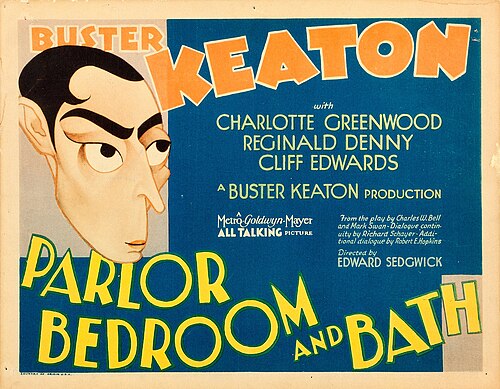
The house you’re watching for the first half of this film is real. It’s Buster Keaton’s actual home — a 10,000-square-foot Italian Mediterranean villa in Beverly Hills that he designed and planned down to the last architectural detail, the kind of estate that suggested, in 1931, a man at the peak of his earning power and creative control. By the time Parlor, Bedroom and Bath was shot inside it, Keaton had neither. He had signed away his independent production unit to join MGM in 1928 — a decision his friend Charlie Chaplin reportedly called the worst of his career — and by his third talking picture, he was being handed door-slamming Broadway farces from 1917 that he personally disliked, stripped of the directorial authority that had made The General and Sherlock Jr. into some of the most sophisticated comic filmmaking America had produced.
What survives in Parlor, Bedroom and Bath is a strange and genuinely fascinating document: a studio system grinding one of cinema’s great visual artists into a conventional farce performer, while that artist’s own house sits in the background as a monument to everything he was about to lose. The film is in the public domain. You can watch it free right now, and you can watch Buster Keaton’s actual swimming pool, actual staircase, and actual front lawn doing the work that his comic genius wasn’t permitted to do.
Parlor, Bedroom and Bath 1931 — Movie Overview Table
| Detail | Information |
|---|---|
| Title | Parlor, Bedroom and Bath |
| UK Release Title | Romeo in Pyjamas |
| Release Date | 1931 (spring release) |
| Country | United States |
| Runtime | 73 minutes |
| Genre | Pre-Code Comedy, Farce |
| Language | English (simultaneous French and German versions also produced) |
| Format | Black & White, Sound |
| Director | Edward Sedgwick |
| Producer | Buster Keaton (credited); Larry Weingarten (selected the project) |
| Based On | 1917 Broadway play by Charles W. Bell and Mark Swan (232-performance run) |
| 1920 Silent Version | Directed by Edward Dillon; starring Eugene Pallette and Ruth Stonehouse |
| Dialogue Continuity | Richard Schayer; additional dialogue by Robert E. Hopkins |
| Cinematography | Leonard Smith |
| Art Director | Cedric Gibbons |
| Editor | William LeVanway |
| Recording Director | Douglas Shearer |
| Studio | Metro-Goldwyn-Mayer |
| Filming Location | The Italian Villa — Buster Keaton’s own 10,000-sq-ft Beverly Hills estate |
| Foreign Versions | Buster se marie (French); Casanova wider Willen (German) — filmed simultaneously |
| Keaton’s Place in Career | His third talking picture, following the loss of his independent production unit |
| IMDb Rating | 6.1/10 |
| Public Domain | Yes — copyright not renewed |
Full Cast Table — Parlor, Bedroom and Bath (1931)
| Actor | Role |
|---|---|
| Buster Keaton | Reginald “Reggie” Irving |
| Charlotte Greenwood | Polly Hathaway |
| Reginald Denny | Jeffrey Haywood |
| Cliff Edwards | Bell Hop |
| Dorothy Christy | Angelica Embrey |
| Joan Peers | Nita Leslie |
| Sally Eilers | Virginia “Ginny” Embrey |
| Natalie Moorhead | Leila Crofton |
| Edward Brophy | Detective |
| Walter Merrill | Frederick Leslie |
| Sidney Bracey | Butler |
A Genius Without Creative Control — Keaton at MGM in 1931
To understand Parlor, Bedroom and Bath, you need to understand the specific catastrophe Buster Keaton’s career had become by the time it was made. Through the 1920s, Keaton ran his own independent production company, writing, directing, and starring in films that he controlled from concept through final cut — The General (1926), Sherlock Jr. (1924), and The Cameraman (1928), the last of which he made under his new MGM contract and which remains the high point of that arrangement. In 1928, against the advice of friends including Charlie Chaplin, Keaton dissolved his independent unit to sign with MGM directly — trading creative autonomy for studio resources and the financial security of a major contract.
The arrangement deteriorated quickly. MGM producer Larry Weingarten selected Parlor, Bedroom and Bath as a vehicle for Keaton after seeing a 1930 stage revival of the 1917 farce — a genre of “door-slamming” Broadway comedy that Keaton himself reportedly disliked and had no real affinity for. He was, by this point, simply assigned to projects rather than developing them. One contemporary assessment captures the pattern precisely: “Convinced that slapstick was not only finished but infra dig for a major star, Thalberg saddled him here with a Broadway farce from 1917, ploddingly handled in the ‘photographed stage play’ manner.” MGM had purchased the rights to dozens of stage plays during this period — cheap, pre-tested content to feed the new demand for talking pictures — and Keaton was simply slotted into whatever property needed a star.
What makes the film genuinely poignant rather than merely a curiosity is that traces of the old Keaton survive within the new constraints. He was permitted to recycle a stunt from his own 1920 short One Week — the gag where he’s nearly struck by a train, only to have a second train pass from the opposite direction at the exact moment of apparent impact — inserted into this film essentially unchanged. It’s the clearest evidence in the picture of what Keaton could still do when given even minimal room, and the clearest evidence of how little room he was actually given.
The Italian Villa — Watching Keaton’s Real Life Decorate His Fictional Decline
The entire first half of Parlor, Bedroom and Bath was filmed at the Italian Villa, Keaton’s actual Beverly Hills estate — a 10,000-square-foot Mediterranean mansion that he had personally designed down to the architectural details. Multiple film historians and reviewers identify this as the single most genuinely interesting thing about the picture today. As one retrospective review put it: “one of the film’s chief attractions today is the opportunity to glimpse the truly palatial home of a Hollywood star during the heyday of the studio era.”
The detail carries a weight that the film itself never acknowledges. Keaton’s home life in 1931 was already deteriorating alongside his career — his marriage to Natalie Talmadge was collapsing, his drinking was worsening, and within a few years he would lose both the house and the marriage entirely, eventually selling the Italian Villa during his bankruptcy. Watching him perform pratfalls and forced “ladies’ man” routines against the backdrop of his own soon-to-be-lost home, for a studio that was actively mismanaging his talent, gives the film a documentary quality that has nothing to do with its plot. One reviewer noted simply: “anyone who lives in the house on display in this film” seems, at that specific moment, impossible to feel too sorry for — a feeling the broader arc of Keaton’s 1930s makes considerably more complicated in retrospect.
Full Plot Summary — Parlor, Bedroom and Bath (1931)
Jeffrey Haywood (Reginald Denny) wants to marry Virginia “Ginny” Embrey (Sally Eilers). Ginny refuses to marry until her older sister, the impossibly hard-to-please Angelica (Dorothy Christy), marries first — she’s afraid of being seen as having passed over an “old maid” sibling. Angelica’s problem is specific and consistent: she finds every man she meets too dull, too predictable, too safe, and prefers to stay single rather than settle.

While distracted watching Angelica on the diving board of his own swimming pool — the Italian Villa’s actual pool — bill-poster Reggie Irving (Keaton) walks into the path of Jeffrey’s moving car and is struck. Jeffrey brings the injured, mild-mannered Reggie back to the Embrey mansion to recuperate. Angelica finds him handsome. Jeffrey, recognizing an opportunity, lies to her: Reggie isn’t a simple working man, he’s a notorious, wealthy playboy run out of Europe’s resort towns for his romantic exploits.
Building the Lothario — Polly’s Hopeless Tutoring Job
Angelica’s interest sharpens when several women — secretly hired by Jeffrey — arrive to fight over Reggie’s attention, manufacturing exactly the playboy reputation the lie requires. Reggie himself is alarmed by all of it: he genuinely finds Angelica attractive, but has no idea how to actually woo a woman and is terrified of being exposed as the ordinary man he is. He attempts to flee the situation entirely, only to be caught and re-concussed by the Embrey groundskeepers, acting on Jeffrey’s orders, and brought back to continue the charade.
Worried that Angelica will eventually see through Reggie’s obvious dullness, Jeffrey enlists Polly Hathaway (Charlotte Greenwood) — a society journalist — both to plant rumors about Reggie’s exploits and to personally tutor him in seduction technique. The plan involves booking Polly and Reggie into adjoining rooms at the Seaside Hotel, where she’s meant to teach him “how to treat a woman right” while staging a compromising scene for Angelica to discover, proving once and for all that Reggie is anything but dull.
The Hotel — Where the Film Actually Comes Alive
Reggie proves to be a catastrophic student. The hotel sequence rapidly spirals into a door-slamming farce in the most literal sense: mistaken identities, a jealous husband (Walter Merrill as Frederick Leslie) whose wife Nita (Joan Peers) keeps colliding with Reggie’s increasingly chaotic seduction attempts, a bellhop (Cliff Edwards) who walks in at exactly the wrong moment with metronomic regularity, and Reggie ending up in compromising positions with a rotating cast of women he never intended to be alone with. The chaos builds toward the exposure, confusion, and reconciliation the genre demands — with multiple reviewers noting that this back half of the film, freed from the more stagebound first act at the Embrey mansion, is where the picture’s energy and Keaton’s actual comic instincts finally get room to operate.
Charlotte Greenwood — The Performer Critics Agree Saves the Film
If there’s a single point of consensus across nearly a century of reviews of Parlor, Bedroom and Bath, it’s that Charlotte Greenwood’s performance as Polly Hathaway is the film’s genuine highlight — and that her chemistry with Keaton is the one element that fully works. Turner Classic Movies’ assessment is unambiguous: “best of all, unquestionably, is the eccentric, loose-legged Charlotte Greenwood… her sharp line delivery and physical agility make her a formidable match for Keaton.”
Greenwood was a genuine stage talent — tall, athletically gifted, with a high-kicking physical comedy style that few performers of her era could match. Her work here was significant enough that Rodgers and Hammerstein later conceived the role of Aunt Eller specifically for her in the original 1943 Broadway production of Oklahoma!, though scheduling prevented her from playing it until the 1955 film version. Contemporary 1931 reviews recognized her immediately: Mordaunt Hall of the New York Times praised her “marvelous energy and acrobatics,” and Photoplay‘s review delivered one of the more memorable lines written about the film: “until you’ve seen giraffy Charlotte and half-pint Buster neck, you haven’t seen necking.”
The physical comedy Keaton and Greenwood generate together — including a sequence where Keaton lifts the considerably taller Greenwood overhead while kissing her, and another where she performs full splits while playing unconscious — represents the film’s clearest evidence that Keaton’s underlying skill hadn’t disappeared. It had simply been handed the wrong material, with one exceptional scene partner who happened to fit it anyway.
The Play’s Long Broadway Run and Charles W. Bell’s Unusual Second Career
The source material — Parlor, Bedroom and Bath, by Charles W. Bell and Mark Swan — opened on Broadway on Christmas Eve, 1917, and ran for 232 performances, a substantial success by the standards of the period. By the time MGM optioned it for Keaton in 1930, the play had remained popular enough to support stage revivals for over a decade, which is precisely what brought it to producer Larry Weingarten’s attention.
Charles W. Bell himself had an unusual second career entirely outside theatre: he was a practicing Canadian criminal lawyer who went on to serve as a Member of Parliament for the riding of Hamilton West. A working Canadian MP co-writing a hit Broadway sex farce that would later become a vehicle for one of America’s greatest silent comedians is exactly the kind of biographical detail that tends to get lost in standard plot summaries — and it’s a reminder that the pipeline between Broadway and early talkie Hollywood ran through some genuinely unexpected source material.
The 1920 silent film version, directed by Edward Dillon, starred Eugene Pallette and Ruth Stonehouse — a decade before Pallette would become one of Hollywood’s most recognizable character actors with his distinctive gravelly voice. Some accounts suggest Pallette was involved in the production side of this 1931 remake as well, though not as a cast member.
Three Languages, One Set — The Multi-Version Production
Before dubbing technology became standard, Hollywood studios in the early sound era frequently solved the foreign-market problem by shooting entirely separate versions of the same film in different languages, often using the same sets and sometimes the same scene blocking with different casts. MGM produced two such versions of Parlor, Bedroom and Bath simultaneously: Buster se marie in French and Casanova wider Willen in German. This was a substantial undertaking even for a major studio, and it underscores how much commercial confidence MGM still placed in the project despite Keaton’s own reservations about the material — international audiences were considered a real enough market to justify the expense of essentially remaking the film twice more, back to back, on the same production schedule.
Where to Watch Parlor, Bedroom and Bath (1931) Free Online
Parlor, Bedroom and Bath is in the public domain and legally available across multiple platforms at no cost.
| Platform | Format | Cost |
|---|---|---|
| Internet Archive | Stream + Download (multiple formats) | Free |
| YouTube | Stream | Free |
| Public Domain Movies | Stream | Free |
| Industrial Strength Keaton DVD | Restored print with commentary track and Italian Villa featurette | Paid |
Parlor, Bedroom and Bath (1931) on Internet Archive:
Is Parlor, Bedroom and Bath (1931) in the Public Domain?
Yeah, Parlor, Bedroom and Bath (1931) is kinda in the public domain in the United States, since the copyright just… wasn’t renewed under the older pre 1978 U.S. system. So basically you can legally stream it, download it, share it, and even screen it, with no restrictions at all no payment either.
Critical Reception — Then and Now
The film holds a 6.1 out of 10 on IMDb — a score that reflects exactly the divided response the film has generated since 1931. Contemporary reviews at the time were generally positive: both Mordaunt Hall at the New York Times and Variety praised Keaton’s slapstick alongside Greenwood’s physical comedy, and the film was, by most accounts, well received on release.
Modern reassessment is more conflicted, and almost entirely organized around the same central tension: how much of the “real” Keaton survives inside material this fundamentally unsuited to him. One frequently echoed sentiment captures the prevailing modern mood: “Watching Buster Keaton’s movies after 1929, where he no longer had creative control, is a bit like seeing a magnificent animal in a zoo… we cannot help but feel sad for him.” Time Out’s assessment is harsher still, calling it “pitiful to watch” and noting the plot “prevents him from developing a single gag.” But a substantial counter-current exists too — defenders who argue the film is unfairly dismissed by reputation alone, with one Amazon reviewer insisting it’s “very, very funny, and certainly comparable to… Battling Butler,” one of Keaton’s lesser silent features.
The most balanced reading treats the film exactly as what it is: a transitional document. Not a Keaton film in the way his independent silent features were Keaton films, but a genuine record of what a great comic artist could still produce — in flashes, in scenes with Greenwood, in a recycled train gag — even after the industry had stripped him of the control that made him great in the first place.
Frequently Asked Questions — Parlor, Bedroom and Bath 1931
Q: What is Parlor, Bedroom and Bath (1931) about?
A mild-mannered bill-poster is accidentally injured by a car and brought to a wealthy family’s mansion to recover. To help the family’s older daughter find a husband (a precondition for her younger sister’s own marriage), the bill-poster is falsely passed off as a notorious international playboy, with chaotic results once he’s sent to a hotel to learn actual seduction technique from a society journalist.
Q: Is Parlor, Bedroom and Bath in the public domain?
Yes. The film is in the public domain in the United States because its copyright was not renewed. You can legally stream, download, and share it for free.
Q: Was Parlor, Bedroom and Bath filmed in Buster Keaton’s real house?
Yes. The entire first half of the film was shot at the Italian Villa, Keaton’s actual 10,000-square-foot Mediterranean estate in Beverly Hills, which he personally designed. It’s widely cited by reviewers as one of the film’s most genuinely interesting elements today, offering a rare glimpse of a major studio star’s real residence during the height of the studio era.
Q: Why is this considered one of Buster Keaton’s weaker films?
By 1931, Keaton had lost the independent production control that made his 1920s silent features (The General, Sherlock Jr., The Cameraman) into classics. MGM assigned him to pre-purchased Broadway farces like this one, stripping away his directorial input. Many critics and Keaton fans view his MGM talkies, including this film, as evidence of a great comic artist constrained by material and a studio system unsuited to his strengths.
Q: Who plays opposite Keaton, and is she good?
Charlotte Greenwood plays Polly Hathaway, and her performance is consistently cited as the film’s best element. Her physical comedy chemistry with Keaton is widely praised, and Rodgers and Hammerstein later wrote the role of Aunt Eller in Oklahoma! specifically with her in mind.
Q: Is Parlor, Bedroom and Bath based on a play?
Yes. It’s based on a 1917 Broadway farce by Charles W. Bell and Mark Swan that ran for 232 performances. Bell, unusually, was also a practicing Canadian criminal lawyer who later served as a Member of Parliament for Hamilton West. A 1920 silent film version starred Eugene Pallette.
Q: Were other-language versions of this film made?
Yes. MGM simultaneously produced a French-language version (Buster se marie) and a German-language version (Casanova wider Willen) — a common early-sound-era practice before dubbing technology was standard, allowing studios to reach international markets with separately filmed versions of the same story.
Q: Does this film reuse any gags from Keaton’s silent films?
Yes. A train-track stunt sequence is recycled essentially unchanged from Keaton’s 1920 silent short One Week — one of the clearest moments in the film where his original silent-era comic sensibility breaks through the more conventional studio material surrounding it.
Q: What was the UK release title for this film?
The film was released in the United Kingdom as Romeo in Pyjamas.
Q: Where can I watch Parlor, Bedroom and Bath (1931) for free?
The film is freely available on the Internet Archive, YouTube, and Public Domain Movies. All versions are legal to stream and download under public domain status. For the sharpest picture quality, the Warner Archive ‘Industrial Strength Keaton’ DVD set offers a restored print with commentary.
Related Free Classic Silent and Comedy Films
If Parlor, Bedroom and Bath (1931) drew you into Buster Keaton’s filmography and early Hollywood comedy, these are the natural titles to explore next:
- Public Domain Cartoons
- Public Domain Horror Movies – Free Classic Scary Films Online
- Reign of Terror (1949) Full Movie Review, Plot, Cast & Free French Revolution Classic
- Public Domain Movies List – All Free Classic Films (Complete Guide)
Movie Tags
Parlor Bedroom and Bath 1931, Parlor Bedroom and Bath full movie, watch Parlor Bedroom and Bath free, Parlor Bedroom and Bath public domain, Buster Keaton MGM talkies, Buster Keaton Italian Villa mansion, Buster Keaton 1931 film, Charlotte Greenwood actress, Charlotte Greenwood Oklahoma Aunt Eller, Reginald Denny actor, Edward Sedgwick director, Cliff Edwards bellhop, pre-Code comedy 1931, Romeo in Pyjamas, Broadway farce film adaptation, Keaton creative control MGM, One Week train gag recycled, free classic Buster Keaton movie online, 1931 sound comedy public domain, Keaton sound era decline