
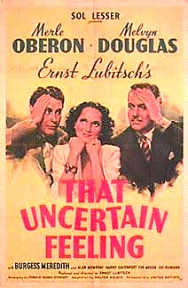
Ernst Lubitsch made about eighty four minutes of romantic comedy in 1941, and he called it That Uncertain Feeling, and i think the part most people never really notice is that the strongest bit of acting in it is actually Burgess Meredith playing Sebastian — a concert pianist, so neurotic, so ridiculously absorbed in himself, so loyal to the idea that ordinary human behaviour is kind of beneath him, that once he walks into a scene everything instantly turns into a question of whether the other characters can tolerate his presence .
Meredith was thirty three, and he had just come off Of Mice and Men. Later he would do Rocky, in between he did this, and somehow it counts as one of those more surprising comic turns in a movie directed by the same guy who invented the Lubitsch Touch.
The movie itself is basically a remarriage comedy, built on a psychoanalysis joke — a woman goes to a psychiatrist about nervous hiccups, starts poking holes in her completely comfortable marriage, then briefly falls for the wrong man, and eventually finds her way back, to the husband she almost left, who was actually the right one all along. The whole shape is very classic Lubitsch: take a social institution, apply a light but steady pressure, watch where it cracks, and then stitch it back together with enough cleverness that the audience feels smug or smart for staying with it.
That Uncertain Feeling 1941 — Movie Overview Table
| Detail | Information |
|---|---|
| Title | That Uncertain Feeling |
| Release Date | April 30, 1941 |
| Country | United States |
| Runtime | Approx. 84 minutes |
| Genre | Romantic Comedy, Screwball |
| Language | English |
| Format | Black & White |
| Director | Ernst Lubitsch |
| Producer | Ernst Lubitsch |
| Screenplay | Donald Ogden Stewart and Walter Reisch |
| Based On | Divorçons (1880 French play by Victorien Sardou and Émile de Najac) |
| Music | Werner R. Heymann (Academy Award nomination, Best Original Score) |
| Production / Distribution | United Artists |
| Notable Detail | Lubitsch’s second adaptation of Divorçons — he first filmed it as The Marriage Circle (1924) |
| Public Domain | Yes — freely available to stream and download |
Full Cast — That Uncertain Feeling (1941)
| Actor | Role |
|---|---|
| Merle Oberon | Jill Baker |
| Melvyn Douglas | Larry Baker |
| Burgess Meredith | Alexander Sebastian |
| Alan Mowbray | Dr. Vengard |
| Eve Arden | Sally Aikens |
| Harry Davenport | Jones (Larry’s lawyer) |
| Sig Ruman | Mr. Kafka |
| Mary Currier | Miss Travis |
| Olive Blakeney | Margie |
The Lubitsch Touch — What It Means and Where You Find It Here
The Lubitsch Touch is one of those critical terms that gets invoked often and explained rarely. In practice it describes, sort of, a particular technique of implication: Lubitsch would rather show you the door actually closing and then let you figure out what took place behind it, instead of staging the whole scene straight on. He relied on his viewers to finish the joke on their own, and that reliance — along with the more sophisticated writing and the careful precision of the performances — kind of built a comic style that seemed grown up in a way that most Hollywood output from that period didn’t really reach.
In That Uncertain Feeling, the Touch operates mostly through what Sebastian represents rather than what he does. He doesn’t seduce Jill in any conventional sense — he just exists in her vicinity and is comprehensively unlike her husband. Larry is pretty reasonable, mostly agreeable, professionally successful, and somehow emotionally uncomplicated. Sebastian, no… he’s none of that. He’s a full on personality mess, and Jill kinda finds that mess, briefly, more interesting than the steady comfort she already has.
Lubitsch doesn’t really judge her for it. He also doesn’t judge Larry. Larry deals with it with this smooth grace that the movie recognizes as its own special sort of strength. The comedy, well it comes from the distance between what Jill thinks she wants and what she actually needs. And then the film closes that distance, without turning anyone into a fool just because they were caught up there for a bit. That “Touch”… isn’t just one trick or technique either. It’s more like a steady attitude, toward the people on screen.
Full Plot Summary — That Uncertain Feeling (1941)
Jill Baker (Merle Oberon) has like everything that a certain sort of 1941 comedy wife is supposed to have, a successful husband, a cozy New York apartment, and a social position that keeps the right kind of people close to her at parties. She also gets a nervous hiccup too, chronic, embarrassing, and for reasons that sound mostly like psychosomatic. A friend tells her about Dr. Vengard (Alan Mowbray), a stylish psychiatrist, whose waiting room is full of folks in basically the same predicament, you know, similar straits and all that.
The Waiting Room — Where the Trouble Starts
In Dr. Vengard’s waiting room, Jill meets Alexander Sebastian (Burgess Meredith) — a concert pianist who has come to the psychiatrist not because he believes in psychiatry but because he seems to believe that suffering at the hands of an analyst is more distinguished than suffering without one. He is vain, theatrical, and fascinatingly impossible to manage in conversation. He speaks in monologues. He holds opinions about everything. He is completely unlike Larry.

Jill invites him to a dinner party. Sebastian arrives, dominates the room in the most irritating way imaginable, and proceeds to make Larry’s professional associates thoroughly miserable. Larry, who has the constitution of a man who has decided life is too short for unnecessary conflict, is politely gracious throughout. Dr. Vengard’s sessions, meanwhile, have been nudging Jill toward the conclusion that her hiccups are the physical expression of marital dissatisfaction. She begins to believe this. It suits her, for a while, to believe it.
The Separation — and Sebastian in the Apartment
Larry, with characteristic reasonableness, agrees to a separation. He doesn’t make a scene. He doesn’t fight. He makes arrangements, moves out, and handles the dissolution of his marriage with the same competent efficiency he applies to everything else. Jill and Sebastian begin spending time together in earnest.
It becomes clear, fairly quickly, that Sebastian is considerably more manageable as a romantic fantasy than as a daily reality. His eccentricities — charming as contrast to Larry’s steadiness — are exhausting as the primary feature of a living arrangement. He practices piano at unsuitable hours. He has positions on subjects that don’t warrant positions. He is, in short, exactly what he appeared to be in the waiting room, and Jill slowly recognises that she has traded something functional for something that only looked more interesting from a distance.
The Reunion — and the Hiccups That Cure Themselves
The film’s resolution comes through a sequence of romantic misunderstandings, a man imitating a woman sobbing in the next room, and the accumulated weight of Jill realising that the dissatisfaction she brought to Dr. Vengard was never really about Larry. It was about a version of her life that she’d decided, without much examination, wasn’t enough.
Larry and Jill reunite. The hiccups disappear. Lubitsch frames the cure not as a medical event but as an emotional one — the psychosomatic symptom resolving itself once the underlying question is settled. It’s the Lubitsch Touch applied to a plot point rather than a scene: the implication is clear, the mechanism is left offscreen, and the audience fills in everything that matters.
Burgess Meredith as Sebastian — The Performance That Holds the Film Together
Burgess Meredith had the kind of career that defies simple categorisation. He was a serious stage actor — trained, respected, capable of carrying weight. He was also a character performer with a gift for comic eccentricity that major dramatic roles didn’t always give him room to use. Sebastian is the role where those two things are present simultaneously in the most productive proportion.
What makes the performance work is that Meredith never plays Sebastian as a joke. He plays him as a man who is entirely sincere about his own significance — which is what makes him both unbearable and oddly compelling as a screen presence. You understand completely why Jill is briefly taken with him, because Meredith gives Sebastian enough genuine intensity that his appeal is legible. You also understand, at exactly the same pace Jill does, why that intensity becomes suffocating.
The scene where Sebastian performs at the piano is the clearest demonstration of this. He plays well. The music is real. And yet the performance manages to be simultaneously impressive and an act of aggression against everyone in the room — which is exactly the contradiction that defines the character. Meredith holds that contradiction without resolving it, and the film is better for it throughout.
Melvyn Douglas as Larry — the Straight Man Who Isn’t Straight
Melvyn Douglas spent a good portion of the 1930s playing opposite Greta Garbo — in Ninotchka (1939), in Two-Faced Woman (1941) — and developed in that time a specific comic skill: how to be funny while appearing to be completely serious. Larry Baker uses that skill throughout That Uncertain Feeling.
Larry is not the villain of this film. He’s not even the obstacle. He’s the answer that Jill takes eighty minutes to recognise as an answer, and Douglas plays that position with a generosity toward the character that the screenplay doesn’t always make easy. Larry agrees to a separation. Larry is polite to Sebastian in circumstances where politeness requires considerable internal resource. Larry waits. And Douglas makes the waiting something you want to watch rather than something you want to skip past.
The comedic irony built into the casting is that Douglas had just played opposite Garbo in a Lubitsch picture — and here he is again, in another Lubitsch picture, playing opposite a woman who needs to rediscover what she already has. Lubitsch clearly trusted him with this specific emotional register, and that trust was well placed.
Eve Arden and the Art of the Perfect Supporting Performance
Eve Arden plays Sally Aikens, and Eve Arden plays Sally Aikens the way she played every other part she ever had: with this dry , slightly world-weary intelligence that made each line sound like it was the last word on the matter . She was, basically, the most dependable scene-stealer in Hollywood for about three decades, and she does here what she always did—shows up, throws out something a bit more pointed than anyone else in the room has just said, and then vanishes before the rest of the characters have even properly clocked the fallout.
Sally functions as the film’s chorus — the friend who sees Jill’s situation with more clarity than Jill does and comments on it with the particular freedom that irony affords. Arden plays the role without softening the edges. Sally’s observations aren’t kind exactly, but they’re accurate, and in a film about a woman who needs to see her own situation more clearly, that accuracy is a form of friendship.
Divorçons — The Source Material and What Lubitsch Did With It Twice
That Uncertain Feeling kind of comes from Divorce ons, an 1880 French comedy play by Victorien Sardou and Émile de Najac, it’s one of those stories about a wife who keeps pushing for a divorce, and then, somehow, finds out that her husband was already the thing she really wanted. The play had a notable stage triumph in its day, and it got reworked for the screen many times, both in the silent period and later when sound came around.
Lubitsch had sort of filmed the same material once before , as The Marriage Circle in 1924, a silent movie people often treat as one of the top comedies of that decade. Returning to the same source seventeen years later wasn’t nostalgia. It was a filmmaker recognising that the material had more in it than a single treatment could exhaust, and that the addition of sound — of dialogue as a primary comic instrument — would let him find things in the story that silent film couldn’t reach.
The psychoanalysis framing is entirely Lubitsch’s addition. Sardou’s original play doesn’t have a psychiatrist. Bringing one in — and making the therapy sessions the mechanism through which Jill’s dissatisfaction gets named and therefore validated — was a 1941 update that made the material speak to a contemporary audience and gave Alan Mowbray one of the film’s quietly funniest roles.
Where to Watch That Uncertain Feeling (1941) Free Online
That Uncertain Feeling is in the public domain and freely available across multiple platforms. The print quality on Archive.org is reliable for a 1941 United Artists release.
| Platform | Format | Cost |
|---|---|---|
| Internet Archive | Stream + Download (multiple formats) | Free |
| YouTube | Stream (multiple uploads; quality varies) | Free |
| Tubi | Stream (with ads; often in classic romance collections) | Free |
| Public Domain Movies | Stream | Free |
That Uncertain Feeling (1941) on Internet Archive:
Is That Uncertain Feeling (1941) in the Public Domain?
Yes. That Uncertain Feeling (1941) is in the public domain in the United States. The film’s copyright was not renewed under the terms that were required for works of its period, and it has been freely and legally available for some decades. You can stream it, download it, share it, and screen it without restriction or payment.
The Internet Archive copy is the most reliable version for downloading, and the download link above points to the 512kb MP4 — a clean, watchable file for a film of this age and format.
Critical Reception — Then and Now
When it came out, that uncertain feeling got a kind of polite reception, but not too much enthusiasm really. It didnt become a big box office hit, and it slipped in between The Shop Around the Corner (1940) and To Be or Not to Be (1942, two of Lubitsch’s finest and most well-regarded films), so it ended up in a sort of shadow that it may not have fully deserved. Trade reviews pointed to the wit and the performances and overall it was read as, more of a lesser Lubitsch than a major one. That interpretation has mostly stuck around ever since.
Werner R. Heymann’s score actually earned an Academy Award nomination for Best Original Score, which was sort of a nod to the one part of the production, reviewers seemed to agree on without much debate, it was genuinely excellent.
Modern viewing tends to elevate it above its period reputation. Viewers who approach it as Lubitsch rather than as a romantic comedy genre exercise find more in it than the minor-work framing suggests — specifically the Burgess Meredith performance, which looks better and stranger the further it gets from its original context. The film has developed a specific audience among classic Hollywood comedy enthusiasts who know that a minor Lubitsch still has more craft in it than most directors’ best work. That audience isn’t wrong.
Frequently Asked Questions — That Uncertain Feeling (1941)
Q: What is That Uncertain Feeling (1941) about?
A comfortably married New York woman named Jill Baker develops a nervous hiccup, visits a fashionable psychiatrist, and begins questioning her marriage to her reliable husband Larry. She becomes briefly involved with Alexander Sebastian, a neurotic concert pianist she meets in the waiting room. After discovering that Sebastian is considerably more manageable as a fantasy than a daily presence, she reconciles with Larry — and the hiccups cure themselves.
Q: Is That Uncertain Feeling (1941) in the public domain?
Yes. That Uncertain Feeling is in the public domain in the United States. The film’s copyright was not renewed and it has been freely and legally available for decades. You can stream, download, and share it at no cost via the Internet Archive, YouTube, Tubi, and other public domain platforms.
Q: Who directed That Uncertain Feeling?
Ernst Lubitsch directed and produced the film. Lubitsch was one of Hollywood’s most sophisticated comedy directors, known for the Lubitsch Touch — a technique of implication and restraint that trusted audiences to complete the joke themselves. That Uncertain Feeling was his second adaptation of the same source material; he first filmed it as the silent comedy The Marriage Circle (1924).
Q: Who plays the neurotic pianist in That Uncertain Feeling?
Burgess Meredith plays Alexander Sebastian — a concert pianist of spectacular self-regard whose eccentricities make him briefly attractive as an alternative to Jill’s comfortable marriage and exhausting as an actual presence. Meredith plays the role with complete sincerity, which is what makes Sebastian both funny and legible as a romantic complication.
Q: What is the source material for That Uncertain Feeling?
The film is based on Divorçons, an 1880 French comedy play by Victorien Sardou and Émile de Najac. Lubitsch had previously adapted the same play as The Marriage Circle (1924). The psychoanalysis framing — including the psychiatrist character Dr. Vengard — is Lubitsch’s own addition to the original material, updating the story for a 1941 audience.
Q: Did That Uncertain Feeling receive any Academy Award nominations?
Yes. Werner R. Heymann was nominated for the Academy Award for Best Original Score for his work on the film. It was the film’s sole Oscar nomination. That Uncertain Feeling was not a major box office success on release, landing between two of Lubitsch’s most celebrated films — The Shop Around the Corner (1940) and To Be or Not to Be (1942).
Q: What is the Lubitsch Touch and how does it appear in this film?
The Lubitsch Touch describes Lubitsch’s technique of implication — showing the door closing rather than staging what happens behind it, trusting the audience to complete the comedy themselves. In That Uncertain Feeling, it operates through what Sebastian represents rather than what he does, through Larry’s graceful restraint in accepting the separation, and in the final scene where Jill’s hiccups resolve — the cure is emotional rather than medical, and Lubitsch frames it entirely through suggestion.
Q: Is Melvyn Douglas good in That Uncertain Feeling?
Yes. Melvyn Douglas plays Larry Baker — the husband whose apparent steadiness Jill briefly mistakes for limitation — with a specifically comic skill he’d developed playing opposite Greta Garbo in Ninotchka (1939) and other Lubitsch collaborations: how to be funny while appearing completely serious. His performance makes Larry someone the audience wants to see Jill return to, which is the structural job the film needs him to do.
Q: Where can I watch That Uncertain Feeling (1941) for free?
That Uncertain Feeling is freely available on the Internet Archive, YouTube, Tubi, and various public domain film platforms. The Internet Archive has the most reliable copy for downloading, available in multiple formats including a clean 512kb MP4.
Q: How does That Uncertain Feeling compare to other Lubitsch films?
It is generally considered minor Lubitsch — ranked below Ninotchka, The Shop Around the Corner, Trouble in Paradise, and To Be or Not to Be in most critical assessments. That ranking undersells it somewhat. Viewed as a standalone romantic comedy rather than as a competitor to Lubitsch’s best work, it holds up strongly — particularly for the Burgess Meredith performance, Eve Arden’s scene-stealing, and the characteristic wit of the Donald Ogden Stewart and Walter Reisch screenplay.
Related Free Classic Romance and Comedy Films
If That Uncertain Feeling (1941) sent you further into classic Hollywood romantic comedy and public domain screwball films, these are the natural places to keep going:
- Public Domain Horror Movies – Free Classic Scary Films Online
- Public Domain Cartoons
- Bird of Paradise (1932) Full Movie Review, Plot, Cast & Free Classic Romance Film
- Public Domain Movies List – All Free Classic Films (Complete Guide)
Movie Tags
That Uncertain Feeling 1941, That Uncertain Feeling full movie, watch That Uncertain Feeling free, That Uncertain Feeling public domain, Ernst Lubitsch director, Lubitsch Touch explained, Merle Oberon actress, Melvyn Douglas actor, Burgess Meredith early career, Eve Arden supporting actress, Alan Mowbray actor, Divorçons film adaptation, Marriage Circle 1924 remake, Werner Heymann Oscar nomination, United Artists 1941 comedy, Hollywood screwball comedy public domain, free classic romantic comedy online, 1940s marriage comedy film, psychoanalysis comedy 1941, classic Hollywood romance free