
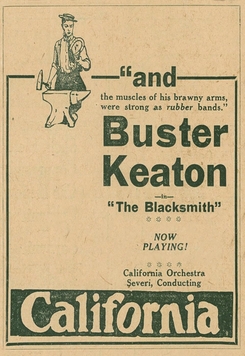
In the mid-1950s, actor James Mason bought a mansion in Beverly Hills once owned by Buster Keaton. While exploring the property, he discovered a private vault containing several of Keaton’s original 35mm nitrate prints — film elements nobody knew had survived. Mason donated them to the Academy of Motion Picture Arts and Sciences, and for decades afterward, the version of The Blacksmith (1922) contained in that vault was the only version anyone knew existed. Then in June 2013, Argentine film historian Fernando Martín Peña — the same researcher who had previously unearthed the complete cut of Fritz Lang’s Metropolis (1927) — found a second version of the film with an entirely different final reel.
A third version, with at least one scene found in neither of the other two, turned up afterward in the archives of the former distributor Blackhawk Films. The Blacksmith is a 25-minute two-reel silent comedy starring Buster Keaton as the most catastrophically incompetent blacksmith’s assistant in cinema history. It exists, as far as anyone has been able to determine, in three meaningfully different cuts — making it one of the most studied textual puzzles in all of silent comedy. It is in the public domain. And you can watch it free right now, gag for chaotic gag.
The Blacksmith 1922 — Movie Overview Table
| Detail | Information |
|---|---|
| Title | The Blacksmith |
| Release Date | July 21, 1922 |
| Country | United States |
| Runtime | ~25 minutes (two reels) |
| Genre | Silent Comedy, Short Film |
| Language | Silent (English intertitles) |
| Format | Black & White, Silent |
| Directors | Buster Keaton, Malcolm St. Clair |
| Writers | Buster Keaton, Malcolm St. Clair |
| Producer | Joseph M. Schenck |
| Cinematography | Elgin Lessley |
| Distributor | First National Pictures |
| Known Versions | Three distinct cuts (Mason vault version; Peña 2013 discovery; Blackhawk Films archive version) |
| Restoration Note | Multiple versions preserved by Academy of Motion Picture Arts and Sciences |
| IMDb Rating | 7.0/10 |
| Public Domain | Yes — freely available to watch and download |
Full Cast Table — The Blacksmith (1922)
| Actor | Role |
|---|---|
| Buster Keaton | Blacksmith’s Assistant |
| Joe Roberts | The Blacksmith |
| Virginia Fox | The Horsewoman |
| Edward F. Cline | Supporting role |
| Billy Franey | Supporting role |
A Mystery in Three Reels — The Three Versions of The Blacksmith
What makes The Blacksmith exceptional within Keaton’s filmography has nothing to do with what happens on screen and everything to do with how many different screens there actually are. The version known in America for decades — the one preserved through James Mason’s vault discovery — appears, based on subsequent research, to date from mid-to-late 1921. Crucially, it contains none of the additional material that Fernando Peña would later uncover.
When Peña found his alternate cut in June 2013, the differences were not minor. Kevin Brownlow — one of the most respected silent film historians alive — wrote to Peña after seeing the discovery: “I have not seen European releases of American films which differ in any more than the odd shot, extra title or varying camera angle. Half a reel is unprecedented.” The Peña version’s final reel diverges completely from the familiar American cut. Most notably, the celebrated extended gag in which Keaton accidentally sprays oil across an entire white mare — a sequence audiences had considered a highlight of the film for decades — is entirely absent from the Peña print, replaced instead with Keaton driving through town, running over his own boss, and triggering a madcap chase sequence.
The Peña version also includes material that doesn’t exist anywhere in the familiar American cut: a father for Virginia Fox’s character, who makes a direct appearance; a chase sequence between Keaton and Joe Roberts around a small studio set built specifically as a fictional “Chamber of Commerce” building; and a marriage proposal sequence in which Keaton’s character pleads with Fox that he won’t always be a blacksmith — a scene that makes their subsequent elopement considerably more plausible than it is in the version most people have seen.
Film historians have since concluded that the rediscovered Peña version represents Keaton’s actual final cut — the version intended for the film’s wide July 1922 release — while the long-familiar American vault print was an earlier, privately held version that predates the additional reshoots. In other words: for nearly a century, the version most audiences thought of as “The Blacksmith” may not have been the film Keaton actually wanted the public to see.
A third version, distinct from both, turned up afterward in the archives of Blackhawk Films, a defunct film distributor — containing at least one sequence found in neither of the other two prints. Three different complete edits of a 25-minute two-reel comedy is, by any measure, an extraordinary survival pattern for a film from this period, and it has made The Blacksmith a genuine case study for silent film preservation scholars in ways that have nothing to do with its comedy.
Full Plot Summary — The Blacksmith (1922)
The film introduces Keaton’s character beside a palm tree — the first gag of the picture before the plot has even begun. The camera tilts slowly upward from the base of the tree toward its top, climbing and climbing until an extreme wide shot finally reveals just how short Keaton is compared to the impossibly tall, thin tree beside him. It’s a joke about scale delivered entirely through camera movement, with no dialogue and no slapstick required.
More Read

Keaton plays assistant to a large, intimidating blacksmith (Joe Roberts) — a frequent Keaton screen antagonist whose sheer physical bulk makes every confrontation between the two men visually comic before either of them does anything. Keaton’s clowning around the shop inadvertently provokes a fight with his boss. The blacksmith is arrested and taken to the police station, leaving Keaton alone to run the shop and serve the customers who arrive in his absence.
Catastrophe by Catastrophe — The Customers Keaton Ruins
What follows is a sustained sequence of escalating disasters as Keaton attempts — and fails — to competently serve every customer who walks through the door. He tries to shoe horses and repair automobiles with results that range from merely incompetent to genuinely destructive. In the version most commonly seen, he destroys a Rolls-Royce while attempting to fix the car parked next to it — a sequence widely cited as one of the film’s best because of how methodically it escalates from a small mistake into total vehicular destruction.
One of the film’s most beloved sequences involves Keaton devising an ad hoc shock-absorbing mechanism for a horse’s saddle — a piece of engineering improvisation that one reviewer specifically singled out as “rather genius,” in keeping with Keaton’s broader reputation for gags built on real mechanical logic rather than simple pratfalls. Virginia Fox appears as a horsewoman who brings her mount in for shoeing — and becomes, across the various versions of the film, Keaton’s romantic interest, with the scope of their relationship varying significantly depending on which cut you’re watching.
The Resolution — Versions Diverge
The blacksmith returns from custody and the customers Keaton has wronged arrive seeking revenge — converging on the shop for the film’s climactic chaos. From here, the two major known versions of the film genuinely part ways: the familiar American cut resolves around the oil-soaked white mare gag and a train sequence that multiple modern reviewers single out as one of the most purely beautiful pieces of slapstick destruction in silent comedy. The Peña version instead sends Keaton fleeing through town in a car, running over his own boss, and into the additional Chamber of Commerce chase sequence and the Virginia Fox marriage proposal that don’t exist in the other print. Both versions resolve the basic premise — chaos, consequence, eventual escape — but the specific path each takes to get there differs by roughly half a reel of footage, which is precisely what made Kevin Brownlow’s reaction to the discovery so significant.
Buster Keaton’s Mechanical Comedy — Why The Blacksmith Still Works
What separates The Blacksmith from generic slapstick of the same period is the same quality that defines all of Keaton’s best work: every gag operates on genuine mechanical or physical logic, even when the outcome is pure chaos. The shock-absorbing saddle mechanism isn’t just a funny prop — it’s an actual piece of invented engineering that a viewer can follow and understand. The oil-spraying mare gag escalates through a comprehensible chain of cause and effect rather than arbitrary slapstick. The Rolls-Royce destruction builds methodically from one small error to total catastrophe, each step legible and inevitable in retrospect.
A modern reviewer captured the film’s specific quality precisely: “Pure slapstick chaos. Buster Keaton turning manual labor into an art form of destruction. Almost a century later, the timing is still perfect.” That timing is the entire point — Keaton choreographed physical comedy with the precision of an engineer, and The Blacksmith, built around the literal mechanics of a workshop, gave him a setting where that precision could operate as both subject and method simultaneously.
Joe Roberts — Keaton’s Most Frequent Imposing Foil
Joe Roberts appeared opposite Keaton in numerous films during this period, almost always cast for the same essential quality: imposing physical size deployed as comic and dramatic counterweight to Keaton’s small, precise frame. As the blacksmith, Roberts provides the film’s necessary threat — a man whose anger feels genuinely consequential, which is exactly what makes Keaton’s chaos in his absence land as funny rather than simply slight. The contrast between the two performers’ physicality is foundational to how the film’s comedy is structured from its very first scenes.
Malcolm St. Clair — Keaton’s Co-Director and Collaborator
Malcolm “Mal” St. Clair co-wrote and co-directed The Blacksmith alongside Keaton — a collaborative credit that is easy to overlook given how thoroughly Keaton’s authorial reputation has come to dominate discussion of his shorts. St. Clair would go on to a substantial directing career of his own through the silent and sound eras, working across comedy and drama at multiple studios. His contribution to The Blacksmith‘s construction — alongside cinematographer Elgin Lessley, whose camera work delivers the film’s opening palm-tree gag with the patience the joke requires — is part of the larger collaborative apparatus that made Keaton’s solo screen persona possible. The films credited to “Buster Keaton” during this period were, almost without exception, genuinely collaborative productions.
Where to Watch The Blacksmith (1922) Free Online
The Blacksmith is in the public domain and freely available across multiple platforms. Because multiple distinct versions of the film exist, the specific cut you encounter may vary depending on the source.
| Platform | Format | Cost |
|---|---|---|
| Internet Archive | Stream + Download (multiple formats) | Free |
| YouTube | Stream (multiple uploads; versions vary) | Free |
| Public Domain Movies | Stream | Free |
The Blacksmith (1922) on Internet Archive:
Is The Blacksmith (1922) in the Public Domain?
Yes. The Blacksmith (1922) is in the public domain in the United States, having predated the modern copyright term and never having its registration renewed under the pre-1978 system. You can legally stream, download, share, and screen it without restriction or payment. Note that, due to the film’s unusual preservation history, different free sources online may host different versions of the film.
Critical Reception — Then and Now
The movie shows a solid 7.0 out of 10 on IMDb, and it kinda points to its place as a real , even if small-ish entry in Keaton’s well known filmography of two-reel comedies, from those early 1920s years. Folks in reviews keep circling the same basics, relentless pacing , a high gag density, and this very particular delight in seeing Keaton’s growing cluelessness turn into something actually self destructive. It’s like you can feel the momentum, then the jokes just stack up and keep going, almost against his own interests.
One detailed analysis described the experience precisely: “Keaton makes twenty minutes of screen appear like 2. From the very beginning until the end, we never get bored.” A Letterboxd reviewer’s assessment of Keaton’s broader filmography, written specifically in response to this film, captures something genuine about his enduring appeal: “I’m sorry for entering a parasocial relationship with some guy born in the 1890’s whose accessible two-reelers have ruined my attention span for watching movies longer than 30 minutes.”
Critical opinion on the rediscovered Peña version specifically is more divided than reception of the original familiar cut — one Rotten Tomatoes reviewer who watched both versions noted bluntly, “Neither is particularly good,” a minority assessment that runs against the broader consensus but reflects the genuinely mixed critical standing of Keaton’s lesser-known two-reelers compared to his feature-length masterworks. What’s not in dispute, across every assessment, is the quality of individual gags — the saddle mechanism, the palm tree opening, the Rolls-Royce destruction — each cited repeatedly as evidence of Keaton’s specific genius for mechanically logical physical comedy.
Frequently Asked Questions — The Blacksmith 1922
Q: What is The Blacksmith (1922) about?
Buster Keaton plays an inept assistant to a large, intimidating blacksmith. After accidentally provoking a fight that gets his boss arrested, Keaton is left alone to run the shop — and proceeds to destroy nearly everything customers bring in, from horses needing new shoes to a Rolls-Royce parked outside, leading to escalating catastrophe and eventual revenge from the people he’s wronged.
Q: Is The Blacksmith in the public domain?
Yes. The Blacksmith (1922) is in the public domain in the United States. You can legally stream, download, and share it for free. Different online sources may host different versions of the film due to its unusual multi-version preservation history.
Q: How many versions of The Blacksmith exist?
At least three distinct versions are known to survive: the long-familiar American print preserved from James Mason’s discovery of Keaton’s private vault; an alternate version with a completely different final reel, discovered by Argentine historian Fernando Martín Peña in June 2013; and a third version found in the archives of former distributor Blackhawk Films, containing at least one scene absent from both other prints.
Q: Which version of The Blacksmith is the ‘real’ one?
Film historians now believe the Fernando Peña-discovered version represents Keaton’s actual final cut intended for wide release in July 1922, while the long-familiar American vault print is an earlier version that predates substantial reshoots Keaton undertook after a New York preview screening.
Q: Who directed The Blacksmith?
Buster Keaton co-directed and co-wrote the film with Malcolm St. Clair. Joseph M. Schenck produced. Elgin Lessley served as cinematographer. The film was distributed by First National Pictures.
Q: How was James Mason connected to The Blacksmith’s preservation?
Actor James Mason purchased Buster Keaton’s former Italian Villa mansion in Beverly Hills in the mid-1950s and discovered a private vault on the property containing several of Keaton’s original 35mm nitrate film prints, including The Blacksmith. He donated the discovery to the Academy of Motion Picture Arts and Sciences.
Q: Who is Virginia Fox in The Blacksmith?
Virginia Fox plays the horsewoman who brings her mount to the shop for shoeing and becomes Keaton’s romantic interest. Her role and the scope of the romance varies significantly between the different surviving versions of the film — the Peña version includes additional scenes with her character, including a marriage proposal sequence absent from the more familiar American cut.
Q: How long is The Blacksmith?
The film runs approximately 25 minutes — a standard two-reel short comedy for the period.
Q: Did Fernando Peña make other major film discoveries?
Yes. Fernando Martín Peña previously discovered a complete, uncut print of Fritz Lang’s Metropolis (1927) in the archives of Argentina’s Museo del Cine — one of the most significant film preservation discoveries of the 21st century. His discovery of the alternate Blacksmith cut in 2013 was described by historian Kevin Brownlow as unprecedented in scale for an American short film.
Q: Where can I watch The Blacksmith (1922) for free?
The Blacksmith is freely available on the Internet Archive, YouTube, and Public Domain Movies. All versions are legal to stream and download under public domain status.
Related Free Classic Silent Comedy and Buster Keaton Films
If The Blacksmith (1922) sent you deeper into silent comedy and public domain classic film, these are the natural titles to explore next:
- Public Domain Cartoons
- Public Domain Horror Movies – Free Classic Scary Films Online
- Reign of Terror (1949) Full Movie Review, Plot, Cast & Free French Revolution Classic
- Public Domain Movies List – All Free Classic Films (Complete Guide)
Movie Tags
The Blacksmith 1922, The Blacksmith full movie, watch The Blacksmith free, The Blacksmith public domain, Buster Keaton silent comedy, Buster Keaton short films, Joe Roberts actor, Virginia Fox actress, Malcolm St Clair co-director, Fernando Pena film discovery, James Mason Keaton vault, three versions Blacksmith Keaton, Keaton lost footage, silent film preservation history, First National Pictures 1922, 1920s silent comedy short, Keaton two-reeler, free classic silent comedy online, Buster Keaton filmography, Academy Film Archive Keaton