
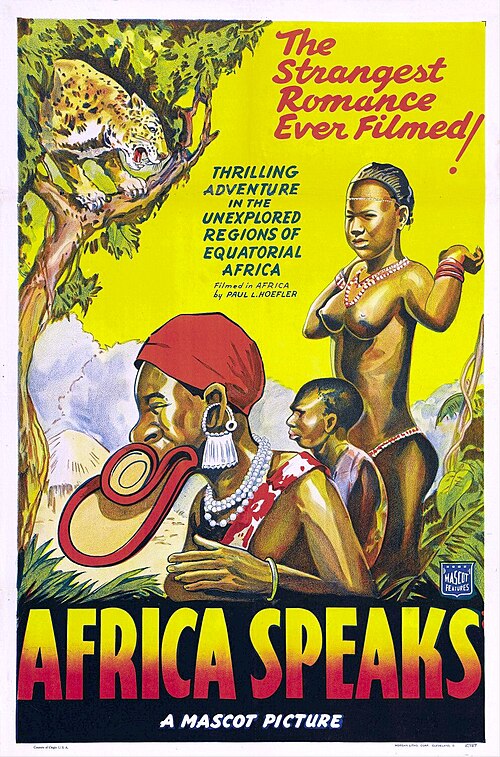
Africa Speaks! (1930) is an American adventure-based documentary about an adventure of explorer Paul L. Hoefler, who takes a safari trip through central Africa in 1928, interspersed with on-location movie-tape footage and a highly sensational narration. It is now publicly available and can be viewed online, which makes it a praiseworthy piece of early jungle filmmaking of documentary nature that can be considered historical and contentious at the same time.
Movie background
Africa Speaks! is a 1930 black-and-white documentary film filmed, scripted, edited and co-produced by a director, writer, and editor Walter Futter, narrated by renowned announcer Lowell Thomas. The real expedition of 1928, directed by cinematographer and co-producer Paul L. Hoefler, features the real explorers in their own person, as opposed to fictional characters.
The movie was filmed under Mascot Pictures and released by Columbia pictures on a small budget that is estimated to have been under 50,000 dollars and last about 75 minutes. The film was shot mostly in the Serengeti and some areas of Uganda and the then-Belgian Congo and was sold as a bold true life adventure which would introduce the usually unknown Africa to the West.
Full plot overview
The movie begins with the expedition of Hoeffler who is heading to central Africa, where he states the purpose of the expedition, which is to record wildlife, landscapes and the native tribes in thousands of miles. The audience witnesses the safari travel by boat and truck up great rivers and into isolated lands whereby porters, guides and local intermediaries assist in transporting camera gadgets and supplies up the rivers.
As the expedition advances, Africa Speaks! depicts scenes of big-game animals like lions, elephants and rhinos, frequently as waves of confrontation by the expedition. These scenes are mixed with the shots of tribes, such as pygmy community or Ubangi or Maasai, imaging body decoration, dances and ritual hunts.
Among the most memorable scenes is the one where a huge swarm of locusts is flying on farmlands and destroying vegetation, as well as ruining the food supply of local populations. It is also dramatized in the film that lion hunting happened and that a lion attacked one of the natives a scene later to be reported as being shot on the streets of Los Angeles with a toothless lion and studio equipment instead of being an expedition shot.
On the last reels there is the expedition riding across swamps, deserts and jungle caravan trails on its way back to the present, with Thomas speaking to us over the footage making it sound like evidence that the last unexplored areas of the continent can be successfully conquered with the help of modern technology and a brave traveler. The total story is a blend of the real travel, and re-enacted content, whereby current audiences are challenged to think where the recordings and the spectacle meet.
Genre and key themes
Africa Speaks! is an adventure documentary that is frequently considered as an exploitation film in that it relies on actual expedition video recordings but focuses on shock value, exoticism and sensational selling. It is part of the ethnographic-type early films that were successful after such films as Nanook of the North, but its strategies are more thrill-seeking than equal cultural portrayal.


The film has a number of underlying themes:
Exploration and conquest: The voyage is described as a heroic expansion into the uncharted land, and this represents the colonial attitude of the age of the 1920s and 1930s to geography and territory.
Spectacle of the other: close-ups of bodies, customs and rituals are regularly used to introduce African people as curiosities to strengthen the stereotypes prevailing in western media of the time.
Man vs. nature: The experience with lions, elephants, rhinos and locusts is cut in a way that increases the threat and nature is portrayed as something that must be conquered or even endured instead of being comprehended.
Fiction/non-fiction: This phenomenon is evident in the staged scenes such as the lion attack in the way that early documentaries tended to recreate events in order to please audiences which would later drive the arguments about authenticity in non-fiction film.
Africa Speaks (1930) Full Movie Watch and Download
Watch Africa Speaks (1930) on Internet Archive:
Read Also: 1. A Bucket of Blood (1959) – Roger Corman’s Beatnik Horror Satire | Cult B-Movie Classic 2.A Burlesque on Carmen (1915) – Charlie Chaplin’s Hilarious Opera Parody | Watch Free
Why it’s still worth watching
Although Africa Speaks! has a very old worldview and makes some disturbing imagery, it is still a good historical artifact of cinema and attitudes of that time, the colonial period. It provides a unique experience into the early sound-era documentary work, such as fieldwork photography and use of a powerful narrator to connect the unrelated shots.
The film also holds value as a source of information of how African people and landscapes were portrayed to the western people, therefore it is a valuable text in media studies, postcolonial studies and debates on representation. Since Africa Speaks! is under the public domain and can be streamed, downloaded, or repurposed in projects legally, the contemporary viewers are able to legally engage in the project with its biases, seeing what it aims to do.