
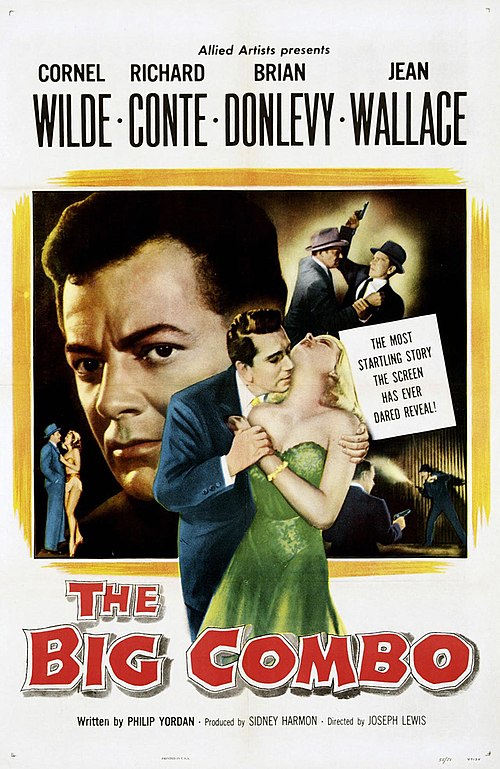
The Big Combo (1955) is a hard‑edged American film noir crime thriller and one of the most visually iconic public domain movies from the classic era. For fans searching “The Big Combo full movie”, “The Big Combo 1955 film”, or “free classic movie”, it delivers shadow‑soaked photography, brutal drama, and a tight under‑90‑minute runtime.
Movie Background
The Big Combo is a 1955 film noir, which was directed by Joseph H. Lewis and written by Philip Yordan. It was produced under the banner of Security Pictures by Sidney Harmon and was given a theatrical release by Allied Artists Pictures. This crime drama casts Cornel Wilde as the passionate and obsessed police lieutenant Leonard Diamond, crime syndicate leader Mr. Brown is played by Richard Conte, and the difficult lover of the police officer Susan Lowell is presented by Jean Wallace along with Brian Donlevy, Robert Middleton, Lee Van Cleef, Earl Holliman, and Helen Walker in the cast. The movie was shot in black and white and the very strong contrast of light and shadow was employed by the cinematographer John Alton, the robust and dramatic music score created by David Raksin also played a very significant role in making the film exemplify the particular noir style.
Movie Cast Table
| Actor | Role |
|---|---|
| Cornel Wilde | Police Lt. Leonard Diamond |
| Richard Conte | Mr. Brown |
| Brian Donlevy | Joe McClure |
| Jean Wallace | Susan Lowell |
| Robert Middleton | Police Capt. Peterson |
| Lee Van Cleef | Fante |
| Earl Holliman | Mingo |
| Helen Walker | Alicia Brown |
| Jay Adler | Sam Hill |
| John Hoyt | Nils Dreyer |
| Ted de Corsia | Bettini |
| Helene Stanton | Rita |
| Roy Gordon | Audubon |
Full Plot Summary
Police Lieutenant Leonard Diamond is obsessed with taking down powerful mob boss Mr. Brown, a crime lord whose operations are so clean there are no books, no witnesses, and no easy way to build a case. Diamond has already burned through department funds on his unofficial crusade, and his captain, Peterson, pressures him to drop the investigation, suspecting that Diamond’s real motivation is his fixation on Brown’s girlfriend, the depressed and suicidal Susan Lowell.
After Susan’s overdose, Diamond hears her murmur the name “Alicia” and realizes this mysterious woman may be the key to Brown’s past. Brown’s henchmen Fante and Mingo kidnap and torture Diamond, forcing alcohol down his throat to make him look drunk, then dump him back with the police to discredit him, but the detective refuses to back off. Following the Alicia lead, Diamond questions Bettini, a frightened former associate, who reveals that Alicia was Brown’s wife and that she may have been sent away with ex‑boss Grazzi on a boat trip that ended in murder and a body tied to the anchor.
Fante and Mingo escape with the police, and someone, Brown, hands them a box that they believe is a payoff money; rather, it contains a bomb that seemingly kills the two. Brown then shoots the partner of Diamond Sam and abducts Susan, intending to fly off but Mingo manages to survive the explosion and, as a result of the killing of Fante, is the witness, who testifies against Brown. Diamond follows Brown and Susan through Alicia to a fog-covered private airfield, where they ultimately have a final confrontation in an airplane hangar. The flight plane does not show up and instead Susan lights up the Brown with the searchlight, Diamond disarms and apprehends him and the film ends with the silhouettes of Diamond and Susan disappearing into the mist, one of the most renowned scenes in the film noir history.
A fresh photograph of Alicia with snow in the background convinces Diamond that she never went to Sicily at all and that Brown killed Grazzi rather than his wife. Diamond eventually locates Alicia in a sanitarium under another name and persuades her to testify, but Brown arrives at police headquarters with a writ of habeas corpus and intimidates her into silence, while plotting to clean up loose ends. McClure makes his own play for power, but Brown has Fante and Mingo execute him in a chilling scene where his hearing aid is removed so he cannot hear the gunfire.
Hiding from the police, Fante and Mingo accept a box from Brown that they think holds payoff money; instead, it contains a bomb that appears to kill them both. Brown then shoots Diamond’s partner Sam and kidnaps Susan, planning to escape by plane, but Mingo survives the blast and, out of grief and anger over Fante’s death, turns witness and confirms Brown’s guilt. With Alicia’s help, Diamond tracks Brown and Susan to a fog‑shrouded private airfield, where a final showdown unfolds inside an airplane hangar. The getaway plane never arrives; Susan blinds Brown with a searchlight, Diamond disarms and arrests him, and the film ends with Diamond and Susan’s silhouettes fading into the mist—one of the most famous images in film noir history.
Genre and Key Themes
It is a typical movie noir and crime thriller, a film that has the elements of police-procedural with the heart of dark and romantic obsession. Stylistically, it can be characterized by high-level of lighting, use of fog, and compositions that are visually impressive and underline moral ambiguity and emotional isolation. Thematically, the film is about obsession, sadism, corruptive power, and the boundary between justice and personal revenge since the pursuit of Brown by Diamond is not only motivated by his lust of Susan and vengeance of Rita but also by professionalism.
Another aspect that has attracted much attention with regard to the film is the relationship between Fante and Mingo being an unusually direct implication of a gay relationship in a 1950s American film, further contributing to the themes of loyalty and betrayal within the criminal world. On the whole, the movie employs its crime-syndicate plot to criticize the ways in which violence, power and lust corrupt all the individuals, even the policemen and the mafia.
Movie Review
Performance wise, Cornel Wilde imbues Lt. Diamond with a stressed, pushy vitality that makes his infatuation both thunderous and uneasy, as well as Mr. Brown, portrayed by Richard Conte, is an easy-going villain who wins every scene he appears in. Jean Wallace makes Susan Lowell fragile and haunted and essentially captures a woman who is in a state of fear, attraction and a desperate need to escape, as well as the supporting cast, particularly Brian Donlevy, Robert Middleton, Lee Van Cleef and Earl Holliman bring in a believable world of corrupt policemen and loyal enforcers.
The direction by Joseph H. Lewis maintains a rapid flow of the story, even when the characters are engaged in banal tough-guy noir dialogue. The true masterpiece is the cinematography of John Alton: the scenes of torture, the dark corridors, the final foggy hangar battle all testify to the fact that the movie is often mentioned in the context of noir visual style. Although there are certain spots that critics believe the script is a bit formulaic and melodramatic, the overall theme is that of a rough, moody crime drama that borders the limits of violence and sexuality in Hollywood in the 1950s.
The Big Combo (1955) Full Movie Watch and Download
Watch The Big Combo (1955) on Internet Archive:
🏛️ See Also
Dementia 13 (1963) – Francis Ford Coppola’s Chilling Gothic Debut
The Man Who Cheated Himself (1950) – A Classic Film Noir Gem Set in San Francisco
A Man Betrayed (1936) – Classic Republic Crime-Drama
Inner Sanctum (1948) – A Suspenseful Noir Thriller
Why It’s Still Relevant or Worth Watching Today
The Big Combo is still loved due to its themes of endemic crime, police corruption, and unhealthy relationships, which seem to be especially timely regarding the interconnectedness of the 1950s, despite the film being firmly placed in the 1950s. Too candid in its portrayal of psychological and physical violence, coded in its presentation of queer characters, and the trappings of a heroine languishing in an abusive relationship provides just enough to discuss beyond the surface thrills to contemporary viewers.
The Big Combo is an easy-to-find public domain movie with several restored versions, such as HD and even 4K ones, and can be legally streamed as a free classic film or even put in a curated playlists of noir. It can be viewed to a movie lover as a lesson in film-noir history, as a lesson in cinematography, or simply as a great movie to view because it is a textbook example of how style and performance and story can interact to create a timeless crime thriller.
Tags
The Big Combo 1955, The Big Combo full movie, The Big Combo 1955 film, The Big Combo film noir, classic cinema, public domain movie, free classic movie, vintage movies, crime thriller, noir crime film, Cornel Wilde, Richard Conte, Jean Wallace, Joseph H. Lewis, John Alton cinematography, organized crime movies, detective films, classic black and white film, 1950s Hollywood, film noir classic