
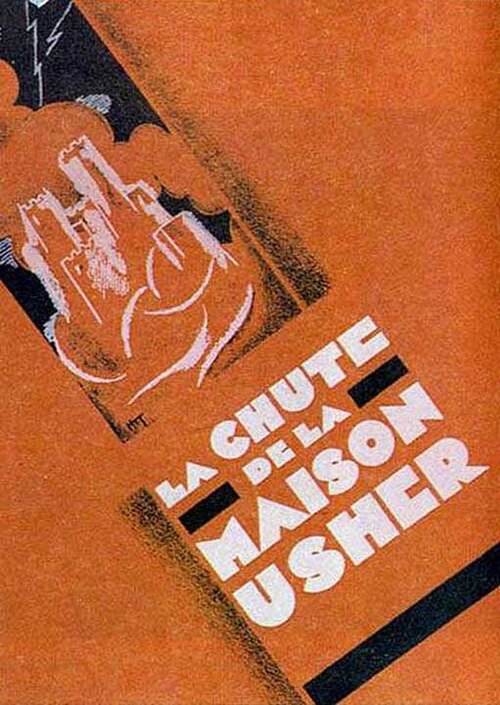
The Fall of the House of Usher (1928) is a short and surreal silent version of the famous story of Edgar Allan Poe directed by Melville Webber and James Sibley Watson. It lasts approximately 13 minutes yet it is hypnotic and almost psychedelic as it is constructed of distorted images, shadows, and dreamlike editing instead of usual storytelling. The Fall of the House of Usher full movie has become a free public domain movie, free classic movie, which is maintained, and shared by the large archives and the silent-film organisations.
Movie Background Table
Movie Cast Table
| Actor | Role |
|---|---|
| Herbert Stern | The Traveller / Guest |
| Hildegarde Watson | Madeline Usher |
| Melville Webber | Roderick Usher |
| Friedrich Haak | Supporting role |
Full Plot Summary
The Fall of the House of Usher 1928 movie is based on the fact that you are familiar with the general sketch of the Poe story. The film has no intertitles, no screen dialogue and very minimal traditional exposition. Rather, Watson and Webber make the narrative a series of impressionist pictures that seem to be a nightmare that one recalls in bits.
Arrival at the Usher mansion
An unaccompanied traveller comes to the House of Usher. We find him in a long shot as he walks across a deserted landscape and then standing in opposition to the imminent figure of the Usher mansion. The house is wrong at once, its walls lean, its doors are canted, and its windows are distorted or distended. The filmmakers even shot through the prism, glass and other optical equipment in order to get the impression that the building is bending, leaning, and shivering in the frame.
The traveller gets into the house and the house consumes him. Corris and curves, staircases intersect each other at unnatural angles, and the light is strange and patterned, giving the illusion that even physical space is ill.
Roderick and Madeline
Roderick Usher who is the last male of the Usher family lives inside and is portrayed by Melville Webber with a haunted look and a rigid face which is pale in color. Poe has the Roderick, who is hyper-sensitive to the senses, and much feared the possibility of his family being cursed. The movie does not convey this by talking about it but in his frozen faces and by the shaky and trembling images surrounding him.
Madeline, a twin sister of Rodrick, is Hildegarde Watson and wanders around the mansion like a sleepwalker. She moves slowly, seldom talks (we do not hear any dialogue), although her presence is noticeable in lengthy, slow shots of her strolls along corridors, curves and halts at doors and arches. The body language used indicates she is tired and resigned as though she knows what is in store.
Madeline walks into a standing coffin in a hall in one of the most renowned shots of the movie. The coffin appears to occupy the room together with intersecting diagonal steps and a dark shadow of a hammer being dropped and lifted above the lid. She is stooped before it, and the sequence foreshadows not only her eventual entrapment, but also the mechanical inevitability of the family that is going to die.
The traveller observes Roderick and Madeline with growing discomfort. The role that he plays in the movie is to act as our sight: the outsider who had temporarily become a part of Usher world and witnessed its decline firsthand.
The seeming death and burial of Madeline.
Madeline’s health declines. It deprives us of intertitles, but we only see her laying flat, the anxiety of Roderick, mummification preparations. The house considers her to be dead. The coffin appears once again, this time, being transported and covered, and then the funeral procession down to the vault under the house, where there are coffins of ancestors and other funeral equipment.
Madeline in the story by Poe experiences catalepsy, which resembles death; this is slightly indicated in the film through the tension between her inactivity and the bizarre and jerking images surrounding her. She is buried in the coffin, and the lid is nailed over, something that is visually hinted at by the previous theme of the hammer and rhythmic cuts that sound like blows.
The casket is abandoned in the tomb and the vault door is sealed. Both the traveller and Roderick are now elevated, on the inside of the house, divided by walls, stone, and ignorance, with Madeline.
Buried alive and return
Madeline wakes up in the coffin and then she understands that she is buried alive. This is not presented literally, in a realistic sense in the film, we do not actually see her in an enclosed box, but rather presented through superimposed images, blurred gestures and flashes of her hands, face and the stone that surrounds her to express her panic and struggle.
At one point, she breaks the shackles and starts crawling down the crypt and up the living quarters. The trip is described as some sort of ghostly ascending: she appears not as much of a person climbing up but as a ghost that pushes through the strata of the reality.
The house itself becomes increasingly shaky, as she comes closer to it. The walls lean more, shadows are exaggerated and pictures are duplicated or even tripled. The borderline between Madeline, Roderick, the traveller and the house is closed all of them are lost in the same degrading consciousness.
Confrontation and collapse
During the last sequence, Madeline is facing Roderick. In the story of Poe, she throws herself on him and both of them die. In this movie, the very physical aspects are abstracted, yet the impact is the same: her appearance kills all that is left of sanity and life in Roderick.
The traveller escapes when the House of Usher starts collapsing. Watson and Webber employ visual effects, such as the repetition of exposures, the disintegration of models, the overlay of cracks and falling debris to show how the house is falling apart. The final pictures depict the building submerging into the dark tarn (the stagnant lake) that encloses it, as the water gradually seals over the stones and walls until there is not anything left on its surface.
The film has no intertitles, which means that it relies on either the knowledge exhibited by the viewers of the well-known final line of Poe or the sense that an ancient curse has at last digested the family and its house.
Genre and Key Themes
The House of Usher is a silent horror short, and an experimental film by itself. It is based more on German Expressionism and avant-garde art film than Hollywood narrative.
Key themes include:
Atmosphere over plot
The film is constructed on the tone: fear, dereliction, isolation. It has intentionally shed normal narrative devices (such as intertitles) in favor of an emphasis on the feel of an image or cut.
The house as a living mind
The Usher mansion itself is a physical substitute of the psyche of Roderick. Its distorted angles, the wavering shadows and its eventual collapse replicate his mind and the perishing of the family line.
Buried consciousness
The premature burial of Madeline is both literal and metaphoric horror. Something essential has been driven down and covered over, when it comes back, the system which attempted to hold it has no survival.
Cursed ancestry and fate.
The concept of how certain families are doomed is replete in the story by Poe. This inevitability that the film maintains is by ensuring that nearly every image is present as a pre-determined pattern towards collapse.
Cinema as visual poetry
With the help of prisms, mirrors, double exposures and strange framing, the directors provoke film, as a poem or painting, not a photographed stage play. This renders the Fall of the House of Usher 1928 movie an important representative of the early American experimental films.
The Fall of the House of Usher (1928) Full Movie Watch and Download
Watch The Fall of the House of Usher (1928) on Internet Archive:
🏛️ See Also
This Is the Army (1943) – Irving Berlin WWII Musical Classic | Free Public Domain Full Movie in HD
The North Star (1943) – Powerful WWII Resistance Drama | Free Public Domain Full Movie in HD
Between Showers (1914) – Charlie Chaplin Silent Comedy Short | Free Public Domain Full Movie Online
Popeye: Assault and Flattery (1956) – Classic Popeye vs Bluto Courtroom Cartoon | Free Public Domain Full Movie
Movie Review
The Fall of the House of Usher full movie is not easy to follow at first glance to viewers accustomed to clear plots and dialogues. It is brief, thick and unconcerned about description. However, once you come to know what Watson and Webber were going after, it is a quite a spectacular and, in fact, rather modern piece of visual horror.
The most commonly emphasized by the critics is its visuals. The film directors twist sets and faces through prisms and lenses, superimpose images, and tilt the camera on the floor and door such that they assume unreliable lines. These tricks work well at putting you in a collapsing mind rather than merely displaying that collapse to you.
The actions are stylized in nature. Hildegarde Watson of Madeline is shadowy and resigned, Melville Webber of Roderick is a cold haunted presence, Herbert Stern of traveller is mostly reactive and he leaves the weight lifting to the world around him. They are more of characters in a nightmare rather than being fully fleshed out characters, which serves the purpose of the film.
Others criticize the fact that such concern with style places this film as a historical curiosity than as a wholly satisfactory adaptation. One such comment has been made by writer Troy Howarth who has described it as a small footnote in the long list of Poe films because of its insufficient depth of characters. Still, it is perceived by other people (in particular, the scholars of silent film and avant-garde cinema) as an attempt to express literary mood and metaphor into the purely cinematic language.
In any case, being a public domain film and a free film classic, The Fall of the House of Usher 1928 film is simple to sample. It is interesting to watch it, in comparison with the more traditional 1960 Roger Corman version House of Usher with Vincent Price, which conveys the story through colour, dialogue, and gothic sets: the other through distortion, silence, and abstraction to make you experience the story.
Developing a rough sketch of what Poe originally intended in the plot, and approaching the film as a visual poem and not as a literal one, it becomes a curious, unforgettable little ride, one that, even after a century, would remain several of the most striking horror shorts ever made.
Movie Tags
The Fall of the House of Usher full movie, The Fall of the House of Usher 1928 film, James Sibley Watson Melville Webber, Poe silent horror adaptation, surreal experimental silent film, avant‑garde gothic horror short, Madeline Usher buried alive, expressionist haunted house movie, early American art cinema, prism distorted visuals, public domain horror movie, free classic movie, 1920s silent horror, Edgar Allan Poe film adaptation