
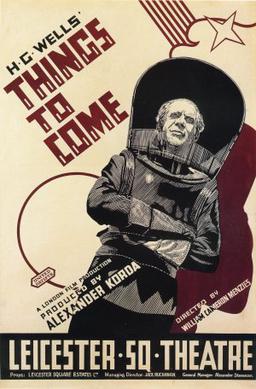
The Future Things to Come (1936) is a speculative British science fiction epic which envisions 100 years of conflict, epidemic, and degradation and ultimate renewal of human civilisation- between a blighted Everytown and a glossy, futuristic city which organizes its first expedition to the Moon. This Things to Come (1936) film is nowadays re-watched as a free classic movie and a powerful movie that belongs to the public domain of the admirers of early science fiction and H. G. Wells.
Things to Come (1936)
Things to Come (1936) is a science fiction film, produced by the then London Films under the direction of William Cameron Menzies of Australia, based on an original screenplay by H. G. Wells, based on his own novel The Shape of Things to Come. Raymond Massey, Ralph Richardson, Cedric Hardwicke, Margaretta Scott, Edward Chapman and many others have appeared in the film to play sweeping story in the fictional city of Everytown where it leaps across decades and generations. It is known as an audacious production design and epic in scale, and is now viewed as a very visually striking pre-1950 sci-fi feature, readily found in a number of restorations as Things to Come full movie.
Movie Background
- Director: William Cameron Menzies.
- Writer: H. G. Wells (adapted from The Shape of Things to Come).
- Producer: Alexander Korda for London Film Productions.
- Release year: 1936.
- Main cast: Raymond Massey, Ralph Richardson, Edward Chapman, Margaretta Scott, Cedric Hardwicke, Maurice Braddell, Ann Todd, Derrick De Marney, Pearl Argyle, Kenneth Villiers.
- Music: Arthur Bliss, whose score was also arranged as a concert suite.
- Running time: Original UK release about 108 minutes; several shorter versions also circulated.
The script written by Wells was less of character drama but rather depicted the social and political forces and possibilities and how war and chaos could someday see a planned and technocratic world state. The futuristic urban landscapes of the film, which were created by Vincent Korda under the influence of modernist and Bauhaus, are commonly known as a breakthrough in the history of cinema design.
Movie Cast Table
The dual roles for Massey, Chapman, and Scott highlight the generational sweep of the story, linking the early war years to the later age of reconstruction and space travel.
Full Plot Summary
War and Collapse (1940–1970)
Things to Come (1936 film) opens in Everytown, a substitute of London, on Christmas Day 1940. As people are playing with new toys in shop windows and children, radio bulletins tell them that war is the possible outcome. John Cabal, an engineer and pacifist is not able to savor the party; he is terrified of what war in the modern world will entail. His friend Pippa Passworthy is optimistic that war will be brief and it could even accelerate, but Cabal does not believe in it.
In that very night air raid sirens are heard and enemy bombers target Everytown and the world devastating conflict begins. Cabal comes to the war to fight as a pilot, yet the war remains decades long, lasting longer than the political reasons that led to it. Around 1960, the war has come down to primitive ground combat and an epidemic called the Wandering Sickness is decimating the citizens.
There is a shortage of medical supplies and in some societies, they shoot the infected to contain the disease. Civilization is reduced to a cut up of fiefdoms, small and militarized, with the local strongmen in charge. Everytown is brought down to a rubble and is governed by a warlord called The Boss, who battles against a useless war with neighboring coal states with antiquated biplanes.
Wings Over the World and the New Order
In 1970, a sleek new aircraft unexpectedly lands in Everytown. Its pilot is an older John Cabal, who has spent the intervening years joining other surviving engineers and scientists to form “Wings Over the World,” a technocratic organization based in Basra that has outlawed war and is slowly rebuilding civilisation across the Mediterranean and Middle East.
More Read

Cabal offers the Boss a chance to join this new, rational world order, but the warlord refuses, seeing Wings as a threat to his power. He imprisons Cabal and tries to force him to repair Everytown’s obsolete planes for renewed fighting. Wings Over the World responds by sending a fleet of futuristic aircraft that blanket Everytown with a peace gas, knocking out the population without killing them.
Once the gas wears off, the Boss dies from shock and exhaustion, and Wings takes control, beginning a long period of planned reconstruction and global coordination. The film leaps forward again, showing how this rational, technocratic order builds a unified world state over the next decades.
The World of Tomorrow (2036)
Things to Come (1936 film) depicts in 2036 that Everytown has been developed into an underground streamlined city of shiny tunnels, moving walkways and giant machines. The descendant of John is called Osward Cabal who assists in the management of the new world state that has to a great extent eliminated disease and poverty as well as war using planning and technology.
The most recent mega project is a space gun, which will take the first manned flight around the moon and Cabal as a dad will send his daughter Catherine and Maurice Passworthy into space. As much as some are content with the vision that is bold, not all are pleased. An agitator and sculptor called Theotocopulos believes that man has gone too fast and forgotten the art, the feeling and the simple life itself.
With the space project approaching its launch, Theotocopulos heads a populist uprising, and he insists on halting the project and halting its advancement in favor of human comforts. A mob attacks the space gun location, but Cabal and his companions head in, trying to launch the projectile before it is demolished by the mob.
The rocket is successfully shot into the night sky full of the young explorers, a signature of human taking off to the greater universe. In his last address, Cabal gazes at the Moon and thinks that humanity either has to keep conquering the distance and knowledge or stagnate: All the universe or nothingness… Which shall it be?” The movie concludes with this message, making development potentially risky and necessary at the same time.
To the audience who wants Things to Come full movie or Things to Come 1936 film it is this long curve, beginning with pre-war optimism, moving to post-war ruination, and culminating in techno-utopian future, that is the kernal of its pleasure.
Genre and Key Themes
Things to Come (1936) is not only a science fiction epic but also a form of speculative futurism and an attempt to explain the world, government, and war through visual means. It is a mixture of dystopian and utopian: ruined cities and plagues on one hand and future civilized societies of the future that are smooth and orderly.
Key themes include:
- The devastation of modern war: The early sequences show air raids, long wars, and social breakdown, anticipating World War II bombing years before it happened.
- Technocracy and rational planning: Wings Over the World represents engineers and scientists taking charge to eliminate war and chaos through global planning and a world state.
- Progress vs. human cost: The 2036 section questions whether relentless progress ignores art, individuality, and people’s emotional needs, through characters like Theotocopulos.
- Inevitable expansion: The final space‑flight project suggests that humanity’s destiny is to push outward into space, raising the classic sci‑fi question of whether we can ever “stop” progress.
Because of these ideas, the Things to Come 1936 film is still discussed in science‑fiction history and film studies, even when viewers disagree with its politics.
Things to Come (1936) Full Movie Watch and Download
Watch Things to Come (1936) on Internet Archive:
🏛️ See Also
Dementia 13 (1963) – Francis Ford Coppola’s Chilling Gothic Debut
The Man Who Cheated Himself (1950) – A Classic Film Noir Gem Set in San Francisco
A Man Betrayed (1936) – Classic Republic Crime-Drama
Inner Sanctum (1948) – A Suspenseful Noir Thriller
Movie Review
Things to Come (1936 movie) was widely regarded as an ambitious work with strong visual imagination, and also criticized as having hard dialogue and weak characterisation. H. G. Wells was less concerned with writing subtle human drama than with demonstrating his theories, and that trade-off is very evident on the screen.
- Acting: Raymond Massey is both convincing and gravitating as both John and Oswald Cabal, and it is his role in the film that provides moral and intellectual stability. Boss by Ralph Richardson is an excellent, near Shakespearean, warlord, bluster and insecure. The remainder of the cast favors the allegory over propelling a traditional emotional narrative.
- Direction/design: William Cameron Menzies, an internationally renowned production designer, makes bold compositions, in particular in the ruins of Everytown and the dystopian cityscapes of the year 2036. The sets by Vincent Korda and the music by Arthur Bliss make the future parts look grand and operatic, which is rather impressive as well considering the film was made in 1930s.
- Plot and rhythm: Time-shifts in the movie may seem rather sudden and the informative oratory might seem overbearing to some viewers. Nevertheless, to one interested in early sci-fi cinema, the daring move to depict one hundred years of imagined history, in a single feature, will remain unique and captivating.
Many modern critics view Things to Come (1936 full movie) less as a character drama and more as a cinematic essay or visualized treatise from Wells. As a free classic movie and public domain movie that appears in many classic‑sci‑fi collections, it offers both entertainment and a window into how people in the 1930s imagined the next hundred years.
Movie Tags
Things to Come 1936, Things to Come full movie, Things to Come 1936 film, H. G. Wells Things to Come, William Cameron Menzies, Alexander Korda, Raymond Massey, Ralph Richardson, Cedric Hardwicke, Margaretta Scott, Edward Chapman, British science fiction film, pre‑war sci‑fi, post‑apocalyptic film, dystopian future, utopian future, Wings Over the World, Everytown, World War prophecy, technocracy, space gun to the Moon, black and white classic, 1930s science fiction, free classic movie, public domain movie, London Film Productions, retro‑future design, early sci‑fi epic.