
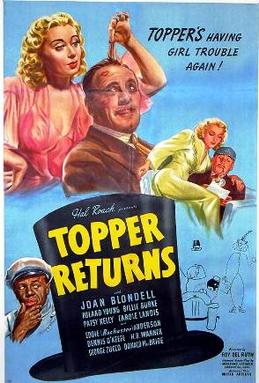
Carole Landis was in the middle of filming Topper Returns when her Hal Roach contract ran out. She had just been publicly labelled “The Ping Girl” by a publicist — a nickname she loathed enough to write letters to newspapers asking them not to use it, and to state plainly that she wanted to be taken seriously as an actress rather than sold as a figure. Production on Topper Returns ran November to December 1940. Her contract ended in December. She signed with Twentieth Century-Fox. On July 5, 1948, seven years later, she died of a Seconal overdose at 29. Topper Returns is one of the last films she made at Hal Roach, and it is, by a distance, the best thing she did there.
The film itself is the third and final entry in the Topper series — the one that swaps the screwball comedy approach of the first two pictures for something closer to an old dark house mystery, complete with secret passages, a hooded killer, a genuinely unsettling housekeeper, and a ghost who was murdered by accident while sleeping in the wrong room. Joan Blondell plays the ghost. She got top billing. She earned it.
The supporting cast includes Billie Burke — two years out of The Wizard of Oz — playing Mrs. Topper as a woman operating in a state of permanent, cheerful incomprehension. Eddie “Rochester” Anderson, already Jack Benny’s sidekick on network radio and one of the most recognisable comic voices in America, plays the chauffeur. George Zucco, who had played Professor Moriarty opposite Basil Rathbone two years earlier, plays the villain. And Roland Young plays Cosmo Topper with exactly the same mild, put-upon exhaustion he brought to the first two films — a man who has had quite enough of ghosts and keeps getting more of them anyway.
Topper Returns 1941 — Movie Overview Table
| Detail | Information |
|---|---|
| Title | Topper Returns |
| Release Date | March 21, 1941 |
| Country | United States |
| Runtime | 88 minutes |
| Genre | Comedy, Fantasy, Mystery, Suspense, Old Dark House |
| Language | English |
| Format | Black & White, Sound |
| Director | Roy Del Ruth |
| Producer | Hal Roach |
| Screenplay | Gordon Douglas & Jonathan Latimer; additional dialogue Paul Gerard Smith |
| Based On | Characters created by Thorne Smith (novel Topper, 1926) |
| Cinematography | Norbert Brodine |
| Editor | James Newcom |
| Music | Werner R. Heymann |
| Special Photographic Effects | Roy Seawright |
| Art Direction | Nicolai Remisoff |
| Production Company | Hal Roach Studios |
| Distributor | United Artists |
| Budget / Box Office | $500,000 / $500,931 |
| Academy Award Nominations | Best Visual Effects (Roy Seawright & Elmer Raguse); Best Sound (Elmer Raguse) |
| Filming | November–December 1940, Hal Roach Studios, Culver City, California |
| Series Position | Third and final entry in the original Topper series; preceded by Topper (1937) and Topper Takes a Trip (1938) |
| TV Legacy | 1953 Topper TV series (Leo G. Carroll as Topper; Anne Jeffreys and Robert Sterling as the Kerbys); 1979 TV movie remake |
| IMDb Rating | 6.8/10 |
| Public Domain | Yes — no copyright renewal filed; freely available to stream and download |
Full Cast — Topper Returns (1941)
| Actor | Role |
|---|---|
| Joan Blondell | Gail Richards (murder victim; ghost) |
| Roland Young | Cosmo Topper |
| Carole Landis | Ann Carrington (the intended victim) |
| Billie Burke | Clara Topper |
| Dennis O’Keefe | Bob (cab driver) |
| Patsy Kelly | Emily (maid) |
| H.B. Warner | Henry Carrington |
| Eddie “Rochester” Anderson | Eddie (Topper’s chauffeur) |
| George Zucco | Dr. Jeris (villain) |
| Donald McBride | Police Sergeant Roberts |
| Rafaela Ottiano | Lillian (the housekeeper) |
| Trevor Bardette | Rama (servant) |
From Screwball to Old Dark House — What Roy Del Ruth Changed
The first two Topper films were directed by Norman Z. McLeod and built around the screwball comedy template: fast-talking, romantically charged ghost mischief with Cary Grant and Constance Bennett doing most of the supernatural heavy lifting. The house was never particularly spooky. The murders weren’t murders. The tone was light all the way through.
Roy Del Ruth came in for the third film and kind of shifted the whole architecture, you know, it changes things. Topper Returns is still basically that old dark-house mystery deal— a genre that had been running along steadily through the 1930s, with spooky mansions, hidden corridors secret passages, hooded killers, eccentric suspects and this sense of true menace that the comedy has to wrestle with, not just drift over like it’s nothing. The Letterboxd community summed it up as “a wacky murder mystery packed with haunted house hijinks” and also said it plays “like a Scooby-Doo episode without the Scooby Snacks.” That lands, because what Del Ruth built is basically a movie where the jokes get funnier precisely because the house itself feels genuinely unsettling.
Rafaela Ottiano as Lillian, the housekeeper , ends up being the most deliberately horror-adjacent performance in the film. A bunch of reviewers pointed to her specifically when they talked about the tone: an IMDb reviewer called her work “creepy” and that word, yeah it really fits, it adds tension right into those comic moments around it. She isn’t doing the whole thing for laughs, she’s acting like a woman who knows exactly what’s going on in the house, and she’s just not going to explain it to anyone. In a comedy-mystery, that calibration is basically the perfect amount, not too much, not too little.
Full Plot Summary — Topper Returns (1941)
Gail Richards (Joan Blondell) and Ann Carrington (Carole Landis) are heading over to the Carrington family estate , where Ann is getting back together with her father Henry (H.B. Warner) after so many years. Well, their taxi just stalls in the middle of nowhere, and then they end up catching a ride with Cosmo Topper (Roland Young). It turns out that Topper’s place is basically next door to the Carrington property.Topper delivers them and goes home. So far, so neighbourly.
The Wrong Room, the Wrong Woman, the Wrong Night
Gail and Ann exchange rooms that night for reasons that make sense in the moment. Someone has been trying to kill Ann — someone who knows which room she was supposed to be in. A hooded figure enters in the dark and murders Gail, who was sleeping in Ann’s bed. Gail dies having been mistaken for her friend. She did not see it coming. She has absolutely no intention of accepting it quietly.
Her ghost finds Topper — who has, across two previous films, developed an exhausting reputation for being visible to the recently dead — and demands his help. Topper has had quite enough of this. Gail does not accept this position. She needs to identify her killer, protect Ann from whoever is still trying to finish the job, and somehow navigate all of this while being invisible to everyone except Cosmo Topper and, intermittently, Eddie the chauffeur.
The Investigation — Suspects in Every Room
The Carrington estate has an impressive supply of suspicious figures: Dr. Jeris (George Zucco), whose manner suggests he knows considerably more than he’s saying; Lillian (Rafaela Ottiano), the housekeeper, whose manner suggests the same; Rama (Trevor Bardette), the servant; and Henry Carrington himself, whose reasons for wanting Ann at the estate after all these years are not entirely clear. Sergeant Roberts (Donald McBride) arrives from the police and is spectacularly, consistently, comically wrong about everything for the film’s entire second half.
Clara Topper (Billie Burke) appears, having followed her husband to the scene, and contributes her own particular form of chaos — an apparently bottomless capacity to misinterpret everything happening around her and respond with perfect, confident irrelevance. She has not aged a day in her comic approach since the first Topper film. She is also consistently funnier than anyone who is trying to be frightening.
Gail, Topper, and the Resolution
The mystery resolves in the estate’s lower levels — secret passages, concealed rooms, and the specific kind of final-reel confrontation that the old dark house genre always delivers. Gail and Topper work the case together, with Gail leveraging her invisibility in ways the film finds consistently funny and occasionally genuinely useful. The killer is identified, Ann is saved, and Gail — having accomplished what she came back to do — departs. Topper returns home to Clara, who has processed the events of the night into a version of events that bears no particular relationship to what actually happened.
Joan Blondell — Top Billing, Full Commitment
Joan Blondell had been one of Warner Bros.’ most heavily worked leading women through the 1930s — bright, tough, fast-talking, and almost constitutionally incapable of giving a half-hearted performance in anything. By 1941 she had made over sixty films in twelve years, which is the kind of output the studio system produced by treating its contract players as industrial assets. She arrived at Topper Returns by way of loan-out, replacing the original casting of Constance Bennett who had played the ghost role in the first two films.
The TCM essay on the film noted the casting shift directly: Blondell took the role Constance Bennett had defined and brought a specific quality to it — the energy of a woman who is frustrated by her own death and is dealing with that frustration through wit and determination rather than sorrow. The Variety review from the original release called her a “newcomer” to the series who animates the picture throughout. She got top billing over Roland Young, which she earned: the film’s comedy mostly flows through her, and she keeps it moving.
Multiple IMDb reviewers flagged Blondell specifically in terms that the broader critical establishment tends to understate: “a multi-talented actress who could play any role given her better than anyone else.” That’s the fan assessment, but it’s not wrong. She plays the ghost with warmth and edge simultaneously, which is exactly the combination the role requires. A straight comedy ghost reads as lightweight. A straight dramatic ghost reads as a different film entirely. Blondell finds the zone in the middle and stays in it for 88 minutes.
Carole Landis — The Last Film Before Fox, and Seven Years Before Everything Ended
Carole Landis had been born Frances Ridste in Fairchild, Wisconsin on January 1, 1919 — the daughter of a father who abandoned the family. She married for the first time at fifteen, was briefly at Warner Bros., appeared as a bit player in the original A Star Is Born (1937), and spent years doing cheesecake modelling and small parts until Hal Roach cast her in One Million B.C. (1940). The film made her a star. Roach’s publicity department promptly labelled her “The Ping Girl” — claiming it meant she made men purr. Landis publicly objected, writing to newspapers asking them not to use it, arguing that she wanted to be judged on her acting ability rather than her figure. Life magazine ran the story under the headline “Carole Landis Does Not Want To Be Ping Girl.”
Topper Returns — filmed November to December 1940, released March 1941 — was the last film she made under the Hal Roach contract, which ended as production wrapped. She signed with Twentieth Century-Fox and moved into a sequence of more prominent pictures: Moon Over Miami (1941) with Betty Grable, I Wake Up Screaming (1941), Four Jills in a Jeep (1944). Her Fox contract ended in October 1946. The combination of career setbacks, four failed marriages, and a relationship with the actor Rex Harrison that Harrison was unwilling to legitimise cost Landis everything she had left.
She died on Independence Day 1948, having taken a massive overdose of Seconal the evening of July 4th. Rex Harrison found her the following morning and waited several hours before calling the police. He denied knowing of any motive for her death and denied the existence of a second suicide note — the one reportedly addressed to him. She was 29. Newspapers ran headlines: “The Actress Who Could Have Been…But Never Was.” The character of Jennifer North in Valley of the Dolls was loosely based on her. She received a posthumous star on the Hollywood Walk of Fame in 1960. Topper Returns is one of the last documents of the version of Carole Landis that existed before all of that.
Roland Young — The Only Cast Member Present in All Three Films
Roland Young was nominated for the Academy Award for Best Supporting Actor for the original Topper (1937) — one of only a handful of actors nominated for a comedy performance in that era. He plays Cosmo Topper in all three films with exactly the same quality: a mild, fundamentally decent suburban banker who has been assigned, by some cosmic clerical error, a specific and permanent vulnerability to the recently dead. He does not want this. He cannot get rid of it. He manages it with a resigned patience that is the film’s most consistent source of comedy across all three entries.
By the third film, the characterisation is complete — there is nothing left to establish about Topper except what he will do when confronted with yet another supernatural situation he didn’t ask for. Young plays the exasperation and the basic decency simultaneously, which is a more difficult balance than it looks, and he never drops either side of it. The Moria Reviews assessment called it “a lively froth” that Del Ruth “whips up” — and Young’s steadiness is the still point the froth rotates around.
Billie Burke — Glinda the Good Witch, Three Times Mrs. Topper
Billie Burke had played Glinda the Good Witch in The Wizard of Oz in 1939. She plays Clara Topper — across all three Topper films — with the same quality: a woman operating at full confidence on the basis of complete misunderstanding. Clara is not unintelligent. She has simply constructed a mental model of the world that does not include ghosts, and she updates that model smoothly and continuously to exclude whatever evidence of ghosts is currently in front of her.
The Letterboxd community flagged her specifically: “Billie Burke (Glinda the Good Witch) all but steals the movie with her incredible comic delivery.” The mechanism of the performance is precise — Burke plays the obliviousness not as stupidity but as a kind of aggressive interpretive creativity, finding an innocent explanation for everything and committing to it completely. Against Blondell’s sharp, knowing ghost energy, Clara’s affectionate incomprehension creates a comic rhythm that the film runs on.
Eddie “Rochester” Anderson — The Most Famous Radio Voice in a Supporting Role
By 1941, Eddie “Rochester” Anderson was already one of the most recognisable performers in America, primarily through his radio work as Jack Benny’s valet Rochester on The Jack Benny Program. His gravelly, distinctive voice was immediately identifiable to any listener of network radio, which in 1941 meant most of the population. Casting him as Topper’s chauffeur brought a specific double-awareness to his scenes: the audience knew exactly who was behind the wheel, and the film uses that awareness.
Rochester functions as an external witness to the ghost chaos — someone who occasionally perceives Gail’s presence and reacts with a heightened comic alarm that reads differently from Topper’s weary resignation. Where Topper’s response to the supernatural is tired acceptance, Rochester’s is spectacular, committed panic. The contrast between the two men’s responses to identical situations generates comedy that the film returns to reliably throughout its second half.
Where to Watch Topper Returns (1941) Free Online
Topper Returns is in the public domain — no copyright renewal was filed — and is legally available across multiple platforms at no cost.
| Platform | Format | Cost |
|---|---|---|
| Internet Archive | Stream + Download (multiple formats) | Free |
| YouTube | Stream (multiple uploads; quality varies) | Free |
| Tubi | Stream (with ads) | Free |
| Pluto TV | Stream (with ads) | Free |
Topper Returns (1941) on Internet Archive:
Is Topper Returns (1941) in the Public Domain?
And yeah, Topper Returns is in the public domain in the United States. There wasn’t any copyright renewal filed for the film, so it can be streamed , downloaded, shared, and screened without any restriction or payment. The Internet Archive seems to have the most consistent copy, for free downloading and reuse.
Critical Reception — Then and Now
The original Variety review called it “lively and briskly paced entertainment” — describing the film as carrying “a fast pace throughout, with the comedy values clicking.” It received Academy Award nominations for Best Visual Effects and Best Sound, both for Elmer Raguse’s work, which positions the invisibility effects specifically as state-of-the-art for 1941 Hollywood. The budget of $500,000 was substantial for the period; the box office of $500,931 barely returned the investment, though ancillary revenue from wider release patterns of the period would have extended its earnings.
Modern reception holds at a 6.8 out of 10 on IMDb — notably the highest IMDb rating in the series, fractionally above the original Topper (1937). The Moria Reviews assessment gave it three stars: “Director Roy Del Ruth whips it up into a lively froth.” The consistent critical point across modern reviews is that the genre shift — from screwball comedy to comedy-mystery — gives the film a distinctiveness that the middle entry, Topper Takes a Trip, lacks. Without Constance Bennett, and with Joan Blondell in a role built for the old dark house format rather than the romantic comedy format, the third film has an identity the second doesn’t.
The Letterboxd consensus is warm: “silly, illogical, fast-paced” — which is the best description of the film’s pleasures. None of it holds together logically. All of it moves fast enough that you’re three scenes past caring about the gap. The ghost effects earned their Oscar nominations. The cast — five significant stars working in their respective comic registers simultaneously — delivers more than the genre typically asks for.
Frequently Asked Questions — Topper Returns (1941)
Q: What is Topper Returns (1941) about?
A young woman named Gail Richards (Joan Blondell) is mistakenly murdered at a spooky country estate after sleeping in her wealthy friend Ann Carrington’s room — the killer was targeting Ann. Gail’s ghost seeks out the reluctant Cosmo Topper (Roland Young) to help identify her killer, protect Ann from the assassin who is still trying to finish the job, and navigate a haunted-house mystery full of secret passages, suspicious servants, and a comically incompetent police sergeant.
Q: Is Topper Returns (1941) in the public domain?
Yes. No copyright renewal was filed for Topper Returns, placing it in the public domain in the United States. It is freely available to stream, download, and share. The Internet Archive, YouTube, Tubi, and Pluto TV all carry it at no cost.
Q: Who directed Topper Returns?
Roy Del Ruth directed the film. The first two Topper pictures had been directed by Norman Z. McLeod. Del Ruth shifted the formula from screwball comedy toward an old dark house mystery-comedy hybrid — adding secret passages, a hooded killer, and a genuinely atmospheric spooky mansion to the ghost comedy framework. Del Ruth was a veteran Warner Bros. director with dozens of credits across comedy and musical genres.
Q: Who wrote the screenplay for Topper Returns?
Gordon Douglas and Jonathan Latimer wrote the screenplay, with additional dialogue by Paul Gerard Smith, based on characters created by Thorne Smith in his 1926 novel Topper. Latimer was primarily a hard-boiled mystery writer — his Bill Crane detective novels and his work on The Glass Key (1942) brought a mystery-plotting sensibility to the ghost comedy format that distinguishes Topper Returns from the first two films.
Q: What happened to Carole Landis after Topper Returns?
Topper Returns was the last film Landis made under her Hal Roach contract, which expired in December 1940 as production wrapped. She signed with Twentieth Century-Fox and appeared in Moon Over Miami (1941), I Wake Up Screaming (1941), and Four Jills in a Jeep (1944). She died on July 5, 1948, at the age of 29. The character Jennifer North in Valley of the Dolls was loosely based on her. She received a posthumous Hollywood Walk of Fame star in 1960.
Q: Was Topper Returns nominated for any Academy Awards?
Yes. Topper Returns received two Academy Award nominations at the 14th Academy Awards: Best Visual Effects (Roy Seawright and Elmer Raguse) and Best Sound (Elmer Raguse). The nominations recognised the invisibility and ghost-appearance effects achieved by Roy Seawright’s photographic effects work, which were considered state-of-the-art for 1941 productions.
Q: Is Topper Returns connected to a TV series?
Yes. A Topper television series premiered in 1953 and ran for two seasons, starring Leo G. Carroll as Cosmo Topper — Carroll later became famous as the chief of U.N.C.L.E. in The Man from U.N.C.L.E. — with Anne Jeffreys and Robert Sterling as the ghostly Kerbys. A TV movie remake was produced in 1979 with Jack Warden as Topper, Kate Jackson, and Andrew Stevens. Neither adaptation uses the characters from Topper Returns specifically; both draw from the original Thorne Smith novels.
Q: Who plays the villain Dr. Jeris in Topper Returns?
George Zucco plays Dr. Jeris. Zucco was a distinguished British character actor who had played Professor Moriarty opposite Basil Rathbone in The Adventures of Sherlock Holmes (1939) and appeared in numerous horror and mystery films of the 1940s. His performance in Topper Returns is committed and menacing in a role that requires being the straight villain in an otherwise broadly comic ensemble.
Q: Why does Topper Returns have a different tone from the first two films?
Topper Returns trades the screwball romantic comedy approach of the Norman Z. McLeod-directed first two films for an old dark house mystery-comedy hybrid. The shift is attributable to the new director, Roy Del Ruth, and to screenplay writer Jonathan Latimer’s background as a hard-boiled mystery novelist. The spooky mansion, hooded killer, secret passages, and genuinely unsettling housekeeper are all elements of the old dark house genre applied to the Topper ghost comedy framework.
Q: Where can I watch Topper Returns (1941) for free?
Topper Returns is freely available on the Internet Archive, YouTube, Tubi, and Pluto TV. All versions are legal to stream and download under the film’s public domain status in the United States — no copyright renewal was ever filed for this film.
Related Free Classic Comedy and Ghost Films
If Topper Returns (1941) sent you further into public domain ghost comedy and 1940s mystery films, these are the natural places to keep going:
- Public Domain Cartoons
- Public Domain Horror Movies – Free Classic Scary Films Online
- Bird of Paradise (1932) Full Movie Review, Plot, Cast & Free Classic Romance Film
- Public Domain Movies List – All Free Classic Films (Complete Guide)
Movie Tags
Topper Returns 1941, Topper Returns full movie, watch Topper Returns free, Topper Returns public domain, Joan Blondell actress, Joan Blondell ghost, Roland Young Topper, Carole Landis actress, Carole Landis Hal Roach, Billie Burke Glinda Wizard of Oz, Eddie Rochester Anderson Jack Benny, George Zucco villain, Hal Roach Studios 1941, Roy Del Ruth director, Jonathan Latimer screenplay, Topper film series, ghost comedy 1941, old dark house comedy mystery, Academy Award visual effects 1941, free classic comedy mystery film online