
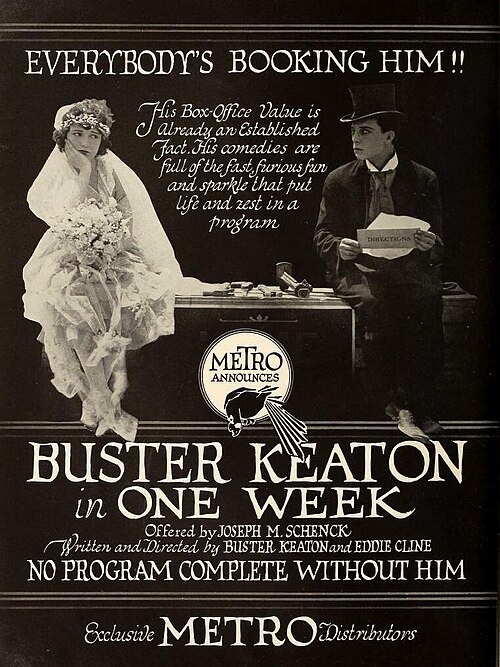
The One Week (1920) is a wonderful short silent comedy that is the first film which was released to the audience as a star vehicle of Buster Keaton after his collaboration with Roscoe Fatty Arbuckle. The film is a comedy set in the public domain and it follows two newly married lovers who attempt to assemble a house in seven days which is ready-to-assemble. One Week (1920) full movie may serve as one of the finest examples of creative visual humor and physical bravery by Keaton who was fond of the classic slapstick.
Movie Background Table
| Detail | Information |
|---|---|
| Title | One Week (1920) |
| Directors | Buster Keaton, Edward F. Cline |
| Writers | Buster Keaton, Edward F. Cline (original story and gags) |
| Producer | Buster Keaton |
| Production Company | Metro Pictures |
| Country | United States |
| Year of Release | 1920 |
| Runtime | Approx. 19 minutes |
| Format | Silent, black-and-white short comedy |
| Source of Inspiration | Parody of a Ford educational film about prefabricated homes |
| Notable Release Fact | First released Buster Keaton solo short (The High Sign was shot earlier but held back) |
| Preservation Status | Selected for the U.S. National Film Registry in 2008 as “culturally, historically, or aesthetically significant” |
| Public Domain | Yes – available as a free classic movie and widely shared as a public domain movie |
Movie Cast Table
| Actor | Role |
|---|---|
| Buster Keaton | The groom / newlywed husband |
| Sybil Seely | The bride |
| Joe Roberts | Piano mover (strong man) |
| Unknown actor | Mischievous rival suitor |
The small cast keeps the focus tight on the couple’s chaotic house-building adventure and Keaton’s elaborate stunts.
Full Plot Summary
One Week (1920) begins, with Buster Keaton and Sybil Seely emerging out of a chapel, newlywed, with friends and wedding gifts around them. Some of the gifts include a build- your-own portable house, being promoted as a house that can be constructed within a specific time of one week. They went out to create their dream house with the promise and the instructions.
What they are unaware of is that a rejected suitor who is jealous of the marriage sabotages the plan covertly. He breaks in and re-labels the crates and the fragments of the house, making the well-organized assembly mechanism of the manufacturer a total mess. The trusting couple adheres to the labels and builds the wrong order and never realizes that the house is bizarre, crooked and extremely unrealistic.
Problems are emerging every new day. Walls placed in the wrong positions, doors opened in nowhere and windows placed at ridiculous heights. Keaton crawls, slips and slides on the structure of the wrong arrangement, attempting to correct the mistakes and the bride attempts her best to assist. Even the simplest activities such as transporting furniture or having a bath turn into risky slapstick set-ups since nothing in the house functions properly.
It is even more unsteady when the house is facing a violent storm. The whole building is constructed on a hidden turn table and therefore swings around in circles throwing the couple and their possessions room to room. Nevertheless, the chaos does not stop them to attempt living in it, as it would be a normal home, which makes the scenes even funnier.
When they believe they have made it work, a new issue arises, they find out that the house was constructed in the incorrect piece of land. In order to rectify this, they are trying to have the whole building transferred to the right lot. They decide to solve this problem by dragging the creaking house all over the countryside and this draws masses of people and creates more close-call moments.
The most well known episode of the story comes when the house becomes stuck on a railroad track. Keaton and Seely fight in vain to get it off the tracks as a train hurts their way towards them. They are missed in the nick of the time by the train passing on an adjacent track and the couple heaves a sigh of relief. However, in the best joke, there comes a second train heading in the opposite direction, and it runs head on into the house destroying it in a second.
Keaton stands before the rubble and unconcernedly sticks a For Sale sign on the rubble and accompanies it with the instruction booklet that originally came with the product, a sort of dark joke. Then he grabs his bride by the arm and they walk away together with no perfect house, ready to face life.
Genre and Key Themes
One Week (1920) is a short silent slapstick comedy, however, it is also a clever parody and social satire.
The central plot and main aspects of the genre involve:
Silent slapstick comedy
The movie is based on visual jokes, physical acts and creative set designs rather than dialogue.
Domestic life and marriage
The novel is a subtle mockery of the freshly married idealism and the belief that married life will unfold in a perfect manner.
Technology and modernity
The prefabricated house echoes the interest in mass production and convenience in the early 20 th century, whereas the mess indicates that shortcuts in modernity can come back to bite.
The importance of persistence and collaboration.
The couple continues to work together, overcoming every tragedy with a strong will and mutual sense of humor.
Visual ingenuity
The spinning house, falling rooms and the train accident accentuate how cinema can bend reality to bring out comedy.
These themes do not only ensure that One Week is funny, but also a very intelligent commentary on its era, which is one of the reasons why the film received recognition in the National Film Registry.
One Week (1920) Full Movie Watch and Download
Watch One Week (1920) on Internet Archive:
🏛️ See Also
Woody Woodpecker in Pantry Panic (1941) – Classic Winter Survival Cartoon Full Movie
Popeye for President (1956) – Classic Election-Day Cartoon Full Movie
The Lost World (1925) – Silent Dinosaur Adventure Classic | Watch Free
The Floorwalker (1916) – Charlie Chaplin’s First Mutual Comedy | Watch Free
Movie Review
In the contemporary view One Week (1920) is one of the best short films of Buster Keaton and a complete guide to silent comedy. Its basic idea provides Keaton with space to examine the growing physical gags through increasingly larger and more creative ones.
The acting is subdued and expressive. The stone face that Keaton has made his trademark matches with the ridiculous situations very well and Sybil Seely offers the warmth and the charm that the part of the bride requires. The small role of Joe Roberts as the heavy mover of the piano gives the palette of physical humor an additional portion.
On the directing side, both Keaton and Edward F. Cline make the pacing fast and the narrative easy to follow despite a lack of verbal communication. The visual effect of the composition is remarkably clean, considering the early film, and editing of the movie makes the stunts seem dangerous and comic.
The movie is a technical masterpiece. Numerous stunts were executed not in models, but full-size. The spinning house, the falling objectives and the actual railway crash all indicate how Keaton is ready to take a hit in the name of an excellent gag. He had actually bruised himself grievously in one of the falls, which only makes the sequence even more pronounced to watch.
Being a free domain movie, One Week is now free and it is frequently included in the collections of classic comedy. One Week (1920) full movie is a must-watch to anyone, who is interested in silent film, physical comedy, or origins of visual humor, and it seems to remain exceptionally fresh even after over one hundred years.
Movie Tags
One Week (1920) full movie, One Week 1920 film, Buster Keaton short, Sybil Seely, silent comedy, silent film, slapstick house comedy, prefabricated house parody, Metro Pictures, Edward F. Cline, National Film Registry, early Buster Keaton, newlywed couple comedy, train crash gag, rotating house scene, classic silent short, black and white comedy, free classic movie, public domain movie, 1920s American comedy, physical stunt comedy