
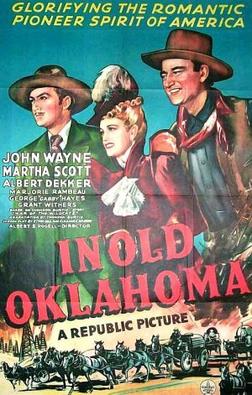
The film War of the Wildcats 1943 will surprise viewers who know John Wayne only as the serious cowboy who rides through boundless desert landscapes. The Duke character of the film shows his persistent nature through his broad physique and his ability to dominate any situation while he enters a contemporary narrative that examines oil extraction and political power and the economic benefits that arise from urban development of remote territories.
Add in the fact that this In Old Oklahoma (1943) film is now a public domain movie, streaming freely in decent prints, and you suddenly have a surprisingly rich free classic movie to recommend to anyone who thinks old Westerns are all the same.
Movie Background Table
Historical Context and Cultural Relevance
The War of the Wildcats film production occurred during a time when American audiences understood both “Oklahoma” and “oil” to have specific meanings. The film takes place in 1906 during the final days before Oklahoma statehood when Indian Territory was being divided and oil companies began to change the natural environment. Ranchers, speculators, and Indigenous landholders were all grappling with what that black gold meant for their futures.
The movie arrived in theaters in 1943, in the middle of World War II. Oil had once again become a strategic resource; headlines were full of tankers, refineries, and fuel rationing. A story about who controlled oil rights on “Indian land” suddenly felt less like distant history and more like a parable about modern power.
In Hollywood terms, Republic Pictures was not a prestige studio. It specialized in B‑westerns, serials, and modestly budgeted programmer films. In Old Oklahoma (the original title) was different. Republic paid for a bigger cast, larger sets, and more location‑style staging. They even scored two Oscar nominations — one for Best Music Score of a Dramatic or Comedy Picture, and one for Best Sound Recording. For a studio often dismissed as “poverty row,” that mattered.
Today, the movie sits in an interesting place in film history. It’s not a towering classic like Stagecoach, but critics and historians now see it as one of the more ambitious Republic westerns, with an unusually layered take on big business vs. the small man — and a John Wayne performance that slides easily between light comedy and full‑tilt heroics.
Movie Cast Table
| Actor | Role |
|---|---|
| John Wayne | Daniel F. Somers |
| Martha Scott | Catherine Elizabeth Allen |
| Albert Dekker | Jim “Hunk” Gardner |
| George “Gabby” Hayes | Desprit Dean |
| Marjorie Rambeau | Bessie Baxter |
| Dale Evans | “Cuddles” Walker |
| Grant Withers | Richardson |
| Sidney Blackmer | President Theodore Roosevelt |
| Paul Fix | Cherokee Kid |
| Others | Townsfolk, ranchers, oil hands |
Cast Biographies: Why These People Work So Well Here
John Wayne (Daniel Somers)
By 1943, Wayne was solidifying his star persona: the blunt but fundamentally ethical westerner, more comfortable with action than speeches. What’s fun about War of the Wildcats is that it lets him play a little looser in the first half — he flirts, he wisecracks, he’s genuinely amused by Martha Scott’s prim schoolteacher. Several reviewers note that this is “one of his best performances, playing light comedy in much of the first half and then his expected action hero thereafter.” It’s a bridge between the scrappier Republic years and the full‑blown icon he’d become at Ford and Hawks.

Martha Scott (Catherine Allen)
Scott came from more “prestige” material — she’d been Oscar‑nominated for Our Town and starred in biblical epics later on. Casting her in a Republic western gave the film a quiet gravitas. As Catherine, the Eastern schoolteacher and romance novelist, she’s not just the stock “pretty schoolmarm.” She brings a sense of internal life; you believe she’s really weighing whether to hitch her future to a cowboy or a powerful oilman.
Albert Dekker (Jim “Hunk” Gardner)
Dekker had a knack for playing complex heavies, and here he’s not a mustache‑twirling villain so much as a ruthless businessman who genuinely believes in progress — so long as he owns it. Some modern viewers single him out as “one excellent actor… an excellent action star as well,” pointing to his fierce fight scenes with Wayne and the fact that he remains “ultimately likable even though he is a pretty rotten scoundrel.”
George “Gabby” Hayes (Desprit Dean)
Hayes was the go‑to sidekick of the era, and War of the Wildcats uses him exactly as audiences expected: comic relief with just enough wisdom behind the beard. His Desprit Dean acts as a bridge between Wayne’s young energy and the older frontier world vanishing under oil rigs.
Marjorie Rambeau and Dale Evans (Bessie & Cuddles)
Rambeau’s Bessie Baxter, the hotel owner, adds earthy humor and a matchmaking instinct, while Dale Evans — before her famous Roy Rogers partnership totally defined her — shows up in a livelier, slightly tougher register than some of her later “sweetheart” roles.
Full Plot Summary
The story opens in 1906, with Eastern schoolteacher and budding romance novelist Catherine Allen causing a mild scandal: her book has made her “notorious,” and she decides to leave polite society behind for the rough promise of Oklahoma.
On the train west, she catches the eye of Jim “Hunk” Gardner, a wealthy and confident oil man already busily acquiring leases on Indian land. His flirtation quickly turns uncomfortable, and Catherine, sensing trouble, asks a stranger in the car — cowboy Dan Somers — to sit nearby and pose as her companion.
Dan is no ordinary cowpoke. He’s a rough‑rider veteran who once fought under Theodore Roosevelt in Cuba, now drifting and taking work where he can. Travelling with him is his friend Desprit Dean, an old‑timer stage driver with a gift for commentary on everything he sees.
When they reach Oklahoma, Dan starts to see the shape of Gardner’s empire. Farmers complain that Gardner bought their land cheap, then struck oil days later. Townsfolk grumble that his deals with tribal leaders are more like steamrolling than fair negotiation.
A key moment arrives when Gardner tries to pressure Chief Big Tree into signing away valuable Indian land for a fraction of its worth. Dan, instinctively siding with the underdog, urges the chief to hold out. Gardner’s friendly mask drops; suddenly Dan isn’t just some cowboy — he’s an obstacle.
Catherine takes a teaching job in Sapulpa, where both men continue to circle her. She finds herself drawn to Dan’s decency but can’t ignore Gardner’s influence and apparent sophistication. Hotel owner Bessie Baxter sees what’s happening and quietly works to nudge Catherine toward the man with a conscience, not just the man with the biggest bank account.
Dan decided to approach the highest authority because he recognized Gardner’s financial resources and powerful connections would destroy smallholders and indigenous tribes. Dan traveled to Washington D.C. to meet President Theodore Roosevelt because he wanted to use his previous Rough Riders military service as a means to obtain a hearing. Roosevelt showed sympathy towards Dan but he also wanted to test him. Dan needed to demonstrate his ability to organize a transportation operation which would deliver thousands of oil barrels to a Tulsa refinery using proper lease agreements. He would receive all the rights which Gardner desired.
Back in Oklahoma, this sets up a race. Dan pulls together a scrappy operation, working with honest landholders and Native partners. Gardner uses every tool at his disposal, from legal maneuvers to outright sabotage. He hires a dangerous hand, the Cherokee Kid, to blow up a key section of Dan’s pipeline, hoping to doom the cowboy’s chances.
The sabotage works — temporarily. Explosions, fires, and stampeding equipment provide the film’s biggest action beats as Dan struggles to keep his crews alive and his oil moving. Catherine, increasingly disgusted by Gardner’s tactics and moved by Dan’s stubborn determination, throws her emotional support behind the cowboy.
As the rivalry escalates, so does the romantic triangle. Catherine tests both men: is Gardner capable of anything other than ruthless pursuit of profit? Is Dan serious about building something, or is he just fighting for the sake of the fight? Meanwhile, Desprit Dean and Bessie serve as a sort of Greek chorus, commenting, nudging, and occasionally scheming to push events toward what they see as justice.
Everything converges in Tulsa. Dan’s battered but still‑running operation faces off against Gardner’s fleet in a showdown over who will secure the refinery contract — and thus effective control over a vast chunk of Oklahoma oil. There’s sabotage, counter‑moves, and finally the kind of one‑on‑one resolution audiences expected in a John Wayne picture: a brutal fistfight between Dan and Gardner that spills across the set.
When the dust settles, Dan has not only proven his personal courage but also shown there’s another way to do business in the new oil age — one that at least nods toward fairness. Gardner, beaten but not rendered cartoonishly evil, is forced to accept that he’s lost this round. Catherine, having seen both men at their truest, knows where her heart lies.
Unique Plot and Character Analysis
What makes War of the Wildcats stand out among Wayne’s 1940s films is the way it shifts the traditional “cattle vs. farmers” western conflict into an oil boom context. Instead of barbed wire and open range, the battlefields are leases, pipelines, and refineries.
Dan Somers isn’t just fighting a bad man; he’s fighting a business model. Gardner represents corporate capitalism pushing into a frontier that once ran on handshake deals and grazing rights. He’s charismatic, capable, and even admirable in his drive — but his approach leaves ruined farmers and underpaid tribal leaders in its wake.
Dan has two reasons for his motive which include his personal dislike of bullies and his philosophical beliefs. Roosevelt serves as more than a plot device because it shows his belief in a greater American narrative that includes him rather than showing him as an isolated character. Teddy continues to show him that frontier values can change into better things while maintaining their original strength.
Catherine’s arc is also more interesting than it first appears. Her scandal back East over writing a romance novel hints that she chafes against prescribed roles. Out West, she’s courted by two visions of modernity: Gardner’s shiny, money‑driven progress and Dan’s rougher, more communal project. Her choice isn’t just between men; it’s between future paths for Oklahoma.
There’s also a subtle commentary in the way the film handles Indigenous land. It never fully escapes 1940s stereotypes, but by making Chief Big Tree’s decision pivotal — and having our hero argue for a fair price instead of a quick sale — the script acknowledges that this boomtown wealth rests directly on Native dispossession.
Genre and Key Themes
War of the Wildcats is a Western, but it’s a transitional one: part frontier romance, part industrial saga.
Key themes include:
- Power and justice
Who gets rich when resources are discovered? Farmers cheated after oil strikes and tribes pushed into bad deals give the conflict real stakes. - Old West vs. New West
Dan and Desprit represent the horseback era; Gardner stands for pipelines and boardrooms. The movie suggests the two can collide without one fully erasing the other, but not without bruises. - Romance and respect
Catherine isn’t just a prize. Her willingness to test Dan’s seriousness and call out Gardner’s behavior keeps the love story from feeling perfunctory. - Loyalty and friendship
Dan’s relationship with Desprit and his easy camaraderie with roughnecks and townspeople underline a “we’re in this together” ethic that contrasts sharply with Gardner’s top‑down empire.
Behind-the-Scenes Facts and Trivia
The production story of this In Old Oklahoma (1943) film is full of little surprises:
- Republic originally bought the “War of the Wildcats” oilfield story as a vehicle for another actor, Ray Middleton, in 1941. Only later did they reshape it for John Wayne.
- The script passed through multiple hands; writers Eleanor Griffin and Ethel Hill were specifically brought in to give it more of an “epic flavor,” which shows in the Washington scenes and large‑scale oil sequences.
- Martha Scott’s casting was considered a coup for Republic, since she was associated with higher‑end studio pictures. Her presence helped justify the bigger budget.
- The film’s two Oscar nominations — for music score (Walter Scharf) and sound recording (Daniel J. Bloomberg) — were a significant badge of honor for a studio better known for modest B‑movies.
- Under its reissue title War of the Wildcats, the movie circulated widely on television and in 16mm prints, which is part of why it later slipped into public domain circulation and became a staple of classic‑western packages.
Critical Reception and Legacy
Contemporary trade reviews treated In Old Oklahoma as “solid entertainment,” praising Wayne’s performance and the oil‑boom angle. It ended up being Republic’s most successful picture of 1943 and proved the studio could handle slightly larger‑scale westerns.
Modern viewers, revisiting it via restorations or the War of the Wildcats – John Wayne (1943) uploads, tend to echo that verdict: “an entertaining western,” “well paced and well acted,” with a strong third act. Some note that the characters are one‑dimensional and certain gender attitudes are dated, but even critical reviews admit the oil premise and political backdrop keep things fresher than many formula plots.
Film bloggers and classic‑cinema writers now sometimes list it among “neglected” or underrated Wayne vehicles — not on the level of Stagecoach or Red River, but worth pulling up from public domain obscurity for its mix of humor, action, and surprisingly contemporary economic themes.
War of the Wildcats (1943) Full Movie Watch and Download
Watch War of the Wildcats (1943) on Internet Archive:
🏛️ See Also
Woody Woodpecker in Pantry Panic (1941) – Classic Winter Survival Cartoon Full Movie
Popeye for President (1956) – Classic Election-Day Cartoon Full Movie
The Lost World (1925) – Silent Dinosaur Adventure Classic | Watch Free
The Floorwalker (1916) – Charlie Chaplin’s First Mutual Comedy | Watch Free
Editorial Movie Review
Seen today, War of the Wildcats plays like exactly what it is: a studio stretching beyond its comfort zone, with a star comfortable enough in his skin to carry them along.
The acting delivers consistent excellence throughout the entire movie. Wayne displays his natural charisma through his relaxed performance which allows him to engage in both lighthearted banter and physical combat. Martha Scott gives Catherine a spine and a mind; she doesn’t just drift toward the hero because the script says so. Dekker creates a two-dimensional character through Gardner who develops into a complete person during the story. The ending fistfight between Gardner and Dekker serves as an authentic battle between competing forces rather than a simple punishment of a cartoonish antagonist.
Albert Rogell’s direction is workmanlike but occasionally inspired. The oil‑field sabotage scenes and the large‑scale transport attempts have a sense of scope that outstrips the average Republic western. The pacing is generally tight, though the middle third lingers a bit long on romantic teasing and town scenes before snapping back into high gear.
Storytelling‑wise, it balances romance, politics, and action more gracefully than you might expect from a 1943 programmers’ studio. The humor — especially from Gabby Hayes and Marjorie Rambeau — keeps things light without undercutting the stakes.
Is it dated? Absolutely. Certain attitudes toward women and Native characters are very much of their time. Some dialogue feels theatrical rather than natural. Yet underneath, there’s a surprisingly current story about resource extraction, corporate muscle, and local resistance.
As a public domain movie now circulating as War of the Wildcats – John Wayne (1943) full movie on platforms like Archive.org and YouTube, it’s an easy recommendation: if you’re in the mood for a John Wayne western that gives you more than cattle rustlers and shootouts, this free classic movie is a smart place to start.
Movie Tags
War of the Wildcats full movie, War of the Wildcats 1943 film, In Old Oklahoma 1943, John Wayne oil Western, Martha Scott Catherine Allen, Albert Dekker Jim Gardner, free classic movie, public domain movie, Republic Pictures western, Oklahoma oil boom story, Theodore Roosevelt in film, George Gabby Hayes, Dale Evans early role, John Wayne fistfight climax, 1940s black and white Western, Oscar-nominated Republic film