

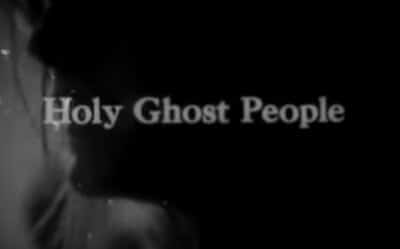
The Holy Ghost People (1967) is an intense documentary that takes viewers to a Pentecostal Holiness church located in rural West Virginia to show them the church’s beliefs through its faith healing and snake handling and tongue speaking and ecstatic worship practices. Today, The Holy Ghost People full movie exists as a free public domain film which people study through various academic programs in anthropology and religion and documentary film classes.
Movie Background Table
Movie Cast Table
Since this is a documentary, the “cast” is mostly real congregants, filmed as themselves.
| Person | Role |
|---|---|
| Peter Adair | Narrator / filmmaker |
| Elza O. Preast | Pastor / preacher (Reverend) |
| Congregants | Various worshippers, interviewees, snake handlers, musicians, and testifiers |
Full Plot Summary
The Holy Ghost People begins with the night shots of a tiny church in Scrabble Creek, a destitute mining town in West Virginia. The structure is plain, illuminated on the mountainous black background, and the people move in a queue in a Holiness service in the evenings. On top of these images, there is the serene narration by director Peter Adair, who presents the congregation; a rural Pentecostal band, whose worship involves faith healing, speaking in tongues, and the risky exercise of handling venomous snakes as an act of faith.
According to Adair, the services take four to six hours and are conducted multiple times per week, and worshipers have to travel a long distance to attend them. Snake handling, a literal interpretation of Mark 16:1718, is given in a matter-of-fact way, when it is mentioned that people are bitten occasionally, typically by copperheads, and that though they occasionally get medical attention, the very process is regarded as a test of faith.
Then, the movie turns to a sequence of one-on-one interviews with members of the congregation. Shot in close-up, individuals narrate their respective stories how they were saved, how the Holy Ghost entered into their lives and how they experience the presence of God in their everyday battles of poverty, disease and loneliness. Others refer to speaking in tongues as a language that passes on through them without them having control over it. Some describe situations where they feel paralyzed, or are taken over, in the process of prayer, which they believe is a direct experience with the Holy Spirit.
The most intense interview shows a woman who begins to shake and tremble while speaking. She displays body tremors when she enters and exits glossolalia, but she attributes her movements to the Holy Ghost, which she believes strengthens her. Adair does not make comments in voice-over, the camera just observes.
The film shifts into a church service after the interviews. Men get in the building and meet each other with a kiss on the lips, a holy kiss, which is inspired by the New Testament. As soon as the audience is seated, applause and church singing start, with instruments and amateurish but enthusiastic voices which fill the room. The camera constantly moves around over faces, hands, Bibles, and instruments creating the feeling of being physically present in the room.
Pastor is Reverend Preast and he starts preaching. He encourages those who have not yet obtained the Holy Ghost to be earnest in obtaining him and urges all people to forget about the camera and go on with worship as normal. Using the slightest of cuts and variations of rhythm the film sends over the message that time is passing: the sermon is going up and down, the congregants are shouting out in their responses of Amen and Glory, and the mood turns somewhat more emotional.
More Read

This service then becomes a communal prayer time. The members are standing and shout out requests of healing, guidance, and assistance of family and work issues. A woman, whose vision is fast becoming defective, is introduced to special prayer. When others congregate around her the camera pans over the room showing the various forms of prayer: some stand still, others move or rock, some fall to the ground, and some are violently shaking, as though they were possessed by some supernatural power.
The editing becomes more brisk in the last part of the film, giving numerous instances of the same service: another man preaches, two individuals sing more, and the emotional tone of the room is constantly escalating higher. A midway through the meeting, boxes of snakes are opened and the worshippers start to touch them: lifting copperheads and other snakes that spread poison all over their heads as the music and applause proceed.
One of the men dances with a snake and then on the ground he falls at once. There is no one rushing to him; the congregation goes on with singing and applauding, but his status remains unclear. Testimonies are then given and offering made. The pastor who is attempting to evoke generosity is holding a snake as he urges people to give money towards the church. In the process, the snake bites him on the hand.
The last picture is that of the swollen, bitten hand of the pastor, which occupies the picture. The documentary does not depict what happens later, but the information outside the film reveals that he died of the bite later. The sudden termination adds weight to the gravity of a religion that makes risking one’s life a holy obligation.
Genre and Key Themes
The Holy Ghost People is a cinema verité / ethnographic documentary that focuses on embodied, communal religious experience rather than on theology or external commentary.
Key themes include:
- Faith and the body
Worship here is physical: shaking, dancing, collapsing, handling snakes, and drinking poison are all presented as proof of belief, not as spectacle for its own sake. The film repeatedly shows how faith is expressed through the body under intense emotional pressure. - Poverty, isolation, and meaning
The congregation lives in a poor, rural, largely cut‑off community. Members describe bleak circumstances and limited opportunities, framing the church as one of the few places where they feel power, purpose, and direct connection to something greater than themselves. - Community and equality
Sermons stress that every person, regardless of background or race, is equally a creation of God and equally loved. For a mostly white Appalachian congregation in the 1960s, this emphasis on spiritual equality challenges some stereotypes about conservative rural religion. - Non‑judgmental observation
Adair’s approach is deliberately non‑didactic. There is minimal narration and no outside “expert” telling the viewer how to interpret what they see. This neutrality is part of what has led anthropologists like Margaret Mead (as quoted by critics) to call it one of the best ethnographic films ever made. - Risk, devotion, and doubt
The documentary doesn’t state whether snake handling is “right” or “wrong”; instead it shows the risk, the intensity, and the real consequences, leaving viewers to wrestle with what drives people to take such chances in the name of faith.
Holy Ghost People (1967) Full Movie Watch and Download
Watch Holy Ghost People (1967) on Internet Archive:
🏛️ See Also
Woody Woodpecker in Pantry Panic (1941) – Classic Winter Survival Cartoon Full Movie
The Last Time I Saw Paris (1954) – Elizabeth Taylor Romantic Drama Classic | Free Public Domain Full Movie
Sabotage (1936) – Alfred Hitchcock London Terror Thriller | Free Public Domain Full Movie
Love Laughs at Andy Hardy (1946) – Mickey Rooney Postwar College Romance | Free Public Domain Full Movie
Movie Review
The Holy Ghost people as a film is often hailed as being raw as it is and the unwillingness to turn its head away in an effort to sanitize or sensationalize whatever it captures. The camera dwells on clumsy silences, sweat, uncertainty and pandemonium creating the confidence that we are observing something as close to being unfiltered as possible within the documentary. To students and viewers who are interested in religion it provides access to a community that, although much caricatured, is rarely given an opportunity to talk at length in its own voice.
Peter Adair’s light narration is key to that effect. He frames the setting and practices, then steps back. There are no jokes at the subjects’ expense, no horror‑movie tricks, and no moral lectures; this even‑handed tone is a big part of why anthropologists and documentary scholars still assign the Holy Ghost People 1967 film in classes. The result feels at once intimate and unsettling.
On the film side the movie is beautifully minimal yet efficient to look at. The sense of being there is created with handheld camerawork and close-ups of face in ecstasy or strain, long take in the cramped church space. There is a heavy aural presence created by overlapping prayers, shouting sermons, clapping and singing, which can be nearly overwhelming to listen to, just like it would be to be in the room, surrounded by all the noise and emotion.
It might seem difficult to some contemporary audience or even uncomfortable to see children offering themselves in such severe and even risky practices. Some others may seek to have further follow-ups regarding what became of individual persons, particularly the bitten pastor. However, it is claimed by many critics that it is in the restraint and ambiguity which the film displays that its strength lies in the fact that it provokes serious thought not easy conclusions.
And outside of film circles, The Holy Ghost People full movie has inspired subsequent representations of charismatic and snake-handling communities, such as the 2013 thriller Holy Ghost People, which directly references its imagery and in certain instances even uses footage. It is also readily available in restored versions in that it is a public domain film, so it is able to continue circulating in new generations with this odd, difficult historical record of American religious life intact.
Movie Tags
The Holy Ghost People full movie, Holy Ghost People 1967 film, snake handling church documentary, Pentecostal Holiness documentary, Scrabble Creek West Virginia religion, Peter Adair cinema verite, ethnographic film classic, faith healing and speaking in tongues, Appalachian Pentecostal worship, religious ecstasy on film, public domain documentary, free classic movie, anthropology teaching film, American religion documentary, 1960s rural church movie