
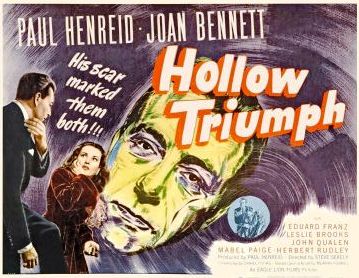
The Scar (1948), better known under its original U.S. title Hollow Triumph, is one of those lean, mean film noirs that gets under your skin and stays there. A small‑time mastermind thinks he’s clever enough to become someone else entirely, right down to carving a matching scar into his own face—and discovers too late that fate, not planning, runs this universe. Shot by legendary cinematographer John Alton and now available as a public domain movie in many upgraded prints, The Scar full movie is a perfect example of how low‑budget noir could look and feel far bigger than its modest origins.
Movie Background Table
Movie Cast Table
| Actor | Role |
|---|---|
| Paul Henreid | John Muller / Dr. Victor E. Bartok |
| Joan Bennett | Evelyn Hahn |
| Eduard Franz | Frederick Muller |
| Leslie Brooks | Virginia Taylor |
| John Qualen | Dr. Swangron, dentist |
| Mabel Paige | Charwoman (cleaning lady) |
| Herbert Rudley | Marcy |
| Thomas Browne Henry | Rocky Stansyck |
| Charles Arnt | Coblenz |
| George Chandler | Artell, assistant |
| Sid Tomack | Aubrey, manager |
| Alvin Hammer | Jerry |
| Ann Staunton | Blonde |
| Paul E. Burns | Harold |
| Charles Trowbridge | Deputy |
| Morgan Farley | Howard Anderson |
| Jack Webb | “Bullseye” (henchman, uncredited) |
Full Plot Summary
John Muller is an intelligent, frustrated criminal just out of prison. Once a medical student with a background in psychoanalysis, he’s drifted into cons, phony stock schemes, and fraud. The parole board lines up a dull clerk’s job at a medical supply firm, thanks to the efforts of his honest brother Frederick, but Muller has no intention of living out his days behind a desk.
Barely settled into freedom, he quietly reconnects with his old crew. He plans one big score: a robbery of an illegal gambling joint run by Rocky Stansyck, a powerful mobster with a long memory and a mean reputation. The heist goes off only half‑successfully. Muller escapes with money, but several of his men are captured. Under torture, they give up the names of Muller and his partner Marcy before Stansyck’s people kill them. Now Muller knows that, sooner or later, Rocky will send killers.
Realizing he can’t stay in the same circles, Muller tries to disappear into an ordinary life. He takes the office job arranged by Frederick in a downtown medical building, filing invoices and fetching coffee. The work bores him quickly, and his contempt for everyday people—“Nobody really looks at anybody else, they’re all too busy thinking about themselves”—starts turning into a philosophy.
The nervous dentist Dr. Swangron arrives at the office because he needs to find Dr. Victor Bartok who works as a psychoanalyst in the building. Swangron stares at Muller and remarks, stunned, that he looks exactly like Bartok, except for a scar Bartok has on his left cheek. The offhand comment lodges in Muller’s brain. The man shows his professional status through his face.
Muller begins to follow Bartok because he wants answers but also because he has developed a new level of urgency. He watches Bartok as he enters his office and then he observes his daily activities before he finally enters the empty suite. While rifling through files, he’s caught by Evelyn Hahn, the doctor’s receptionist and lover. At first she mistakes him for Bartok and kisses him; then, noticing minor differences, realizes he’s someone else. The woman who has stopped believing in love permits herself to be seduced by him after he avoids police contact.
Muller studies Bartok from a distance—his handwriting, manner, and patient list—and, in time, hatches a plan to become him. With his medical training, he believes he can fake psychoanalysis well enough to keep up appearances. All he needs is the scar. He obtains a photograph of Bartok from Swangron and uses it as a guide to carve a matching wound into his own cheek with a razor.

There’s one fatal mistake: the photo negative was printed reversed. Muller copies the scar onto the wrong side of his face. He doesn’t realize the error until it’s too late—until after he has ambushed and murdered Dr. Bartok and taken the body to a riverbank to dispose of it. Looking down at the dead man in the moonlight, he finally notices that their scars are mirrored.
Shaken but committed, Muller dumps the body and steps fully into Bartok’s life. Surprisingly, nobody appears not to notice. Even Evelyn, who takes in him, barely questions him. The cleaning woman, a sly and nosy charwoman, does suspect something is awry and she poses bizarre questions, but Muller explains everything away with smooth words. His cynical theses concerning the self-absorption of people seem to be true: individuals are able to see only what they want to see.
Muller, as Dr. Bartok, finds out that his new identity has baggage. The actual Bartok also possessed a glamorous and demanding girlfriend, Virginia Taylor, who plays and frequents a posh casino called Maxwell. He was a heavy gambler also, in debt with the house. Muller is playing the role publicly where he takes Virginia out and keeps the cold distance with Bartok privately but he is secretly panicked with the traps he has inherited in the form of money.
Frederick in the meantime attempts to find his brother when John suddenly quits the clerical position. His trail takes him to the office of Bartok. He is shaken when he thinks of the man with a scar on his cheek—but the scar makes him believe that this must be an accident, and not John. Remarking, still, about her previous experiences with Muller prior to the change, Evelyn informs Frederick that John informed her that he was heading to Paris. Frederick, who at least is glad that his brother is no longer directly in danger of being killed by Stansyck, comes home none the wiser.
Eventually, Evelyn’s instincts catch up with her. Little details in “Dr. Bartok’s” behavior and a few overlapping fragments of John Muller’s backstory tip her off. She confronts him, and Muller admits everything: he killed Bartok, took his place, and hoped to outrun Rocky’s revenge by vanishing into this borrowed life.
Instead of turning him in, Evelyn is too tired and too in love to blow up the world again. She buys a steamship ticket to Honolulu and plans to leave, hoping to start over far from cold city offices and dangerous men. Muller tells her he will come with her, that he is finally ready to walk away from the crooked life and the easy money. She wants to believe him but doesn’t. She has seen him choose greed over safety too many times.
Before he can join her, the past closes in from a different direction. At Maxwell’s and other casinos, Muller has been steadily losing as Bartok, running up large debts. Two tough collectors corner him on the dock as he heads toward Evelyn’s ship. As far as they are concerned, he is Dr. Bartok, and Dr. Bartok owes $90,000. They don’t care about stolen identities or Rocky Stansyck; they care about balance sheets and orders.
They usher him away for a “talk.” When Muller panics and tries to break free, they shoot him down on the foggy wharf. As he lies dying, Evelyn’s ship pulls away, carrying her toward a new life she believes she has chosen alone. She has no idea that the man who almost joined her has finally paid for both of his lives at once.
Genre and Key Themes
The Scar / Hollow Triumph is film noir to the end: the condensed crime story full of fatalism and identity games and shadow pictures.
Major themes include:
Identity and self‑deception
When Muller thinks that he can just slip out of the skin of another man, he thinks that the blindness of all the other people will take care of him. The inverted scar itself turns into a physical symbol of his egoism: his philosophy of the fact that details do not matter turns out to be his killer.
Fate vs. control
The novel is constructed through coincidence, the two, the inverted negative, the gambling debts, and critics have pointed to the artificiality of this. In noir reason, however, that stacking up of luck drives the point that you only get into a bigger mess when you attempt to out-manifest destiny.
Alienation and cynicism
Muller begins by looking at people as selfish and unattentive. During the greater part of the movie, it appears that the world is on his side: nobody sees the scar, nobody asks about the change, and even Evelyn avoids looking at murder because she is too desensitized to rebel. His weapon and his cage are that alienation.
Guilt and complicity
Evelyn, refusing to turn Muller in, Frederick refusing to continue digging after he believes that John is safe, the charwoman is happy to be lulled, all of this suggests how the normal compromising and shushing better places bad men beyond the reach of the law, at least temporarily.
The hollow triumph
And the title speaks volumes, as Muller only has to win the game of identity to end up with an equally deadly and meaningless life as the one he was escaping. His new situation does not make him free, only the individual holding the gun is different.
The Scar (1948) Full Movie Watch and Download
Watch The Scar (1948) on Internet Archive:
🏛️ See Also
Woody Woodpecker in Pantry Panic (1941) – Classic Winter Survival Cartoon Full Movie
A Study in Scarlet (1933) – Reginald Owen’s Early Sherlock Holmes Mystery | Free Public Domain Full Movie
Boys of the City (1940) – East Side Kids Haunted House Mystery | Free Public Domain Full Movie
Love Laughs at Andy Hardy (1946) – Mickey Rooney Postwar College Romance | Free Public Domain Full Movie
Movie Review
The Scar (1948) is a little gutter rat of a movie, though you may puncture its reasoning. Paul Henreid, whom most people remember as the noble Victor Laszlo in Casablanca, employs that bred grace to portray a man of quite a different order: John Muller is an educated, manipulative, and completely egocentric man. Henreid draws a clear line between Muller and Dr. Bartok, assigning each his particular rhythm and aura, despite the fact that the plot is based on the physical resemblance of the two characters.
One of the silent strengths of the film is Joan Bennett Evelyn. She is portraying a woman who has been not only disappointed too many times but cannot help but reach out to her when she thinks she has something in common with Muller/Bartok. How she manages to be world-weary and vulnerable, critics have praised, is what makes the choice to depart made by Evelyn at the end of their romantic relationship so understandable and painful.
Frederick, played by Eduard Franz, lends the film a momentary, but essential touch of decency the brother who made an attempt to do the right thing by getting him a job in the law firm, and who turns out to be deceived by one mere physical appearance. The glitter and danger of Virginia by Leslie Brooks is a symbol of the high-cost-high-glamour life that accrues to Bartok in name and debts.
It is through the direction of Steve Sekely that is accompanied by the cinematography of John Alton where The Scar actually earns the noir title. Sharp contrasts, dramatic shades and angular forms used by Alton transform offices, alleys and docks in psychological locations where paranoia of Muller is aesthetically justified. The appearance of the film is a significant point of attraction even to noir-saturated viewers.
The movie has a fast pace in terms of narrative. Critics such as Thomas M. Pryor in The New York Times admitted that the plot there lacked a sufficient amount of logic to support it, but also admired the speed and the acting, saying that the plot proceeds like it wants to break things, and there is always the danger of more of that right around the corner. It has been described as an important fatalistic noir by noir scholar Spencer Selby and an inventive theme of doppelgangers as well as classy visuals.
When it comes to a sticking point, it is namely the dependence on coincidence, on people overlook the reversed scar. It is difficult to believe that there is no one who would notice the difference later, more so to someone as much of an observer as Evelyn. The movie requires one to suspend disbelief in a particularly heavy dose, as a number of contemporary critics have opined, to be rewarded.
To people ready to allow it, The Scar full movie provides a satisfactorily pessimistic ending. Muller, who has been insisting throughout the film that other people are blind, is killed since he is the one who never really looks at the underbelly of his own decisions. Evelyn is carried away without resolution and this seems more true to noir than any courtroom would.
Being a free classical film in the public domain, The Scar / Hollow Triumph now spreads like a wildfire in both low-quality and quality versions, being restored on the sites of the public domain and classic film stations. It is a smaller, slicker first step to a mid-budget noir- and a lesson that sometimes the best knife a movie can possibly have is the one it cuts itself with.
Movie Tags
The Scar full movie, Hollow Triumph full movie, The Scar 1948 film, Hollow Triumph 1948 film, Paul Henreid film noir, Joan Bennett Evelyn Hahn, doppelganger noir story, scarred identity crime drama, Steve Sekely director, John Alton cinematography, Eagle‑Lion film noir, B‑movie fatalistic thriller, classic black and white crime drama, free classic movie, public domain movie