
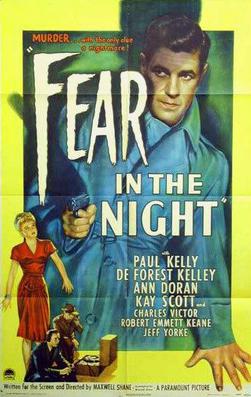
It is possible that some film noirs begin with a crime, Fear in the Night (1947) begins with the possibility that there is a crime in the mind of a man. Young bank teller dreams that he has stabbed a stranger in a mirrored room, only to wake up with blood on his cuff, bruises on his throat and a key in his pocket that he does not understand how he got. After that, the film resides in the grey area of the nightmare and reality.
The Fear in the Night full movie is one of the movies that are currently available in free classic movies sites and public domain collections, and is frequently viewed due to being the initial movie appearance of DeForest Kelley, before he became Dr. McCoy of Star Trek. However, besides this trivia, this low-budget noir movie continues to deliver the audience a hook in the form of a tight idea, a hypnotist villain, and a plot that keeps on asking whether you can trust yourself.
Movie Background Table
Movie Cast Table
| Actor | Role |
|---|---|
| Paul Kelly | Cliff Herlihy |
| DeForest Kelley | Vince Grayson |
| Ann Doran | Lil Herlihy |
| Kay Scott | Betty Winters |
| Charles Victor | Captain Warner |
| Robert Emmett Keane | Lewis Belknap / Harry Byrd |
| Jeff York | Deputy Torrence |
Full Plot Summary
Vince Grayson is a typical bank teller who has a good career and a quiet life. One night he dreams so real a dream it is like a memory. In the dream, he is seduced into an octagonal room that has mirrors. A fight ensues and everyone gets mixed up as Vince stabs a man and forces the corpse into a closet and closes the door with a key that the victim drops.
He wakes up in a panic. His heart is thumping, his room is not strange and yet minute details fail to tally. He has bruises on his throat like someone was trying to choke him. He has a strange key in his pocket, and a loose button and a smear of blood at the shirt cuff. It is not real, however, that the dream may be imaginary.
Still shaking, Vince visits his brother-in-law, Cliff Herlihy, a simple-looking police detective, married to his sister, Lil. He spills the beans and tells about the weird mirrored room, the stabbing, the locked closet and the key that is mysterious. Cliff listens, but being an earthly policeman working cop assumes that Vince is over-working himself or possibly experiencing some form of nervous outburst. He attempts to console him that it was just a nightmare.
Vince can’t let it go. The tangible evidence is disturbing to him. The days later he becomes even more withdrawn with flashbacks of the mirrored room in his mind. He even places an ad in the paper to rent a house with an octagonal mirrored room in hopes that someone would respond, and confirm that the place does not exist or does exist.
Nothing comes of the ad. Vince’s anxiety spikes. He begins to shun employment and relationships and spends his time wandering the city and talking to himself in a voice-over, attempting to determine whether he can commit murder. His girlfriend Betty observes his weird behavior. Lil and Cliff are concerned that he is going to a breakdown.
Vince goes out with Cliff and Lil one afternoon on a drive and picnic out of the city. The field trip is supposed to be a letdown of his head. Rather it sends him back to the nightmare. A storm is coming, the rain is falling in sheets and they seek shelter. Suddenly, Vincent claims to be familiar with a nearby house, one he cannot possibly have ever been to but which he is able to describe in considerable detail.
They drive towards country roads as instructed by him until they arrive at a big, lonely house. Vince is recognized by a coldness as they come closer. They enter a mirrored octagonal room which is just what his dream had been. The important Vince awoke up with fainting one of the doors. He faints, half of which he has just demonstrated himself a murderer.
A policeman of the area comes to investigate the area and when he talks about a recent crime, he says that one day two people were discovered dead there one in the mirrored room and the other one was run over in the driveway. Mrs. Belknap, who was in the house, was able to make a dying description of the man she had seen just before she was struck, which is not inaccurate to Vince. The other is her husband who is the other victim.
Initially, Vince is relieved when he recalls how he does not know how to drive; perhaps he could not have done the hit-and-run. However, as he gazes upon the closet, bloodstains and the room design, bits of his dream fall into place. It was Mr. Belknap the man he stabbed in his sleep. Feeling guilty and believing that he is a danger, Vince tries to commit suicide, and he is rescued and saved by Cliff.
The cop instincts of Cliff take effect. He concludes that it can not be just a nervous breakdown. Being on-site and going through the narrative of Vince, he notices some strange facts: how Vince remembered what he had never seen, how the key was a perfect fit, how the murders are almost too perfect and how the murder are aligned with what Vince has dreamed of. He begins to wonder that someone is working with the head of Vince.
His attention turns to a neighbor and acquaintance of Vince’s, a man named Harry Byrd, who has a background in hypnosis and a slightly too‑friendly manner. Cliff experiments with Vince, asking him about Byrd’s way of speaking, his eyes, and whether he’s ever felt “blank spots” around their conversations. The idea emerges that Vince could have been hypnotized into committing a crime and then made to forget it.
Digging deeper, Cliff discovers that Byrd is actually Lewis Belknap under another name, a man with motive and a talent for psychological manipulation. Belknap appears to have orchestrated a scheme in which Vince would be used as an unwitting weapon to kill a rival and then take the blame, with hypnotic suggestion covering the tracks.
Cliff makes a trap in order to demonstrate this. He makes Vince go to Belknap /Byrd and suggest that he still knows it all and would like the hush money to keep it a secret. Hopefully Belknap will make an attempt to regain control, exposing how they do it and how guilty they are. Belknap predictably comes to the bait.
He hypnotizes Vince once more and drives him to a lake, where in a rather calm manner he tells Vince to write a confession and drown himself so as to leave no loose end. When Vince, with his glassy eyes, steps into the water Cliff interferes and hauls him out before he drowns. Belknap drives away in a car, and the police pursue him. His car crashes in a final scramble killing him and terminating the manipulation.
Now that Belknap is killed and the fact of his hypnotic control is showing up, it is suggested that Vince will be absolved of criminal responsibility. He did stab a man in the adjoined room which was being used as a mirror room, but this was under hypnosis and in self-defense when he was at bay with the actual murderer. The movie ends on a tepid note of relief: Vince might end up sleeping without having the worry of what he will wake up to.
Genre and Key Themes
Little film noir Fear in the Night (1947) is a movie noir with highly emotional thriller notes.
Several themes stand out:
Question of reality and memory.
The entire storyline is pegged on the fact that Vince doubts his own thoughts. The movie is in a continuous state of confusion of dream and awakening, with the mirrored room and the recurring imagery keeping the audience off-balance with him.
Agency abuse and manipulation.
Hypnosis in this case is not a stage show, it is a weapon. Belknap employs it to make Vince a tool and it brings up the issue of guilt when one person guides the actions of another.
Horror as an intrusion in everyday life.
Vince is not a gangster, a detective, he is a bank teller. Noir tends to recruit clerks and housewives to join the criminal side, and this movie is inclined into that direction by demonstrating how easily a normal life can be turned into hell by the plan of another person.
Trust and skepticism
The story of Cliff, who at first disregards the story told by Vince as a case of nerves, then works on it and tries to use it as a hint to solve the case under consideration, is a silent thread of the way law, family and friendship approach claims which seem absurd to them, yet which may turn out to be true.
Those concepts provide the movie with a sense of psychological stinging that is a bit bigger than the humble length of the film implies.
Fear in the Night (1947) Full Movie Watch and Download
Watch Fear in the Night (1947) on Internet Archive:
🏛️ See Also
Woody Woodpecker in Pantry Panic (1941) – Classic Winter Survival Cartoon Full Movie
The Last Time I Saw Paris (1954) – Elizabeth Taylor Romantic Drama Classic | Free Public Domain Full Movie
Sabotage (1936) – Alfred Hitchcock London Terror Thriller | Free Public Domain Full Movie
Love Laughs at Andy Hardy (1946) – Mickey Rooney Postwar College Romance | Free Public Domain Full Movie
Movie Review
Fear in the Night looks on the surface a bare-bones production: there are not many sets, the cast is small, and the story is being told primarily by the dialogues and several stressful set-pieces. Below, it is a surprisingly good mood film that breathes or dies on air and acting.
In his debut film role, de Forest Kelley is convincing as Vince. He does not play him as a toughened noir antihero but as an insecure, good man who senses that he is losing his grip on reality. The voice quail, the sunken eye glances, the physical snatching in as he physically shrink as uncertainty gnashes at him all make the very core of the nightmare plausible.
The film stars Paul Kelly portraying the role of Cliff, the detective brother in-law. He is fast, cynical, and realistic enough to provide a corrective to the panic of Vince. Their dynamic, man one in dire need to feel believed in and man two in slow to believe anything that could not be found in the standard procedure makes the dialogue scenes not to feel stagnant.
Belknap/Byrd of Robert Emmett Keane is a villain held back. He doesn’t rant; he insinuates. Such decision suits the theme of hypnosis, as he is not dangerous by being physically threatening, but by having the ability to sneak into your lifestyle and tilt the ideas in your mind.
The direction of Maxwell Shane smartly uses its resources. The reflected room is a set, though so memorable that the reoccurrence of it is truly spooky. Plentous use of shadow and contrast is recorded by the cinematographer J. Roy Hunt (credited on some sources as Pine-Thomas work) and archived prints and the film has the correct noir appearance despite the lack of big cityscapes.
Modern critics did not always find it impressive. The reviewer of the New York Times at the time described the movie as dumb and quite tiresome, blaming its realism and time flow. More recent critics have been more forgiving. It was critical of it as an excellent low-budget psychological thriller, good use of the pulp source material of Woolrich, the dark black and white photography, and the acting of Kelley. Film-noir critics single out it as one of the earliest screen adaptations of Cornell Woolrich, whose novels would provide the inspiration of several classic noirs.
Fear in the Night (1947) full movie is a puzzle that is short and moody as a viewing experience today. Their performance is good, the main conceit remains, and the hypnotism element brings an extra twist to ensure that the did I kill someone set-up is not generic. It is commonly in the public domain, and so can be readily found, often in poorly maintained print copies, sometimes in clearer restorations, but even in lower-quality versions, the muffled dreaminess can still be experienced.
It is a small and weirdly unforgettable nightmare to noir fans, Cornell Woolrich admirers or anybody who just wants to see DeForest Kelley in a costume before the Starship Enterprise.
Movie Tags
Fear in the Night full movie, Fear in the night 1947 film, DeForest Kelley debut, Maxwell Shane film noir, Cornell Woolrich Nightmare adaptation, hypnotism murder mystery, octagonal mirrored room thriller, low budget psychological noir, Pine-Thomas Productions, Paramount pictures classic, free classic movie, public domain movie.